

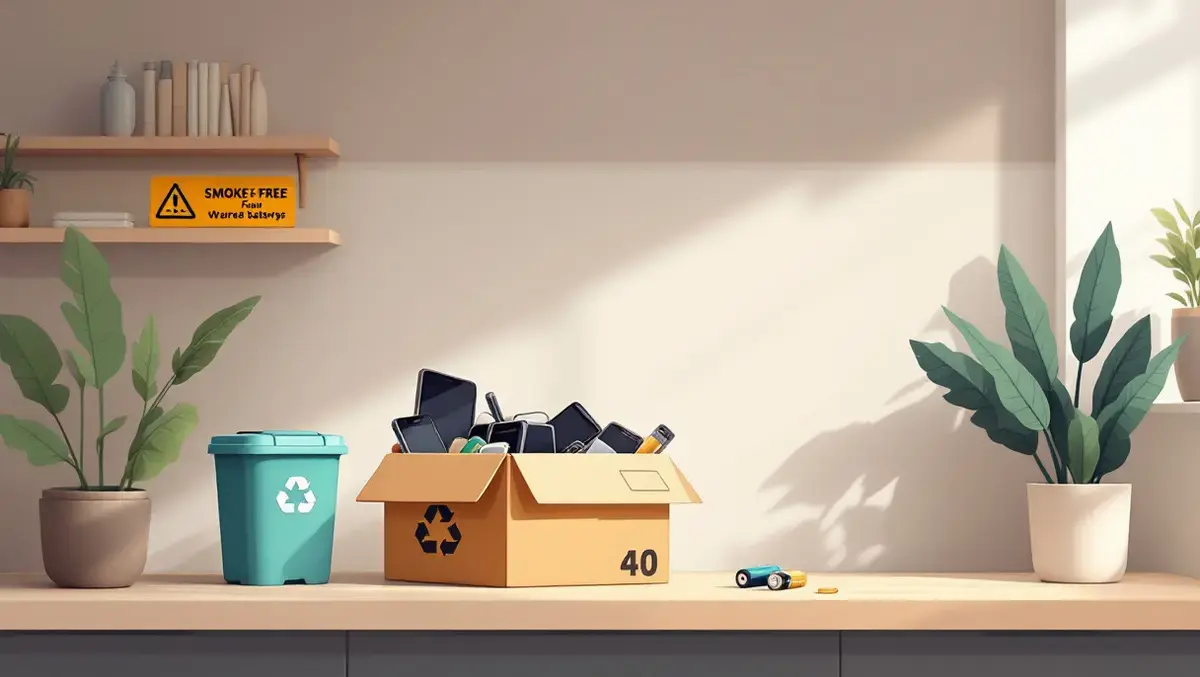
Australians urged to recycle old phones amid pile-up
Fri, 27th Nov 2026 (Today)
MobileMuster is urging Australians to recycle old mobile phones when they buy a new device, with research from the scheme estimating 22.1 million unused phones are sitting in homes across the country.
That figure includes 12.1 million handsets that are broken beyond repair, according to data cited by the program, which is run by the Australian Telecommunications Alliance. The end-of-year buying period often prompts people to replace devices, creating an opportunity to clear out unwanted phones, chargers, batteries and accessories.
Helen Maisano, Head of Sustainability and Social Impact at the Australian Telecommunications Alliance, said many people hold on to old phones despite having little practical use for them.
“If you are upgrading your phone, chances are your old one really wasn't up to the job,” Maisano said.
She said unused devices often sit in drawers for long periods, even when damaged, and warned that older batteries can deteriorate when stored at home.
“For millions of Australians, the old phone simply ends up in a drawer gathering dust. Not only is it taking up space, but batteries can also degrade over time and become a fire hazard.
“Any phone more than five years old is at risk of its battery expanding. A swollen battery tucked away in a drawer is a risk you don't need to take, which is why the safest place for it is a MobileMuster collection point.
“That's why we're encouraging Australians to make recycling part of their upgrade routine. Once you've transferred your contacts, photos and other important information, take a few extra minutes to think about what happens to your old device.
“Those phones might have reached the end of their useful life for you, but they still contain valuable materials which can be recovered and used again.”
Material recovery
MobileMuster says its process recovers more than 95 per cent of the materials in a mobile phone, including copper, aluminium, cobalt, nickel and lithium. Those materials can then be returned to manufacturing supply chains rather than discarded.
Recovering them can reduce demand for newly mined resources. The scheme also advises consumers to back up important files, remove personal data and reset devices before handing them over.
On data handling, MobileMuster says phones are destroyed during recycling, preventing access to their contents after donation.
“Information safety is important for us, and our process ensures people have nothing to worry about when it comes to their old devices,” Maisano said.
Collection network
The service also accepts chargers and accessories through collection points around Australia. Consumers can use drop-off locations at retailers including Optus and Vodafone, as well as council buildings and libraries. Those without a nearby site can send devices using a free postage label and their own packaging.
The recycling initiative began in 1998 and has collected more than 2,000 tonnes of mobile waste, according to the organisation. It describes the program as government-accredited and carbon neutral.
MobileMuster also says it has collected more than 114 tonnes of e-waste for recycling in the current financial year. It says that amount is equivalent to reducing global warming by 308 tonnes of CO2 emissions, 47 years of household energy saving and the planting of 5,107 trees.
The call to recycle comes amid broader scrutiny of electronic waste and the recovery of embedded materials in consumer devices. Phones contain small amounts of metals that are costly to extract individually, making collection volumes important to the economics of recovery.
For consumers, one of the main barriers to recycling old devices has been habit rather than access. Industry groups and environmental schemes have long noted that redundant electronics are often stored for years because owners think they may need a backup handset, plan to retrieve old photos later or are unsure how to dispose of batteries safely.
That behaviour can leave large numbers of dormant devices outside formal waste streams. By highlighting the volume of unused phones and the share already beyond repair, MobileMuster is trying to shift attention from replacement buying to what happens to the outgoing device.
“Recycling your old phone couldn't be easier. You'll find drop-off points at stores such as Optus and Vodafone, as well as many council buildings and libraries. If there isn't one nearby, you can print a free postage label from the MobileMuster website and use your own box.
“MobileMuster began our mobile recycling initiative in 1998 and has since collected more than 2,000 tonnes of mobile waste. It's government-accredited and carbon neutral, and it was the first product stewardship program in Australia to be certified under Climate Active.
“In the 2025-26 financial year, we've collected over 114 tonnes of e-waste for recycling, which has the equivalent benefit of reducing global warming by 308 tonnes of CO2 emissions, 47 years of energy saving for a household, and planting 5,107 trees.
“As we head into the new year, we would love to see more Australians joining us in our mission to raise awareness and educate the community on mobile phone repair, reuse and recycling,” Maisano said.