

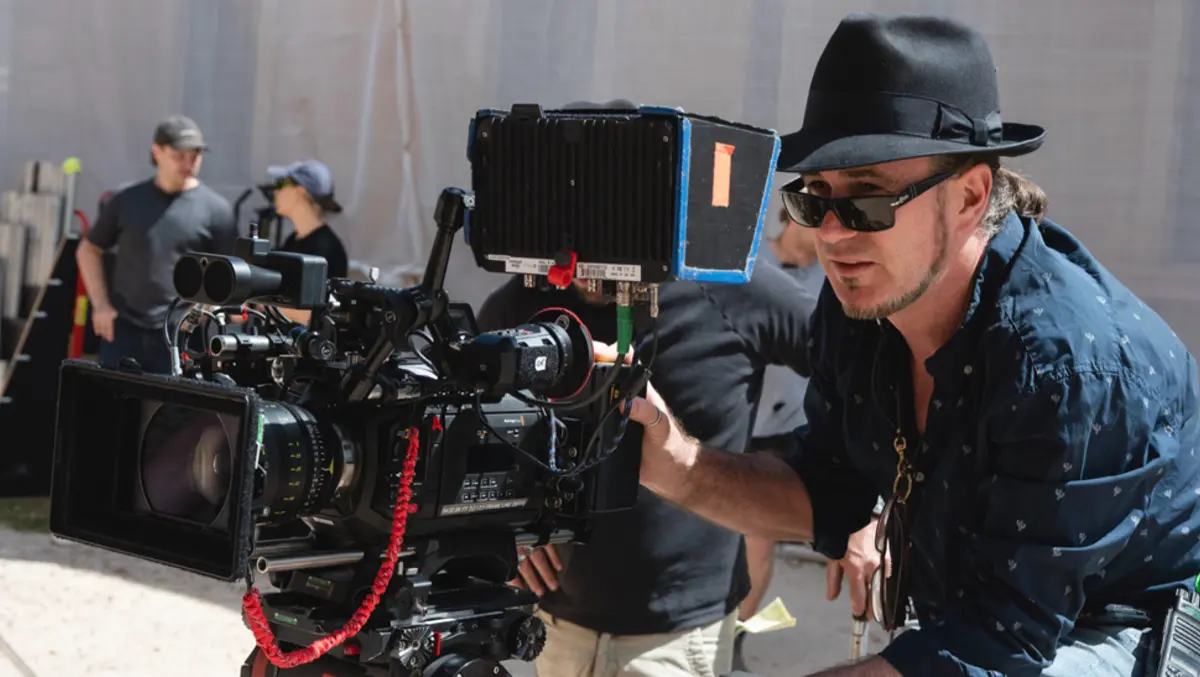
Caper Crew filmed with Blackmagic cameras in Australia
Wed, 3rd Jun 2026 (Today)
Easy Tiger has filmed the ABC Kids comedy series Caper Crew with Blackmagic Design cameras, using Australian-developed equipment on a local children's television production.
The live-action comedy was commissioned by the ABC in association with the Australian Children's Television Foundation and Screen Australia, with support from Screen NSW. It follows siblings Amelia and Kai Delaney after the arrival of their grandmother Queenie, a con artist, in the fictional town of Woodspring.
Director of Photography Judd Overton said the production set out to give the series a look that would stand apart from much of Australian television. The creative brief drew on the composed framing associated with filmmaker Wes Anderson, favouring longer takes and a more controlled visual style.
"When Guy first showed me the brief, I was very excited. It's definitely not something we're seeing on Australian television," Overton said.
"There were many references to Wes Anderson and those really composed frames, so we were after longer takes, not the usual scattergun approach."
The camera package included two URSA Cine 12K LF cameras, paired with Tokina full-frame lenses and Blackmagic monitors. Spectrum Films handled the footage, while the colour grade was completed in DaVinci Resolve.
Overton said the cameras were chosen partly for the look of the large sensor, and partly for the practical benefit of capturing wide frames that could later be adjusted in post-production. That approach can reduce the need for repeated takes, which is especially useful on a series led by younger performers.
"The directors were excited to have the ability to blow up frames and extract an image," Overton said.
"When we're shooting a two-shot in 8K, for example, we could keep a nice depth of field so, if needed, the editors could pull a single or two singles out of that one set-up. This, and the Blackmagic RAW workflow, were part of the pitch for choosing the camera on this show."
Visual shifts
The series uses different visual approaches across its timelines. The present-day story uses a 2:1 aspect ratio with saturated colour, while flashbacks to a 1990 heist were shot anamorphic. Sequences set in the 1940s were filmed in black and white.
Set-up Director Guy Edmonds was joined on the series by Directors Stef Smith and Shelly Lauman. The scripts came from a wider group of Australian children's writers.
First Assistant Camera Juliette Young said the production marked her first major show using the URSA Cine 12K LF as the main camera. She said the system proved workable at the pace of a television shoot once the crew adapted to its menus and controls.
"I was really pleasantly surprised by how well it integrates as a full-time production camera," Young said.
"The menu is quite different from the cameras we were used to, but once you get your head around it, it's quite intuitive. Being able to flip quickly between settings, between 8K and 4K and different aspect ratios, has been really useful. For a fast-moving show like Caper Crew, the base plates and quick-release system make it easy to move the cameras around quickly."
Local technology
The production also highlights the use of Australian screen technology on a domestic series at a time when local producers are under pressure on budgets and production schedules. Blackmagic Design, founded in Melbourne, has built an international profile in post-production and camera systems.
Overton said he has used Blackmagic equipment since the company's earlier cinema cameras and the rise of raw post-production workflows. He added that newer sensors had improved the cameras' reliability and low-light performance.
"The real change has come in the last few years," he said. "The reliability and low-light sensitivity have improved greatly with the new sensors. It's our main camera on this production."
He also said the Australian origin of the equipment carried weight on a locally made series. "It does mean something to me to be using Australian technology to create these shows," Overton said. "It's really nice to be able to bring that home and keep the crew working with that equipment."