

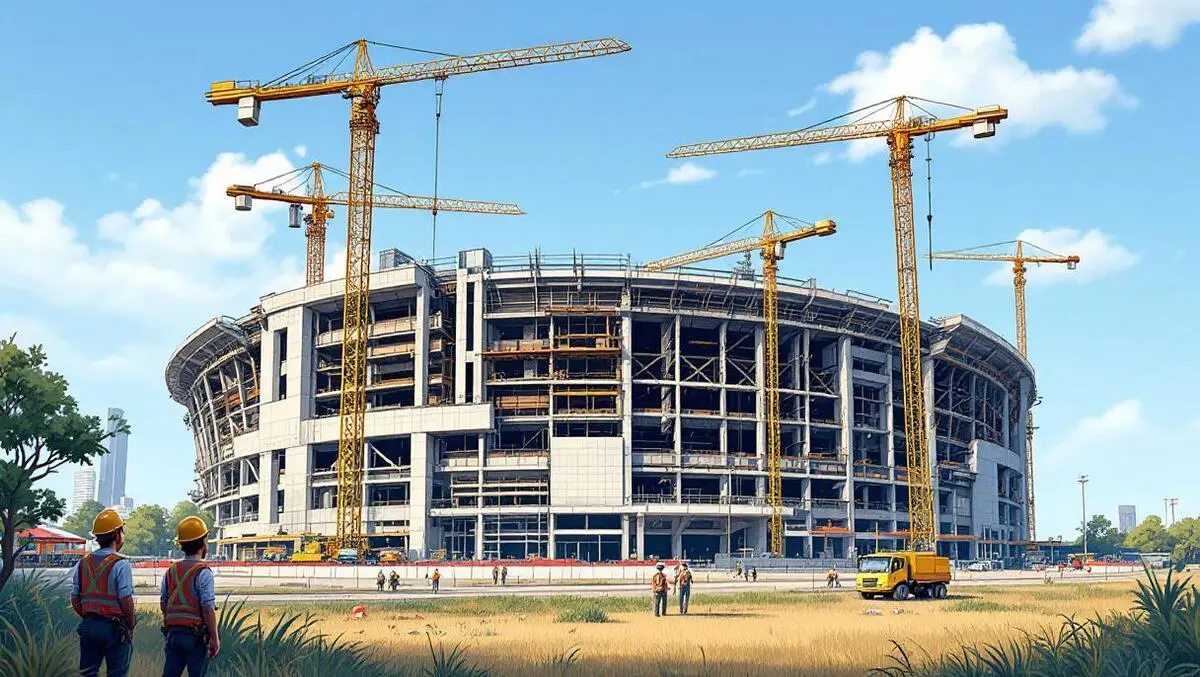
Construction tech proposed as a solution for Brisbane's $7bn Olympic build
Thu, 30th Oct 2025
Queensland's preparations for the 2032 Olympic and Paralympic Games are under threat due to a critical shortage of construction workers and reliance on outdated building methods, raising significant concerns over Brisbane's $7 billion infrastructure programme.
Infrastructure Australia projects a shortage of up to 55,000 construction workers by March 2026, a figure that poses challenges not only to the supply of labour but also to the ability to house such a workforce. Industry leaders are now warning that unless rapid construction technology is adopted with urgency, Brisbane risks missing its 2032 infrastructure targets.
Labour and housing constraints
The shortage arises amid reports Queensland is already falling short of delivering necessary housing and office space. The National Housing Accord target for 1.2 million new homes is tracking 32% below the required rate in Queensland. Parallel data show office completions are currently 34% beneath the rate witnessed over the previous decade, further limiting available housing and facilities for workers.
PT Blink Chief Executive Officer Wayne Larsen openly criticised current building practices in the state, describing them as unfit for purpose in the modern era. He said,
"This is beyond a supply chain problem; it's a systemic failure. Australia is building like it's still the stone age, relying on outdated, slow, and labour-intensive methods while the rest of the world has already transitioned to rapid, manufactured solutions."
Larsen further argued that the inability to house workers would undermine construction efforts entirely, adding,
"If we cannot urgently house 55,000 workers, they simply won't come. We face a scenario where we can't house the workers, let alone the Olympians. And the world will watch as Australia fails to meet the moment for which we bid. Brisbane's $7 billion infrastructure vision will be guaranteed to fail unless we dramatically change how we build, and fast."
Construction technology proposed as solution
The industry response points toward adopting construction technology to alleviate both labour and housing pressures. PT Blink's proprietary Design-Manufacture-Integrate (DMI) system, often described as the "IKEA of construction", is one such example currently in use. The technology is designed to swap out conventional, concrete slab-based construction for precision-made, flat-pack steel structures manufactured entirely offsite.
This approach enables concurrent construction on multiple floors, bypassing the traditional method's progressive, floor-by-floor routines. According to PT Blink, this method has demonstrated the ability to cut typical timelines by more than half, creating a safer, more predictable, and less labour-intensive build process.
Larsen said the barrier now is not the availability of technology, but the failure to adopt it at the required pace.
"The problem isn't demand or innovation; the innovation is here, it's homegrown, and it's working. The problem is a lack of urgency to adopt it. The Australian public needs to understand that we are throwing tonnes of concrete at a problem that requires digital, manufactured precision. We are running a $7 billion infrastructure marathon with a wheelbarrow while global competitors use a Formula 1 car."
Applications in Brisbane's 'golden ring'
A research report by Colliers identifies several critical inner-city precincts, termed 'golden rings', set to accommodate major new venues for the Games, such as Victoria Park Stadium and the National Aquatic Centre in Spring Hill. Targeted development in areas including Spring Hill, Fortitude Valley, Roma Street, Herston, and Bowen Hills is regarded as essential for Olympic infrastructure.
In Spring Hill, a recent seven-storey apartment building was constructed using PT Blink's DMI system, rising from podium to roof in only 11 days. This project, the company states, is set to accelerate the overall timeline by four months. The project serves as a case study for the scalable speed required to address current housing and infrastructure shortages in the lead-up to the 2032 Games.
Larsen highlighted the demonstration of this project as evidence of local capacity to address national infrastructure needs, stating,
"The Spring Hill project proves that Australian innovation is ready to solve Australia's infrastructure challenges. We are providing the pathway to build smarter, faster, and more sustainably, ensuring Brisbane can maximise the economic legacy of the 2032 Games without being constrained by outdated construction timelines."