


Matrak signals logistics as construction's new critical path
Thu, 20th Nov 2025
In the construction industry, we often talk about "bricks and mortar" as shorthand for what we do. But that language is increasingly out of date. Today, it's not the concrete, cranes or curtain wall that determine whether major projects succeed or fail, it's the containers, customs clearance, and coordinated deliveries. In short, logistics has become the critical path.
New data from Matrak, the world's leading construction supply chain platform, shows a striking shift underway. Logistics is no longer just a supporting function in construction. It is now the defining factor in project delivery, outpacing both manufacturing and installation as the most dynamic, high-impact activity in the sector.
Two charts tracking millions of supply chain movements tell the story clearly. The first, "Overall Supply Chain Trends – Variance vs. Average by Month," maps the chaos that Covid brought to construction between 2019 and 2021.

You can see that manufacturing initially spiked as Chinese factories rushed to ship materials before lockdowns. Subsequently logistics surged and then collapsed as global borders snapped shut. Finally installation in Australia swung wildly, projects sprinting to finish before shutdowns, then hitting deep troughs. It took nearly two years for the supply chain to stabilise. But now, the same chart reveals a new and persistent pattern: a steep, sustained rise in logistics activity that leaves manufacturing and installation far behind.
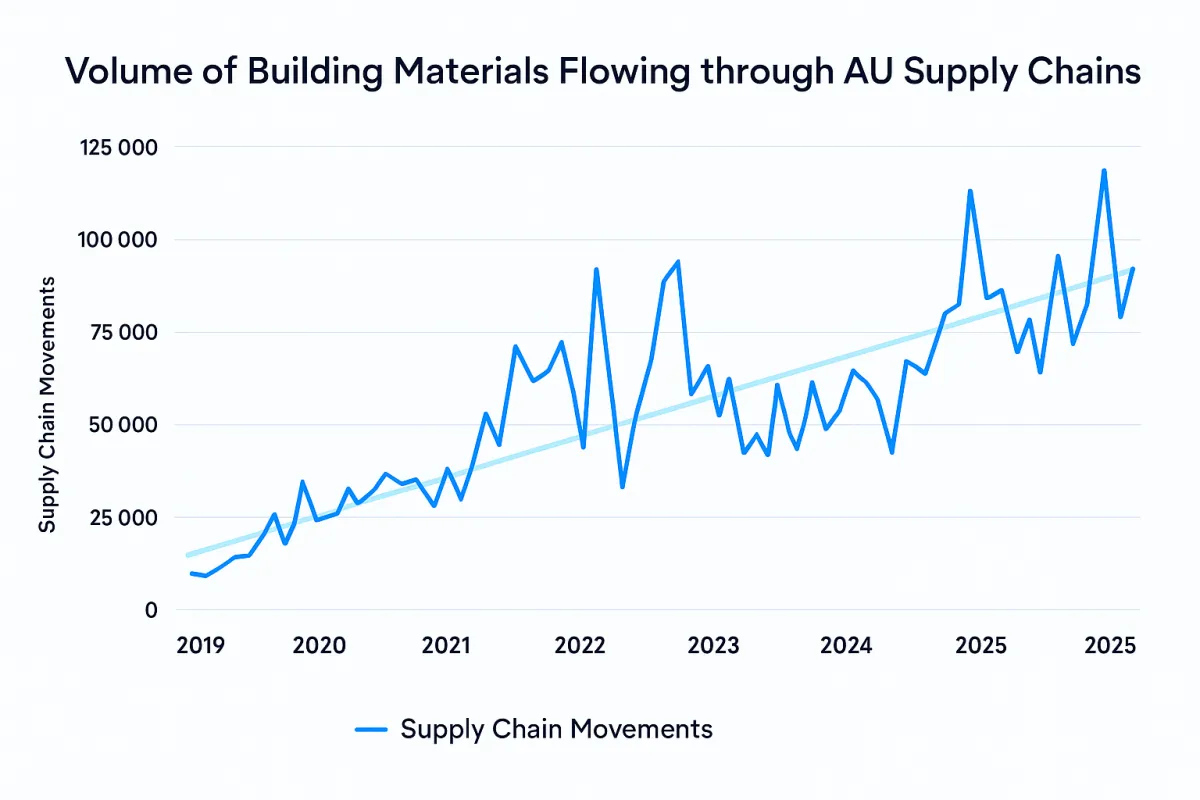
The second chart below "Volume of Building Materials Flowing through AU Supply Chains" adds weight to this shift. The number of supply chain movements tracked through Matrak has more than quadrupled since 2019, even as the platform has expanded across more projects than ever. In that context, the outsized growth in logistics isn't just notable, it signals a paradigm shift in how Australia builds.
 So what's behind this transformation? In a word, complexity.
Projects like hotels or student accommodation tend to follow familiar patterns, design, manufacture, install. But today's mega-projects, especially hospitals and data centres, look nothing like this. These builds are defined not by what's fabricated locally, but by what's procured globally.
Hospitals are filled with owner-supplied, high-value equipment such as MRI machines, surgical suites, FF&E, HVAC systems. Data centres rely on precision infrastructure like power modules, cooling systems and generators, all of which come from a complex global supply chain, often with lead times stretching 9–18 months. Coordinating these components, often from five continents into a single critical path, is now the crux of delivery.
As Matrak Co-founder, I've seen this evolution firsthand. What was once an "invisible" back-office function is now the heartbeat of project delivery. Covid may have exposed how fragile supply chains can be, but today's booming pipeline of hospitals and hyperscale data centres has made logistics the most unforgiving constraint of all. Miss a delivery window, and the whole project slips.
Matrak's customer, Grace Workplace Solutions, the commercial arm of Grace Removals Group, is Australia's largest privately owned removals and specialist project logistics company. They have seen a huge push for hospital furniture, fixtures, and equipment - becoming one of the fastest-growing parts of their business. As their Director - FFE/Commercial, Hamish Dahya, told me: "Unlike standard building products, medical and data-centre equipment involves high value, long lead times and zero tolerance for error. Customers want factory and warehouse QA, real-time inventory tracking, and precise delivery scheduling. That level of precision is why logistics has become so central to construction today."
The market momentum
Independent data backs up that there is strong momentum in Australia. Hospital Infrastructure Partnerships in Australia now counts 54 major health projects worth $42 billion, nearly double what was in the pipeline just two years ago. Data Centres in Sydney alone have surpassed 0.5 GW of capacity, with Australia's investable data centre market forecast to nearly double to $40 billion by 2028. Both sectors represent once-in-a-generation construction booms, and they share one defining trait: logistics is the constraint to beat.
What comes next?
As construction embraces the globalised, just-in-time model familiar to manufacturing and retail, the rules are changing. Traditional project plans that emphasise design and install must now build logistics into every phase, from procurement planning and warehousing to QA, tracking, and site integration.
Firms that fail to manage this shift will find themselves at the mercy of delays, cost overruns and missed handovers. But those who master logistics will unlock real competitive advantage, building faster, safer and smarter.
At Matrak, we see our mission as helping the industry make that leap. Because in 2026 and beyond, it won't be who pours the concrete fastest that wins, it will be who gets the container off the dock, on time, with everything inside, ready to go.