

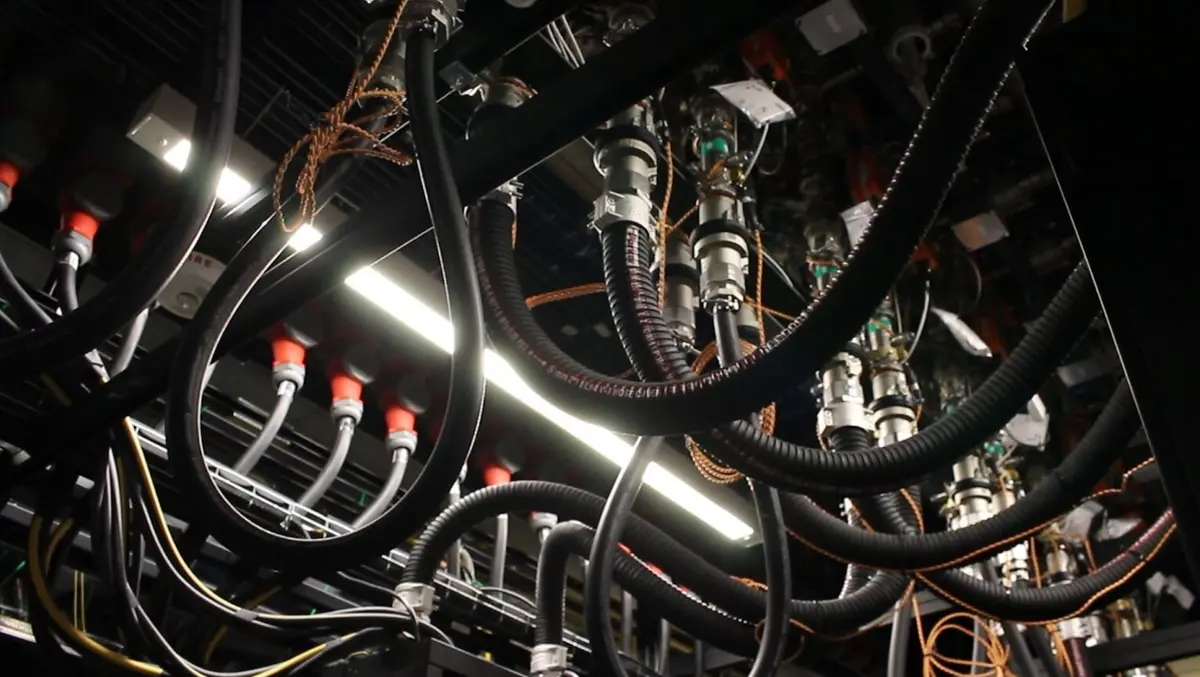
NVIDIA's Rubin servers ditch fans for liquid cooling
Wed, 24th Jun 2026
NVIDIA said its Rubin AI server platform uses a fully liquid-cooled design that can operate with coolant at up to 45C. It is the first system in the company's AI infrastructure range to eliminate fans entirely.
The design marks a shift from hybrid liquid-cooled servers, where only selected chips are cooled by liquid and other components still rely on airflow. In Rubin systems, every chip and networking component is cooled in a closed loop, with no fans anywhere in the system.
The change centres on the temperature of the cooling loop. Rather than relying on colder air and conventional chillers, the servers are designed to accept warmer liquid, allowing operators to reject heat more efficiently and reduce the need for mechanical cooling.
Cooling has long been one of the biggest power demands in data centres, accounting for as much as 40% of electricity use in some facilities. NVIDIA cited industry estimates that a one-degree increase in chiller plant temperature can cut cooling energy costs by about 4%.
At hyperscale, the financial impact can be material. NVIDIA said a 50-megawatt facility could save more than USD $4 million a year in cooling-related energy and water costs by adopting liquid-cooled infrastructure.
Water use
NVIDIA also linked the design to lower water consumption. Dry-cooler-based systems can run in a closed loop without evaporative water cooling for almost all of the year, with chillers needed only during limited periods in some climates, it said.
"The NVIDIA DSX reference design for AI factories has zero water consumption - we have eliminated massive amounts of power usage and pretty much all water usage," said Ali Heydari, Director of Data Centre Cooling and Infrastructure at NVIDIA.
"With dry-cooler-based designs, it's a closed-loop system with no evaporative water cooling - outside of maybe 1% of the year when we might need chillers in some climates," Heydari said.
According to NVIDIA, a conventional cooling-tower-based system can consume roughly 2.6 million gallons of water per megawatt each year. In favourable climates, its 45C liquid-cooling approach can reduce that to near zero by moving heat directly from chips into a recirculating liquid loop and then to outdoor dry coolers.
The coolant is described as a mix of 75% water and 25% propylene glycol. It flows through cold plates mounted directly on processors, absorbing heat at the source before circulating through the wider facility loop.
Industry shift
NVIDIA said the move to full liquid cooling reflects rising chip power densities in AI systems, which are making air cooling harder to sustain. Operators building around the Rubin platform will have to make the transition as part of deploying the new infrastructure, it added.
Motivair, Schneider Electric's advanced cooling division, has worked with NVIDIA for years on cooling systems tied to its roadmap. Richard Whitmore, President and Chief Executive Officer of Motivair, said rising chip-level power draw left little alternative.
"Once the watts per chip crossed a certain level, liquid cooling became mandatory," Whitmore said.
Whitmore said climate remains an important variable in how far operators can simplify site cooling. Cooler regions may be able to avoid refrigeration equipment altogether, while hotter locations may still need chillers during peak conditions.
"In the right geographic location, with the right system design, you don't need any refrigeration equipment," Whitmore said.
"You can just put big radiator coils outside and use the air temperature for all your cooling. It's incredibly efficient," he said.
Engineering changes
The Rubin design required a broader reworking of server thermal architecture. Earlier liquid-cooled systems typically used cold plates on GPUs and CPUs while leaving supporting components dependent on finned heat sinks and moving air.
NVIDIA said its engineering team redesigned those supporting elements so liquid could cool the whole system. It also changed the routing of cooling loops to serve multiple high-power chips with a single inlet and outlet, creating a simpler tray-level layout, according to the company.
That redesign changes the physical form of the server as well as its acoustic profile. NVIDIA said air-cooled machines need perforated bezels and fan-driven airflow, while Rubin servers have sealed front panels and no internal fan noise. Traditional data halls can exceed 85 decibels because of cooling fans, it said.
The company also said fully liquid-cooled systems can support higher rack density. It gave one example in which a system that previously occupied six rack units could be reduced to two rack units in the new design.
Another potential benefit is heat reuse. Because the system captures heat in liquid form at relatively high temperatures, operators may be able to redirect waste heat to nearby commercial or residential buildings where local infrastructure allows.
NVIDIA framed the cooling redesign as part of a broader effort to contain the energy demands of large-scale AI computing. "The processors continue to operate at full performance because liquid-cooled cold plates keep device temperatures within validated operating limits, even with coolant entering the rack at 45 degrees Celsius."