

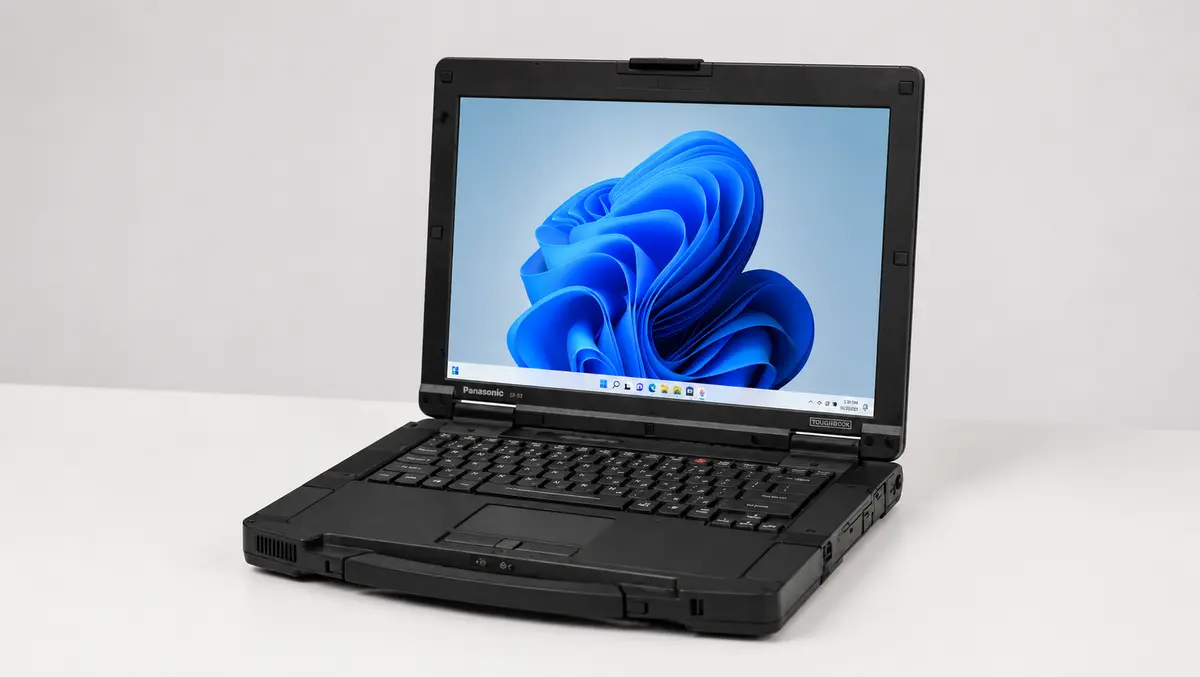
Panasonic launches TOUGHBOOK 56 rugged laptop in Australia
Mon, 6th Jul 2026 (Today)
Panasonic Australia has launched the TOUGHBOOK 56 rugged laptop, priced from AUD $5,199.
The device succeeds the TOUGHBOOK 55 and is aimed at remote workers in defence, field services, utilities and automotive settings, where laptops are used in transit, outdoors, and in environments that expose hardware to dust, moisture and repeated handling. Panasonic says the design reflects a stronger focus on ergonomics for users who carry and open devices frequently during field work.
One of the most notable changes is support for up to three wired LAN connections at once. Panasonic describes this as a first for the rugged mobility market, allowing users to run 1Gb, 2.5Gb and optional 10Gb links simultaneously.
That setup lets workers choose the connection best suited to a given application. Panasonic gave sector-specific examples, including defence users downloading data from several devices at once, telecom workers conducting fibre testing and network updates, and automotive research teams running diagnostics over separate channels.
Wireless connectivity includes Wi-Fi 7 and Bluetooth 5.4, with optional support for 4G private networks. These features broaden the machine's use across both fixed-site and mobile deployments.
Field design
Panasonic has also revised the physical design. The TOUGHBOOK 56 includes a wider retractable handle with a textured resin finish, while a redesigned latch-free edge is intended to allow one-handed opening, even when the user is wearing gloves.
The hinge mechanism is designed to reduce screen-related failures during transport and opening, addressing a common issue for laptops used by technicians, emergency personnel and crews moving between vehicles and job sites.
The display remains 14 inches but shifts to a 16:10 aspect ratio from the 16:9 format used in the earlier model. Panasonic says the change gives workers more room to view data-heavy applications on screen at the same time.
An optional 10-finger capacitive touchscreen is available. The screen can automatically detect whether the user is operating it with fingers, gloves, a pen, or a combination of fingers and pen, removing the need to switch modes manually.
Brightness ranges from 1 cd/m2 to 1000 cd/m2, allowing the screen to be used in bright outdoor conditions as well as darker environments where lower visibility is preferred.
Processing and AI
The TOUGHBOOK 56 also introduces a more advanced neural processing unit than previous models in the range. Panasonic says the Intel AI Boost hardware allows data to be collected, stored and analysed on the device itself rather than relying on a cloud connection.
Processor options include Intel Core Ultra 5 235H and Intel Core Ultra 7 265H chips with Intel vPro, and the system runs Windows 11 Pro. User-upgradable RAM and SSD storage are included, and an optional AMD Radeon W7500M 8GB graphics chip is available for users working with 3D mapping, simulation and CAD software.
These options position the device beyond traditional rugged computing tasks such as maintenance logs and asset inspection. More demanding edge workloads, including AI-assisted analysis and visualisation, are becoming part of field operations in sectors that once relied on simpler mobile terminals.
Compatibility and durability
Panasonic has retained a modular approach with six modular areas, including expansion packs, battery, RAM and SSD. Most peripherals from the TOUGHBOOK 55 remain compatible with the new machine, which may appeal to customers looking to extend existing accessory investments rather than replace full fleets and docks at once.
Battery life is rated at up to 12 hours on a single charge and up to 24 hours with two hot-swappable batteries. For industries operating long shifts away from office power sources, battery swapping remains a practical way to reduce downtime.
The laptop is designed with reference to MIL-STD-810H testing and carries an IP53 rating for water and dust resistance. Panasonic also says it includes identity-focused hardware and software security measures intended to reduce risks linked to device compromise, drivers and firmware.
Marc Amelung, General Manager, Mobile Solutions Group, Panasonic Australia, outlined the company's view of the target market. "Mobile workers and the IT teams that support them need technology that can stand up to the rigours of frontline and field work. We engineered the TOUGHBOOK 56 for high-end computing with AI at the edge and uncompromising security features to deliver efficient work and unwavering customer service," Amelung said.
He added that Panasonic sees continuity as part of the product's appeal for long-term users of the range. "For three decades, TOUGHBOOK has been the choice for workers in industries that cannot afford to sacrifice performance, security, or durability in any circumstance. They deserve the best in purpose-built hardware, software and services to support technology investments for the long haul," Amelung said.