

.webp)
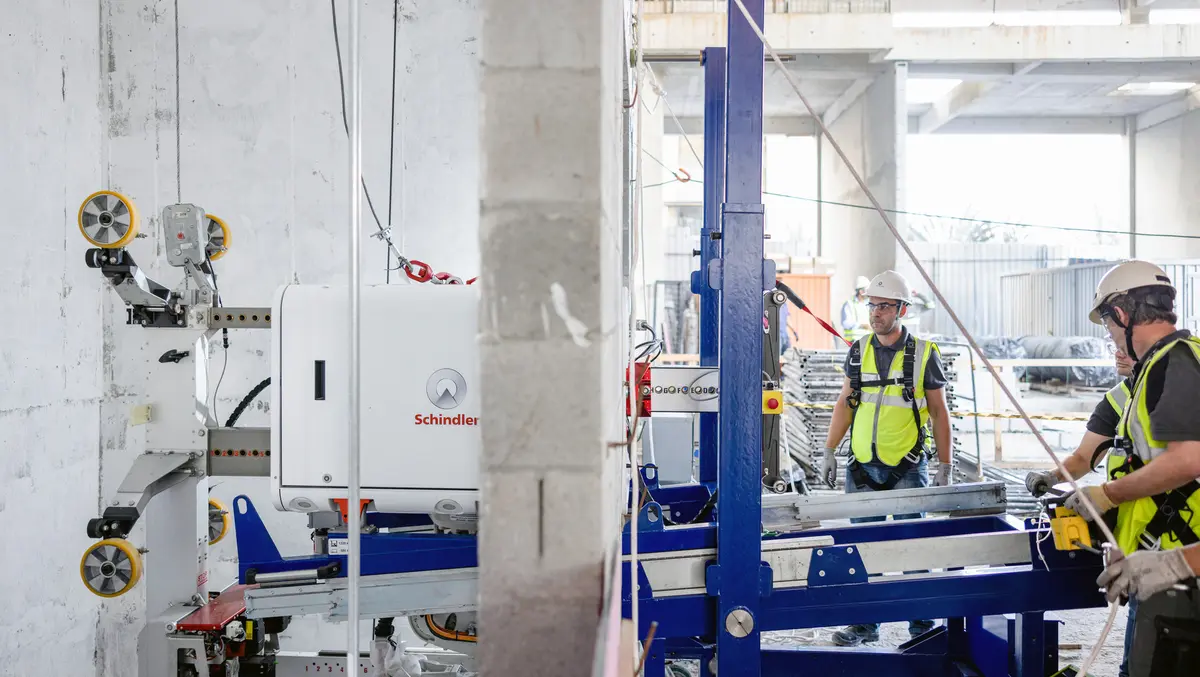
Schindler has added two new R.I.S.E elevator installation robots to its global fleet, bringing the total number in operation to seven.
The expansion comes as builders and contractors increase their use of automated tools for work inside elevator shafts, where drilling and anchor bolt installation are physically demanding and carried out in confined spaces.
Since its launch five years ago, the R.I.S.E system has been used at 36 job sites worldwide. Over that period, the robots have installed about 50,000 anchor bolts to secure guide rails and elevator doors inside shafts.
Projects using the machines have taken place in markets including Austria, Poland, India, the UK, Brazil, China and Singapore. Schindler says the system can cut the time needed for shaft preparation and installation by as much as 40%.
How it works
The robots are designed to carry out several stages of elevator shaft preparation. Using a digital work plan prepared in advance for a specific building, they measure positions on shaft walls, drill holes and install anchor bolts.
Once delivered to a site, the unit is placed at a shaft opening on a transport trolley and lowered by its own winch system. It then moves autonomously within the shaft while operators track progress through a tablet interface with live camera feeds and performance data.
Before drilling, the robot scans the concrete surface to avoid hitting steel reinforcement. It then drills and fixes bolts at pre-set heights and positions inside the shaft.
The work addresses one of the more labour-intensive parts of lift installation. Guide rails, which keep elevator cars moving in a straight line, require numerous brackets fixed to shaft walls, and each bracket is secured by multiple anchor bolts.
In taller buildings, that requirement can quickly scale. Schindler says a high-rise elevator shaft could contain around 1,000 anchor bolts, while one recent project required more than 4,900 anchor bolts for a single elevator group at one site.
Site pressures
Schindler linked growing interest in the robots to tighter construction schedules, labour shortages and increased focus on working conditions. Traditional installation methods can involve weeks of drilling by technicians working from platforms inside shafts, with exposure to noise, vibration and dust.
Faruk Osmanbasic, Lead Advanced Installation Technologies at Schindler, said demand was rising as contractors looked for ways to manage those pressures on site.
"We are seeing growing demand worldwide as construction projects face tighter deadlines and increasingly prioritize safer, improved working conditions onsite," Osmanbasic said.
"Elevator installation is carried out in confined spaces, where workers may spend hours exposed to noise and dust from drilling. Contractors are recognizing the wide range of benefits these robots bring," he said.
Schindler says the system is intended to remove repetitive and strenuous tasks from technicians rather than eliminate the need for skilled labour. Workers can then focus on alignment, guide rail installation and ride quality.
Global network
To support wider deployment, Schindler maintains the robots at regional hubs when they are not in use on construction sites. It currently operates hubs in Switzerland, Hong Kong and Australia, allowing units to be serviced and dispatched to nearby markets.
It is also evaluating additional hubs in markets where demand is increasing, aiming to reduce transport times and speed up deployment. Schindler did not disclose the scale of investment tied to the latest expansion.
The move reflects broader changes in the construction sector, where automation has generally advanced more slowly than in manufacturing and logistics. As buildings become taller and site conditions more tightly regulated, specialist machines for repetitive tasks are taking on a larger role in project planning.
For Schindler, the R.I.S.E programme also marks a shift beyond its traditional role as a supplier of elevators and escalators into more technology-led installation methods. By focusing on shaft preparation, it is targeting a stage of the process where delays and worker fatigue can affect subsequent installation work.
Schindler says customer response has been positive as the robots have been used across more projects and geographies.
"The feedback that we get from customers across the globe is that Schindler R.I.S.E is a very robust solution that offers high precision and delivers excellent results," Osmanbasic said.
"What we are seeing is only the beginning," he said.