

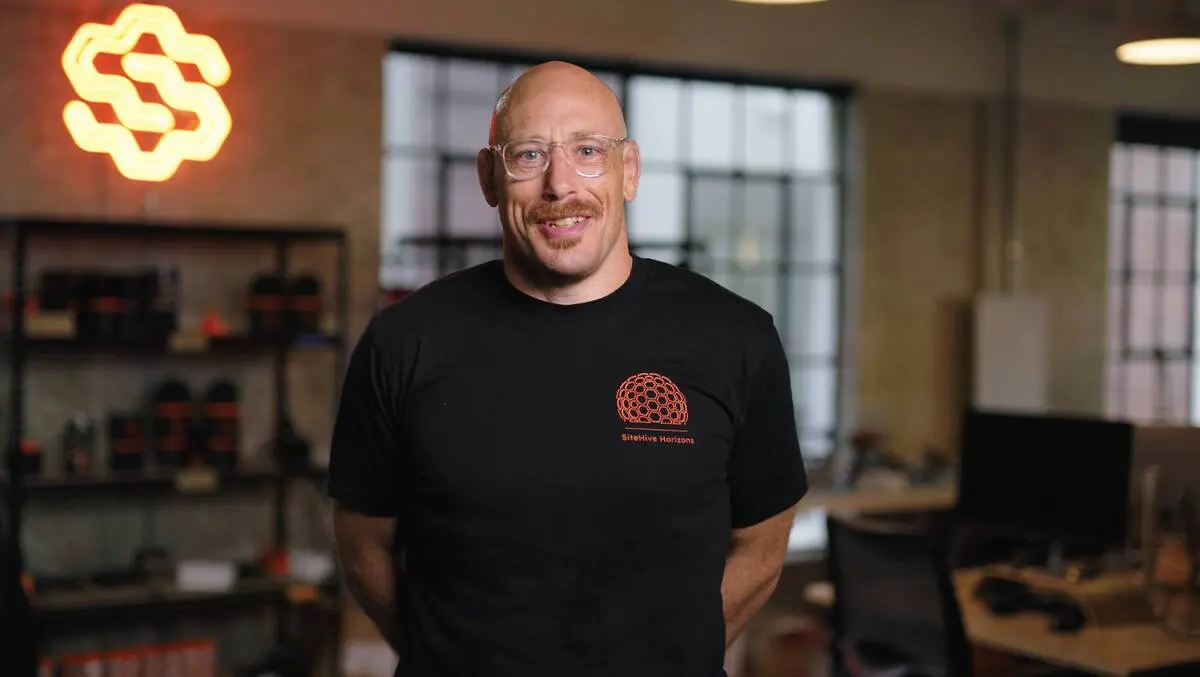
SiteHive gains traction with unblinking eyes on the job
Tue, 7th Jul 2026
Quis custodiet ipsos custodes, goes the old Latin expression, who will watch the watchers? For SiteHive the question is a little different, and goes more to who will watch the construction sites for environmental compliance? Traditionally, that's the job of a site manager who reports into a project or portfolio manager. Not, as you might imagine, very scalable. One site per manager, and those managers are expensive people.
And that's among the key issues SiteHive addresses, with a range of site-deployable sensor solutions monitoring a wide range of variables including vibration, dust and noise. Along with, said SiteHive co-founder Ben Cooper-Woolley, weather. "It is such a significant driver of productivity," he confirmed. "Over half of all projects are delayed because of weather, and despite all the forecasting, you get different reports from different providers, and the only weather you're really interested in is hyperlocal right there on your site."
'Hyperlocal' is the key concept for SiteHive and its provision of environmental monitoring for noise, dust, vibration, water and now weather. While the construction of anything from roads to airports and apartment buildings is obviously essential to the modern way of life, there's no denying that any new project comes as an inconvenience or even hazard to those inhabiting or transiting the existing infrastructure.
For some time, that's been addressed by a combination of site managers questionably aided and abetted with (or hampered by) what Cooper-Woolley described as fragmented analog devices with ancient software. "The kit they had when we started SiteHive included a giant solar panel and the software was supplied on a CD. But the site manager's computers didn't even have a CD drive," he said.
From giant solar panels and CDs to compact connected sensors
This was on site at a bulk earthworks project in western Sydney, and that was back in 2019. There was plenty of room for improvement, and Cooper-Woolley said SiteHive was there for it. "When we demonstrated our sensor, which combined dust and noise sensing in one device, they couldn't believe it."
Reflecting the march of technology and, he agreed, the force of consumerisation, SiteHive's purpose-designed solutions are easier to use, compact, and even discreet. The sensors themselves are placed on site by users (with best practice guidance) and then feed data back via the cellular networks. SiteHive's accompanying SaaS cloud platform consumes the information and serves it up without delay, so site managers have an unwavering eye on key metrics. Should anything stray outside of delineated margins, actions are taken to maintain productivity on the one hand, and minimise harm to the surrounding people.
"We've designed the software specifically like we did the hardware rather than cobbling together existing tools and technology," said Cooper-Woolley. "Crucially, we present information in context, so our customers are able to make informed decisions; it doesn't just say '77' for dust."
Data with context, not just numbers
That's because 77 is meaningless unless the scale for acceptable dust is known, along with insights on what's generating dust, and where the wind is blowing it. Data, after all, only becomes useful if it is seen in relation to other factors, and when that happens, site managers can take remedial or amelioratory actions so that production continues, without excessive impact on residents and passers-by.
"So we'll show your daily limitations on the dust, and we'll show when you're trending over or under; if it's under, you could get the job finished quicker, benefiting the community, and if if there's a risk of an exceedance, get the water out and slow it down," he added.
"It's well established that the construction industry is generally low productivity, but what we're seeing is a few things. We work again on both sides of that equation. On one hand, we let people [site and portfolio managers] work from home. You don't want to do site walks, noise monitoring, or be out at night measuring vibrations. A SiteHive Hexandode is your eyes and ears across your sites, wherever you are. So we're enabling new ways of working, making it easier to be more productive."
And, he added, that context means taking meaningful action. "We don't only measure noise and dust, but tell you where the sound and dust is coming from, with wide angle cameras so you can see exactly what is causing the issue."
AI that tells you whether it's a bird or a bulldozer
No discussion, agreed Cooper-Woolley, is complete these days without mention of AI, and indeed "We also record audio, and layer in AI models, so if there's a loud noise on site, we can say don't worry, it was birds or an ambulance."
He added that newer generations coming into the workforce expect a high technology bar on the jobsite. "They want to talk to and engage with these systems. If it isn't available on their phone and information isn't available at their fingertips, they're not interested."
The result is that SiteHive has quickly found a market for its solutions, signing up a swathe of larger-scale construction companies including Fulton Hogan, Delcon Group, WSP, BuildCorp and more.
Cooper-Woolley said that while there are always barriers to change, and that those on site might see monitoring as an unnecessary intrusion and more evidence of an overbearing safety culture, the idea isn't so much 'big brother' as it is 'productivity booster'.
From construction sites to ports, mining and more
And that's why the company continues gaining traction, and that goes beyond the construction sites that gave birth to the SiteHive idea. "Yeah, look, we're in a good spot, on almost 500 projects currently just across Australia and New Zealand with over 1100 devices now in the field," said Cooper-Woolley.
"We're seeing huge growth and opportunity, particularly in the building sectors. We'll continue to evolve and broaden our product range including by vertical; for instance, ports, these operational facilities need to make good environmental decisions. The operational world is one we're looking at, expanding to mining has a lot of potential, as well as adjacent verticals…[anywhere where there is a] need to manage environmental compliance proactively."
Beyond that, Cooper-Wooley pointed to geographical expansion. "We're in the next phase of our growth, and what that might look like over the next three to five years, but also not losing sight of the opportunity right under our nose and right in front of us. We'll continue to do a good job of serving the customers that have helped us get this far, while growing and developing our services."