


SUBCO boosts diverse fibre links between key cities
Wed, 18th Mar 2026.webp)
SUBCO has expanded the physical diversity of its domestic network in Australia by adding a second, geographically independent path between Sydney and Melbourne and extending access into major data centres across four capital cities.
The updates target what network operators and large enterprise buyers call "path diversity", where separate fibre or cable routes reduce the risk of a single incident disrupting services. Australia's inter-capital links span long distances and follow a limited number of corridors, which can concentrate risk around shared landings, shared backhaul routes, or co-located equipment.
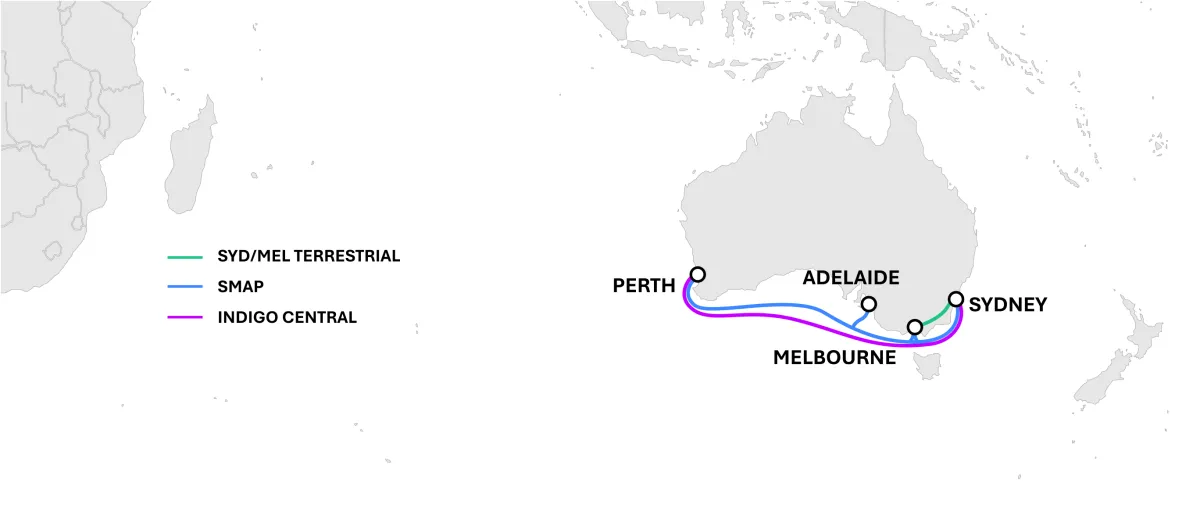
On the Sydney-Melbourne corridor, SUBCO now offers two geographically independent paths combining subsea and terrestrial connectivity. The mix is intended to reduce shared points of failure in a market where fibre routes often converge near metropolitan approaches and along transport easements.
East-west routes
SUBCO also highlighted its Sydney-Perth connectivity, served by two separate cable systems: Indigo Central and SMAP. It described them as distinct routes with separate landing stations and supporting infrastructure.
According to SUBCO, SMAP adds additional inter-capital capacity and is designed to operate independently of existing systems, including Indigo. The two systems use separate cable landing stations, submarine line terminal equipment and data centres-elements that help determine whether services remain independent during a fault, maintenance event, or localised incident.
"Diversity has traditionally been something customers needed to engineer themselves-engaging multiple providers and hoping the underlying paths were physically separate," said Bevan Slattery, Founder & Co-CEO of SUBCO.
"SUBCO's strategy has been to own and operate diverse assets and deliver them as a single, fully integrated offering," Slattery said.
Data centre access
The network update also adds new connectivity points in facilities operated by NextDC, Equinix, AirTrunk and CDC across Sydney, Melbourne, Adelaide and Perth. Access to these sites matters for customers that need to connect international capacity, domestic backhaul and cloud on-ramps within the same carrier footprint.
In Sydney, customers can access NextDC S2, Equinix SY3, SY4 and SY1, NextDC S1, S3 and S6, and AirTrunk SYD2. In Melbourne, the list includes Equinix ME2, NextDC M1 and CDC BK1. In Adelaide, SUBCO flagged access at Equinix AE1. In Perth, it listed NextDC P2 and Equinix PE2.
For network buyers, access into multiple data centres can matter as much as the long-haul route itself. It can affect how quickly a customer establishes a second connection, how directly traffic reaches cloud and content platforms, and whether dual links remain separated in the last kilometres into a city.
Single-provider design
SUBCO framed the expansion as part of a strategy to bundle physically diverse infrastructure into a single service. In the domestic market, many resilience plans rely on sourcing capacity from multiple operators, but overlap can remain if providers share ducts, beach manholes, landing precincts, or metro aggregation sites.
SUBCO has been building both subsea and terrestrial assets, with an emphasis on route independence between major population centres. The Sydney-Melbourne corridor is one of Australia's highest-demand domestic paths, carrying a mix of enterprise traffic, cloud interconnect flows and transit between international gateways on the east coast.
SUBCO also pointed to APX East, which it described as an express hyperscale cable connecting Australia directly to the mainland United States, targeted to be Ready for Service in Q4 2028.
According to SUBCO, APX East is planned with no intermediate landing or regeneration between Australia and the US mainland. It also plans to land the cable north of Sydney's existing cable protection zone, which it said would add geographic diversity and improve resilience for international connectivity out of Australia.
Future work includes progressing APX East towards its target service date, extending domestic route separation, and expanding access into additional carrier-neutral data centre sites.