

Subco launches SMAP cable linking Australia's capitals
Sat, 27th Jun 2026 (Today)
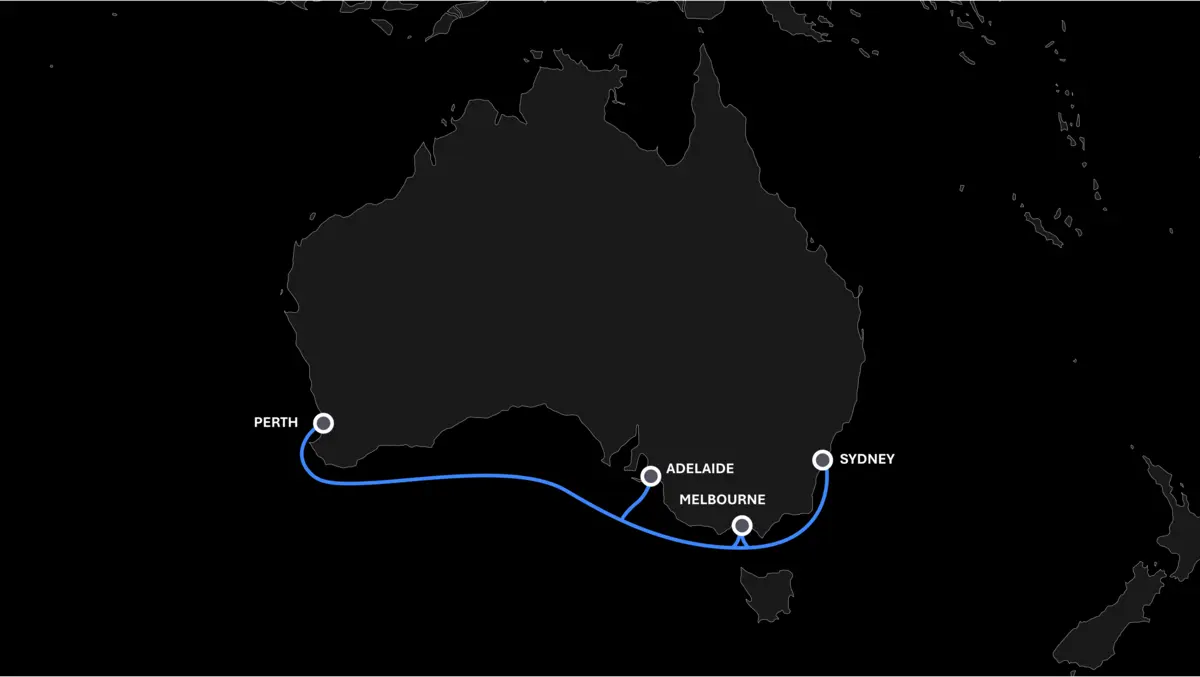
SUBCO has brought its SMAP submarine cable system into service, linking Sydney, Melbourne, Adelaide and Perth.
The 5,000 km system marks Australia's biggest transcontinental capacity increase in almost 25 years, according to SUBCO.
SMAP is designed with 16 fibre pairs and more than 400 Tbps of total capacity, making it one of the largest undersea cable systems globally and the first in Australia to use what SUBCO describes as a hypercable design.
The route is the first submarine cable to land in both Melbourne and Adelaide. It gives carriers and service providers an alternative path across the Sydney-to-Perth corridor as route diversity and network resilience become more prominent issues for telecoms operators, cloud companies and data centre groups.
According to SUBCO, the cable is fully armoured and uses space division multiplexing technology. The build is intended to support large-scale traffic growth between Australia's major cities, including demand tied to cloud infrastructure and artificial intelligence computing.
Foundation customers include Aussie Broadband, Cloudflare, Megaport, 5GN, Swoop, GSL, Host Universal, Kinetix, Leaptel, Telair and Virtutel. Their early commitments suggest domestic and international network operators were willing to reserve capacity before the system entered service.
Bevan Slattery, Founder and Co-CEO of SUBCO, described the launch as a major infrastructure milestone for the country.
"SMAP going live is the culmination of more than three years of hard work, and a landmark moment for Australia's digital future. For the first time, the nation's four major cities are connected by a single, fully armoured, high-capacity subsea system - delivering the resilience and scale that Australia's digital economy, and its role as a connectivity hub for the Indo-Pacific, demands. This isn't just an upgrade; it's a generational reset for Australian infrastructure," Slattery said.
Customer Demand
Several customers framed the project as a way to widen network options and reduce dependence on existing routes. That matters in Australia, where long distances and a relatively small number of backbone paths can make outages and congestion harder to manage.
"By coming on board early as a foundational customer of SMAP, we're locking in the capacity, performance and resilience our customers will need for the next decade and beyond," said Brad Parker, Chief Technology Officer of Aussie Broadband.
"The hyperscale capacity and added redundancy allows us to move massive volumes of traffic between our capital city points-of-presence with lower latency, higher availability and far more headroom for growth," Parker said.
Cloudflare also pointed to the value of additional domestic routing.
"A better Internet is built on resilient infrastructure. SMAP gives Cloudflare diverse new domestic paths across Australia - strengthening our network and elevating the experience for everyone our customers serve," said Damian Matacz, Director of Network Strategy at Cloudflare.
Other early customers made similar points, emphasising redundancy and room for expansion.
"It just ticks every single box for redundancy and for additional network builds for the future," said David Allen, Managing Director of Virtutel.
"We're rapidly growing, particularly in WA, and SMAP gave us a clear pathway for both resilience and capacity," said Matthew Enger, Chief Executive Officer of Leaptel.
"We've had a long history with SUBCO and buying capacity with Indigo Central and West. Competitively priced, good service and another option, another route is always good to have," said Joe Demase, Managing Director of 5GN.
Broader Build-Out
SMAP is part of a wider expansion by SUBCO across domestic and international connectivity. The company has added geographically separate inter-capital routes, including two independent paths between Sydney and Melbourne, as well as new data centre access points in the four largest Australian cities.
SUBCO has also outlined the next phases of the project. It has confirmed a branch extension into Tasmania, which it said would provide the state with route diversity that does not rely on Victorian termination points.
Direct access to the SMAP system in Tasmania would support the low-latency, high-capacity traffic flows needed for large-scale GPU computing, according to SUBCO. That reflects growing interest in where AI-related infrastructure will be built and how it will connect to mainland networks.
Another project in development is APX East, a planned direct cable between Australia and the US mainland with no intermediate landings. SUBCO said the route would be the first international cable to land north of Sydney's existing cable protection zone, adding another layer of geographic diversity to Australia's external network links.
For now, the immediate change is the arrival of a new transcontinental path connecting all four mainland capitals on a single subsea system.
"Our partnership with SUBCO is built on a shared commitment to performance, reliability and customer outcomes. The team has consistently demonstrated deep technical expertise and a collaborative approach, helping support our network growth and long-term connectivity strategy. As a foundation customer of SMAP, we're excited to continue working together as the network expands and creates new opportunities for customers across Australia," said Tom Berryman, Chief Technology Officer of Swoop.