

Sungrow unveils battery & solar storage in Australia
Thu, 2nd Apr 2026
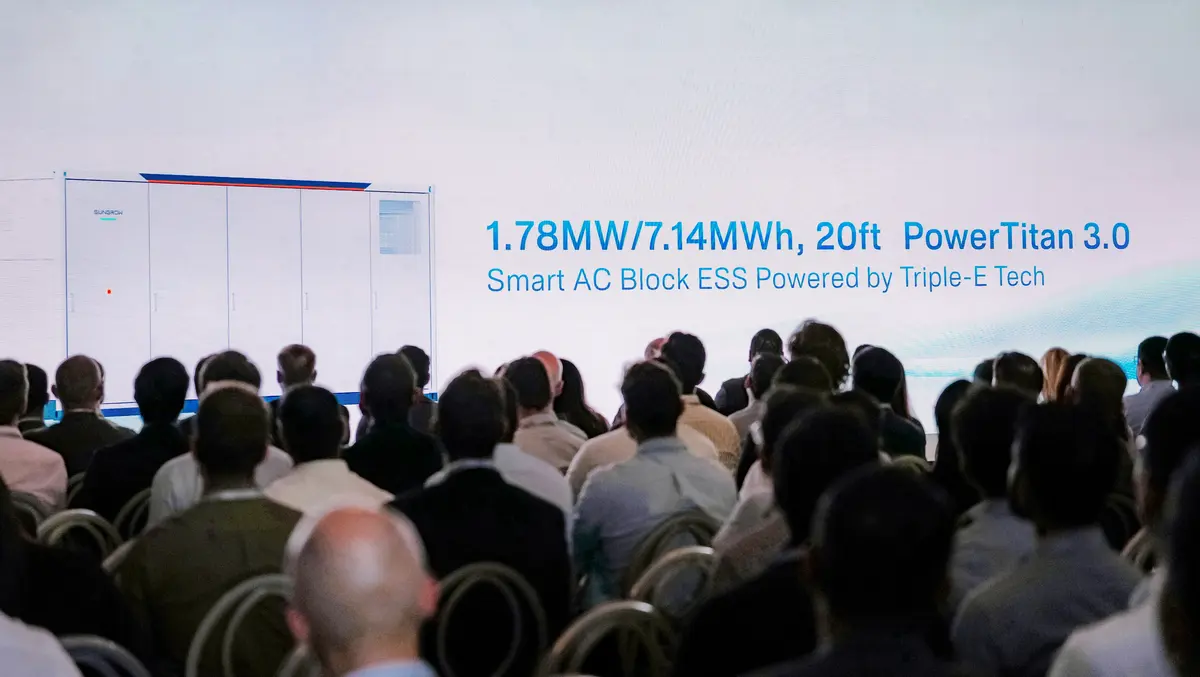
Sungrow has introduced its PowerTitan 3.0 energy storage system and a new hybrid solar-and-storage solution in Australia, as large-scale battery deployment accelerates across the National Electricity Market.
The products were presented in Sydney to more than 300 partners and industry specialists, amid growing interest from developers and investors in projects that can meet stricter technical requirements for grid connection and operation.
Australia's utility-scale renewables market has expanded on the back of federal and state support, including the Capacity Investment Scheme, along with rising investor interest in battery energy storage. That growth has sharpened attention on projects that can provide grid support and energy shifting, particularly in parts of the network affected by weak system strength and voltage instability.
Developers also face lengthy approval processes and complex modelling requirements as grid operators seek stronger evidence that large batteries and solar plants can support stable operation. Grid-forming technology has become central to that process, especially as renewable penetration rises across the electricity system.
Storage Design
PowerTitan 3.0 is designed for utility-scale storage projects operating under these conditions. The system uses an AC block design and is built around battery cells with more than 600 ampere-hours of capacity, with silicon carbide-based power conversion.
Each 20-foot container includes 1.78 MW of power conversion system capacity and 7.14 MWh of battery storage. In a four-hour configuration, blocks can scale to 7.2 MW and 28.5 MWh.
According to Sungrow, this layout can reduce land use by 20% and cut overall project costs. The system is designed to support discharge durations ranging from four to eight hours.
Sungrow said the power conversion system reaches a maximum efficiency of 99.3% and can deliver 120% continuous overload. It added that the stacked-cell design enables system-level round-trip efficiency of 92%.
The equipment is also designed for Australian site conditions, with operation at ambient temperatures of up to 45 °C, noise levels of 63 dBA, IP55 protection and C5 corrosion resistance.
A key part of the launch was the emphasis on installation speed. Sungrow said the AC block design allows factory pre-installation and pre-commissioning, with automated checks completed in under an hour, and that a 1 GWh project could be deployed in 12 days.
Hybrid Model
The second product unveiled was a hybrid solution that combines photovoltaic generation and battery storage through both DC-coupled and AC-coupled configurations. It uses Sungrow's 1+X modular inverter series and links PV, energy storage and PowerTitan 3.0 through a dedicated DC/DC module and a PV-ESS management system.
The company said the design allows discharge durations of up to eight hours, a DC/AC ratio of up to 2.0 and an energy storage system power ratio of up to 100%. It also said system-level energy conversion improves by 3% to 5% compared with traditional designs, while reducing overall project costs.
The launch reflects broader market interest in combining solar and storage assets on a single platform. DC-coupled systems have attracted attention because they can limit conversion losses and make better use of network connection points, although economics vary with project design and market conditions.
Grid Support
During the Sydney event, Dr Dan Xiao, Technical Expert at Sungrow Australia, focused on the role of grid-forming technology in renewable-heavy power systems. Sungrow said its work in the area includes voltage and frequency support, oscillation damping, black start at the gigawatt scale and system strength support.
Those functions are increasingly relevant in Australia, where retiring thermal generation has shifted responsibility for system stability towards inverter-based resources such as batteries and solar. Market participants have been under pressure to demonstrate that new projects can contribute to secure operations rather than increase instability risks.
The event also included a panel discussion with almost 10 industry experts on energy transition pathways and project experience in the field. Sungrow also launched an energy storage safety white paper with TÜV Rheinland.
Australia has been an important market for the company over the past decade, spanning utility-scale solar and battery projects. Sungrow said projects including Cunderdin and Templers are operating, while Pelican Point is under construction.
"In Australia, Sungrow has built a strong foundation over the past 13 years, expanding from early market entry to delivering large-scale utility and energy storage projects across the country," said Joe Zhou, Vice President of Sungrow Asia Pacific. "Key projects such as the Cunderdin DC-coupled project, Templers BESS are in full operation and the Pelican Point BESS is currently under construction demonstrate our capability to deliver at scale. Meanwhile, our pipeline continues to grow, including multiple projects expected to reach financial close in 2026 and landmark developments such as the Halys BESS, with a planned capacity exceeding 3GWh."