

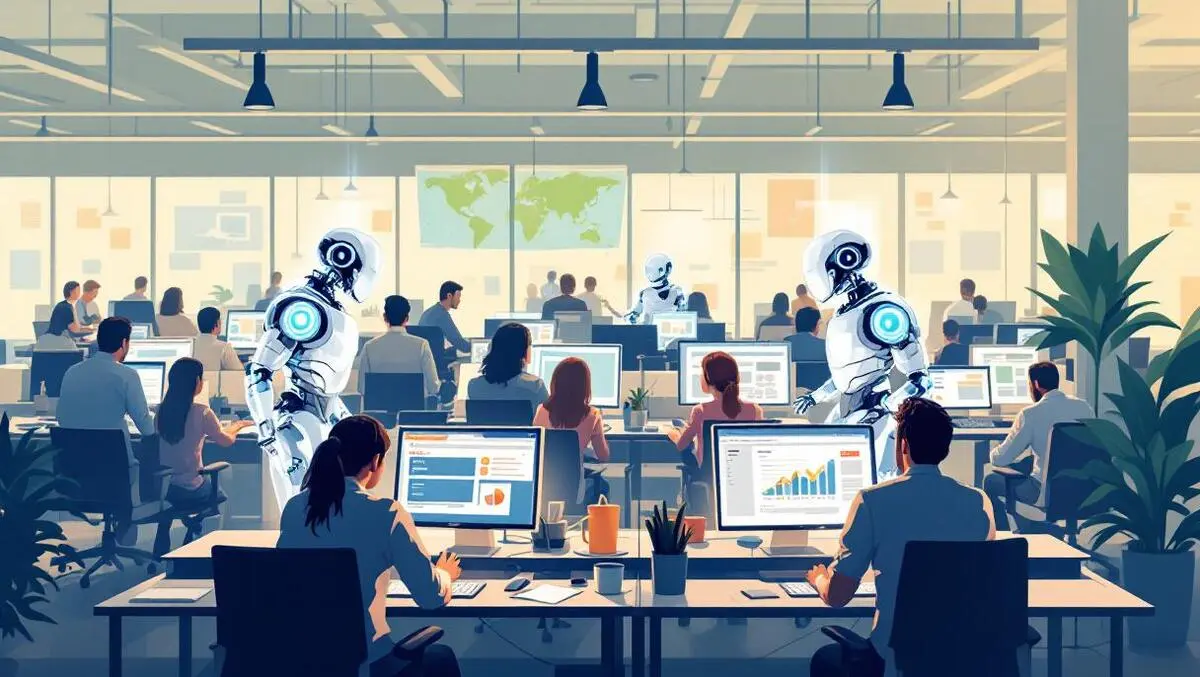
AI agents to power 40% of enterprise apps by 2026, says Gartner
Wed, 27th Aug 2025
According to new research from Gartner, 40% of enterprise applications are expected to feature task-specific artificial intelligence agents by 2026, a significant rise from less than 5% today.
The research outlines the evolution of agentic AI in enterprise environments, anticipating that as organisations speed up digital transformation efforts, AI agents will move beyond enhancing individual productivity and begin to reshape collaboration and workflow efficiency. The findings highlight that advancements in human-agent interactions will set new standards for how teams work and how systems are orchestrated within businesses.
Rapid evolution
Gartner's Senior Director Analyst, Anushree Verma, said, "AI agents are evolving rapidly, progressing from basic assistants embedded in enterprise applications today to task-specific agents by 2026 and ultimately multiagent ecosystems by 2029. This shift transforms enterprise applications from tools supporting individual productivity into platforms enabling seamless autonomous collaboration and dynamic workflow orchestration."
Organisations are currently at an inflection point in the development and deployment of agentic AI. Gartner advises that Chief Information Officers have a key three- to six-month window to establish a clear strategy or risk lagging behind peers who embrace new agentic AI capabilities earlier. The report suggests a focused approach across a framework of five stages in the evolution of agentic AI in enterprise settings.
Stages of agentic AI
The first stage is characterised by AI assistants embedded into nearly every enterprise application by the end of 2025. These assistants help transform previously inefficient applications into systems that automate tasks on behalf of users. However, these assistants still require human input and do not operate independently. Gartner warns that the distinction between AI assistants and agents is often blurred, due in part to what it terms 'agent washing'.
Verma stated, "CIOs and technology leaders must focus on creating seamless employee experiences by integrating AI assistants with robust APIs, enabling a shift from traditional application-centric interfaces."
By 2026, Gartner forecasts that AI assistants will have developed into agents with specialised task capabilities. At this stage, 40% of enterprise applications are forecast to be integrated with these task-specialised agents.
"As AI agents begin acting independently and handle tasks ranging from routine development to complex incident response without human involvement, leaders must ensure strong security and governance," said Verma.
Collaborative agents
The third stage, anticipated by 2027, involves collaborative AI agents operating within the same application. Gartner predicts that one-third of agentic AI implementations at this time will consist of agents with differing skill sets managing complex tasks collectively in application and data environments. The industry currently focuses on single-purpose automation, but Gartner expects greater business impact from collaborative agents that can learn from data in real time and adapt as situations evolve.
At this phase, Gartner emphasises that technology leaders should consider standardisation, interoperability, and the adoption of protocols that promote smooth agent-to-agent communication.
Ecosystems and new business models
The fourth stage, by 2028, forecasts networks of specialised AI agents able to dynamically collaborate across different applications, allowing users to accomplish objectives without direct interaction with each piece of software. Gartner suggests that this could result in changes to business models, increased requirements for transparency, new pricing structures, and further emphasis on ethical standards and governance.
Gartner estimates that by 2028, one-third of user experiences will transition from using native applications to interacting with agentic front ends. This is predicted to require entirely new business models to address potential disintermediation caused by these changes.
A new normal
The fifth and final stage, forecast for 2029, predicts that at least half of knowledge workers will have acquired new skills needed to work with, manage, and even create AI agents capable of handling complex workflows on demand.
Verma said, "As agentic AI matures, standardised protocols and frameworks will enable seamless interoperability, allowing agents to sense their environments, orchestrate projects and support a wide range of business scenarios. Early adopters will set the standard for the new normal while others risk falling behind as humans begin relying on AI agents as much as their smartphones."
Gartner's analysis suggests that as agentic AI becomes more ingrained in enterprise software and operations, organisations will face new challenges and opportunities, especially regarding governance, security, and interoperability. Companies that promptly address these areas are likely to be better positioned in an environment where reliance on autonomous AI agents continues to grow.