

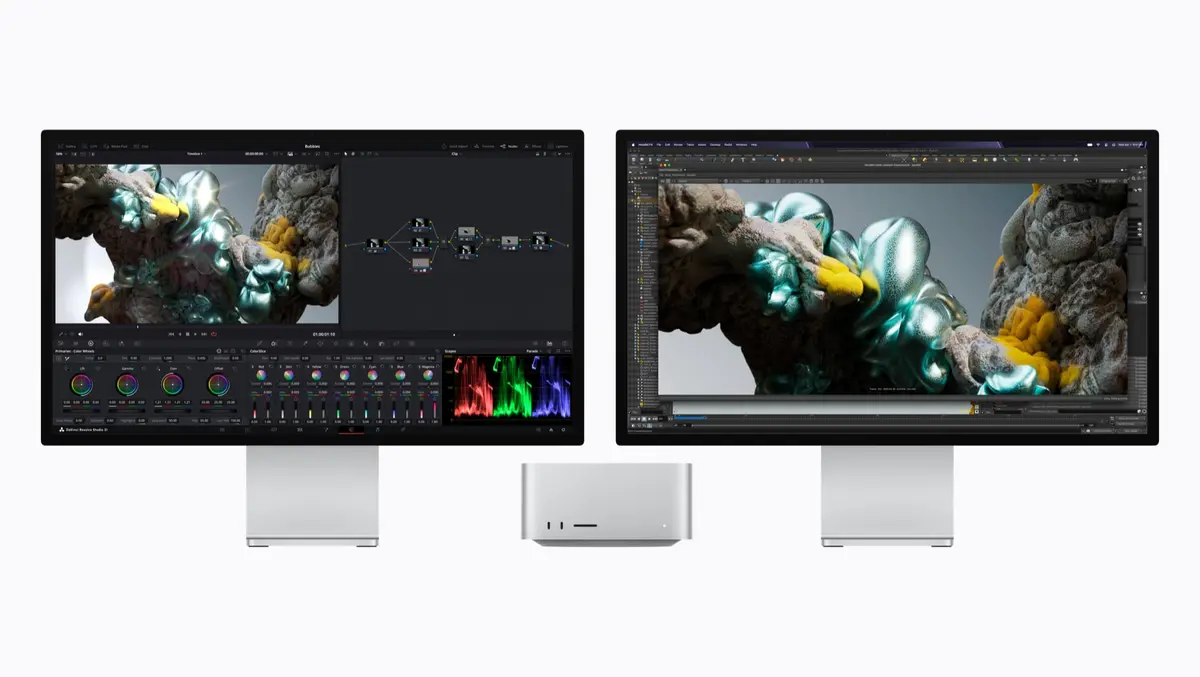
Apple unveils Mac Studio with M5 chips for AI workloads
Wed, 26th Aug 2026
Apple has unveiled a new Mac Studio desktop with M5 Max and M5 Ultra chips, aimed at local artificial intelligence workloads and professional computing tasks.
The new Mac Studio keeps the existing compact desktop format while increasing processor, graphics and memory specifications across the line-up. The M5 Max version includes an 18-core CPU, up to a 40-core GPU and up to 128GB of unified memory, while the M5 Ultra scales to a 36-core CPU, up to an 80-core GPU and up to 512GB of unified memory.
The launch marks Apple's latest effort to position the Mac range as a platform for running large AI models directly on a device rather than through cloud services. Apple said the top-end configuration can run large language models locally, and that multiple Mac Studio systems can be linked through Thunderbolt 5 for distributed AI inference.
According to Apple, a cluster of four Mac Studio systems can deliver up to three times faster AI inference than a single machine. It also introduced support for RDMA, or remote direct memory access, across connected systems to create a shared memory pool for larger models.
AI focus
Apple is placing particular emphasis on graphics-based AI processing in the new machines. It said Neural Accelerators are built into each GPU core, with the M5 Ultra offering up to 4.3 times the peak AI compute performance of the previous M3 Ultra and 9.8 times that of the M1 Ultra.
For the M5 Max model, Apple said on-device AI performance is up to 3.9 times faster than the previous generation used in its comparisons. Memory bandwidth reaches 614GB/s on M5 Max and 1.2TB/s on M5 Ultra, with the latter figure representing a 50 per cent increase on the prior model.
Apple tied the launch to its software tools for AI development on Mac. It highlighted Core AI, a new framework for building, running and deploying AI models on Apple silicon, alongside MLX, its open-source machine learning framework, and Xcode.
Workstation market
Beyond AI, Apple is targeting creative and technical users who need high-end desktop systems for graphics, video and software development. The M5 Max model is intended for musicians, photographers, software engineers and designers, while the M5 Ultra is pitched at users handling heavier visual effects, rendering and data science workloads.
Graphics improvements include third-generation hardware-accelerated ray tracing and updated shader cores. Apple said the M5 Ultra delivers up to 1.8 times faster graphics than the prior generation, while the Media Engine is designed to handle video formats including H.264, HEVC, ProRes and AV1 decode.
Apple also said the M5 Ultra can simultaneously play up to 33 streams of 8K ProRes 422 video at 30 frames per second. For filmmakers and post-production teams, that should allow real-time colour grading of uncompressed 8K footage on a single system.
Apple's benchmark claims span a range of specialist applications. For the M5 Max, text-to-image tasks are said to be up to 7.4 times faster than on a Mac Studio with M1 Max, while DNA sequencing basecalling in Oxford Nanopore MinKNOW is up to 3.5 times faster. For the M5 Ultra, Foundry Nuke CopyCat ML training is said to be up to 15.4 times faster than on a Mac Studio with M1 Ultra.
Connectivity update
The desktop also receives a broader connectivity refresh, adding Wi-Fi 7 and Bluetooth 6 for the first time. Thunderbolt 5 ports provide up to 120Gb/s of bandwidth for external storage, displays and PCIe expansion chassis.
Apple also said storage performance has improved through a PCIe Gen 6-based SSD design that delivers up to twice the throughput of the previous generation. The system supports up to eight displays, or four Studio Display XDR screens at full 5K resolution and 120Hz.
Another addition is genlock over USB-C, which Apple said allows precise synchronisation between a display and professional camera capture. It specifically referenced use with iPhone 17 Pro.
The launch also forms part of a broader software transition across Apple's desktop line. The new Mac Studio will work with macOS 27, which Apple said includes Siri AI, system-wide Apple Intelligence features, and changes to interface design and search functions.
Johny Srouji, Chief Hardware Officer at Apple, described the machine as a major update to the company's top-end Mac desktop line. "Mac Studio is the ultimate desktop for on-device AI and the world's most demanding pro workflows, relied on by users for its tremendous performance and extensive pro connectivity, all in a quiet, compact design that sits right on your desk - and today, we're pushing the boundaries even further," he said.
He added: "With the powerful M5 Max and the incredible capabilities of M5 Ultra, Mac Studio ushers in a new era of desktop computing, delivering huge performance gains for pro workloads and AI inference with frontier-class models. By integrating Neural Accelerators directly into the GPU and offering massive amounts of high-bandwidth unified memory, the new Mac Studio is our most powerful Mac ever."