


Australians turn to AI as trust gap widens, study finds
Tue, 2nd Jun 2026
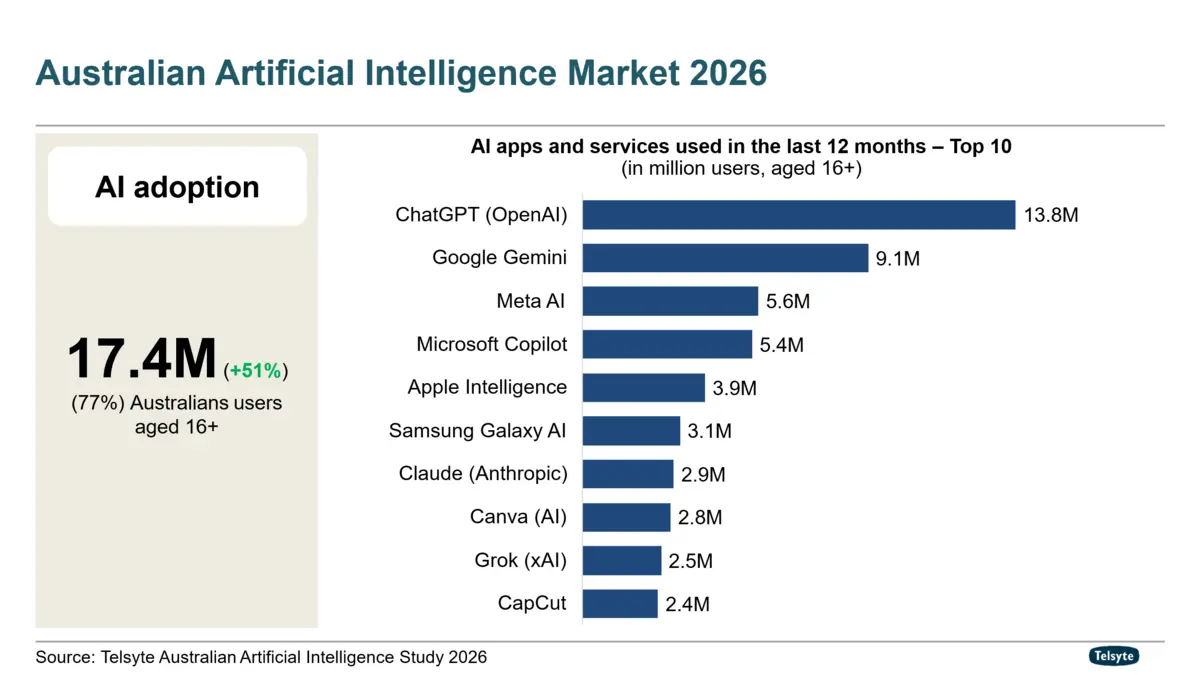
Telsyte says 17.4 million Australians now use artificial intelligence, with four in five AI users engaging with it at least monthly.
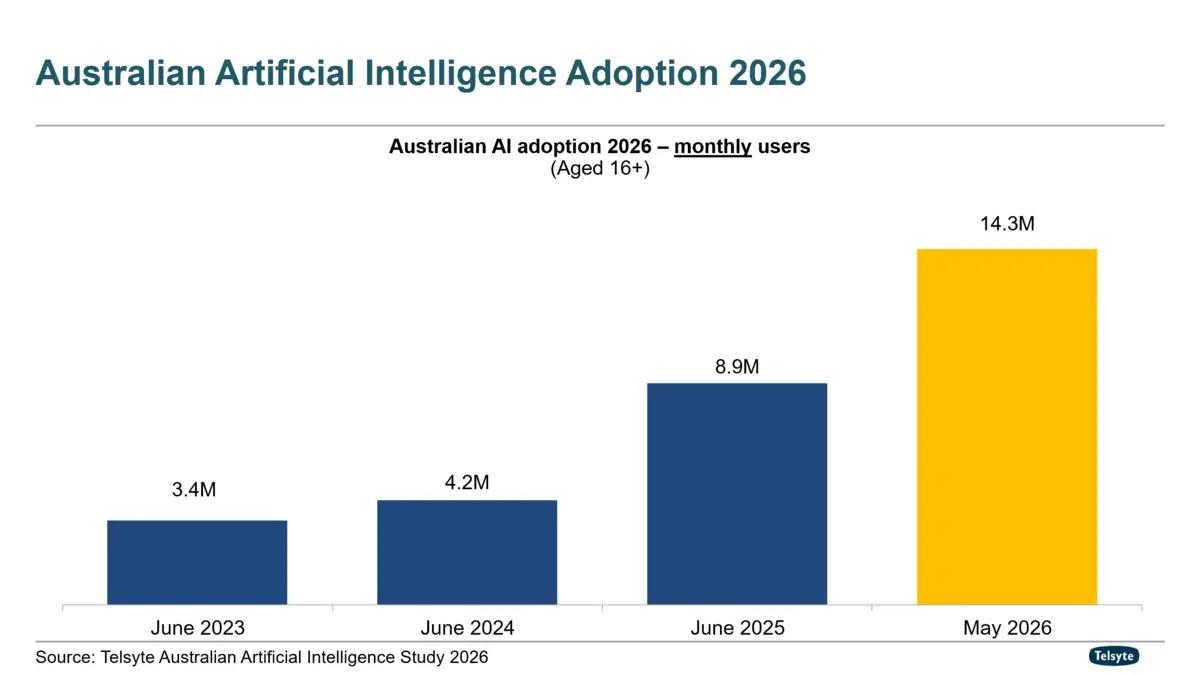
The national AI user base grew by more than 6 million over the past year to 77% of Australians aged 16 and over. Some 14.3 million people now use AI at least once a month, while 5.2 million use it every day.
Engagement has also intensified. More than a third of users say they are using AI significantly more than a year ago, and 48% say they have become more proficient with AI tools over the same period.
Usage remains concentrated among a handful of brands, though the market is broadening. ChatGPT is the most widely used service, with 13.8 million users, followed by Google Gemini on 9.1 million, Meta AI on 5.6 million and Microsoft Copilot on 5.4 million.
The next tier includes Apple Intelligence with 3.9 million users, Samsung Galaxy AI with 3.1 million, Claude with 2.9 million, Canva AI with 2.8 million, Grok with 2.5 million and CapCut with 2.4 million. More than one in five AI users now use five or more services, and that share is nearly twice as high among daily users.
Trust gap
Rising adoption is running alongside unease about the pace of change and the handling of personal data. Telsyte found 62% of Australians feel technology is changing faster than they can keep up with, while only 35% trust technology companies to use their data responsibly.
Those concerns are becoming more important as AI groups look for ways to monetise large free user bases. Most users remain on free tiers, and advertising is emerging as one revenue route, with OpenAI already testing ads within ChatGPT in Australia and the United States.
Consumers appear open to ad-funded access in principle, but less willing to accept advertising inside AI responses. Telsyte found 70% would choose a free, ad-supported service over a paid, ad-free alternative, yet only 27% are comfortable seeing ads within AI-generated answers. More than half, or 52%, say sponsored AI answers are less trustworthy than organic responses.
Foad Fadaghi, Principal Analyst at Telsyte, addressed that tension directly: "If it erodes confidence in AI-generated answers, it cuts against the fundamental value proposition. That is a difficult trade-off to walk back."
Search shift
The data also points to changing online search habits. Twelve per cent of Australians now identify AI tools as their main way of finding information online, up from 5% a year earlier.
Awareness of AI-generated search summaries is already widespread. Telsyte found 81% of people know such summaries appear in search results, and half say they would often rely on the summary without clicking through to the original source.
That shift has implications for publishers, advertisers and search providers as users spend less time moving from search pages to websites. For retailers and eCommerce groups, the findings suggest content may increasingly need to be structured for machine-led discovery as AI agents play a bigger role in product comparison and purchasing.
Devices and agents
Smartphones remain the main access point for AI, used by 78% of AI users, compared with 58% on computers.
Built-in tools such as writing assistance, live translation and photo editing have helped make AI a routine part of smartphone use. Computers still hold an advantage for more complex work, including coding, broader workflows and locally run AI agents.
AI is also moving beyond responding to prompts. More than a quarter, or 27%, of Australian AI users say they have already used AI to complete tasks on their behalf, including product comparisons, inbox management, scheduling and online shopping.
Even so, comfort with deeper delegation remains limited. Only 31% say they are comfortable with AI taking on a larger role in managing everyday activities. Nearly two in five, or 39%, say they would allow AI to complete tasks if they approve the final step, rising to 66% among daily users.
Privacy, account security and concerns about mistakes are the main barriers to giving AI more autonomy. Australians are most comfortable granting AI access to calendar data at 32%, location at 26% and email at 24%, while more sensitive areas such as cloud storage, personal notes and payment methods all score below 12%.
Work and income
The study also links AI use to a growing gig and sharing economy. Telsyte says that market has expanded by 65% since 2024 to nearly 8 million Australians, at a time when 58% of people say they feel more financially stretched than a year ago.
AI use is particularly high in that segment. Three quarters of gig and independent workers use AI tools at least weekly, above the 66% average across the broader AI user population, and 61% say AI has enabled them to accomplish tasks that were previously beyond their reach.
Two-thirds of gig workers still regard these earnings as supplementary rather than primary income. Alvin Lee, Senior Analyst at Telsyte, said: "Despite the anticipation around AI-native hardware, existing form factors like smartphones and wearables are where mass AI adoption will happen."