

Carbonix wins drone certification for Surat Basin ops
Mon, 6th Jul 2026
Carbonix has secured Safety Assurance Integrity Level III certification for its long-range autonomous fixed-wing drone platform from Australia's Civil Aviation Safety Authority.
The certification is a regulatory milestone for beyond visual line of sight drone operations. It also marks a shift away from approving complex flights one mission at a time.
The approval covers more than the aircraft itself. The assessment also recognised Carbonix's software, avionics, communications architecture, manufacturing systems, maintenance procedures and operational setup.
That broader scope matters because long-range drone operations in Australia have often faced a fragmented approval process. Operators have typically needed regulators to assess individual missions, limiting repeatable commercial use across large areas.
Following the certification, Carbonix received approval to operate across Queensland's Surat Basin. The company described the operational area as roughly the size of Belgium and said the work will focus on inspecting gas gathering and pipeline networks for major energy companies.
Industrial use
Carbonix is targeting sectors that need to monitor large, often remote assets. These include bushfire detection, electricity transmission inspection, gas pipeline monitoring, mining operations, disaster response, environmental monitoring and remote surveying.
The company argues that autonomous aircraft can reduce the need for helicopters, light aircraft and ground crews for some of those tasks. For industry, the appeal is lower fuel use, fewer people exposed to hazardous work and more frequent data collection over long distances.
Dario Valenza, Founder and Chief Executive Officer of Carbonix, said the approval reflects coordination between the company and the regulator.
"Australia has developed some of the world's most advanced drone technology and this milestone shows what can be achieved when industry and regulators work closely together," said Valenza, Founder and Chief Executive Officer of Carbonix.
"It creates an important pathway towards safe, scalable autonomous aviation operations in Australia," he said.
Design roots
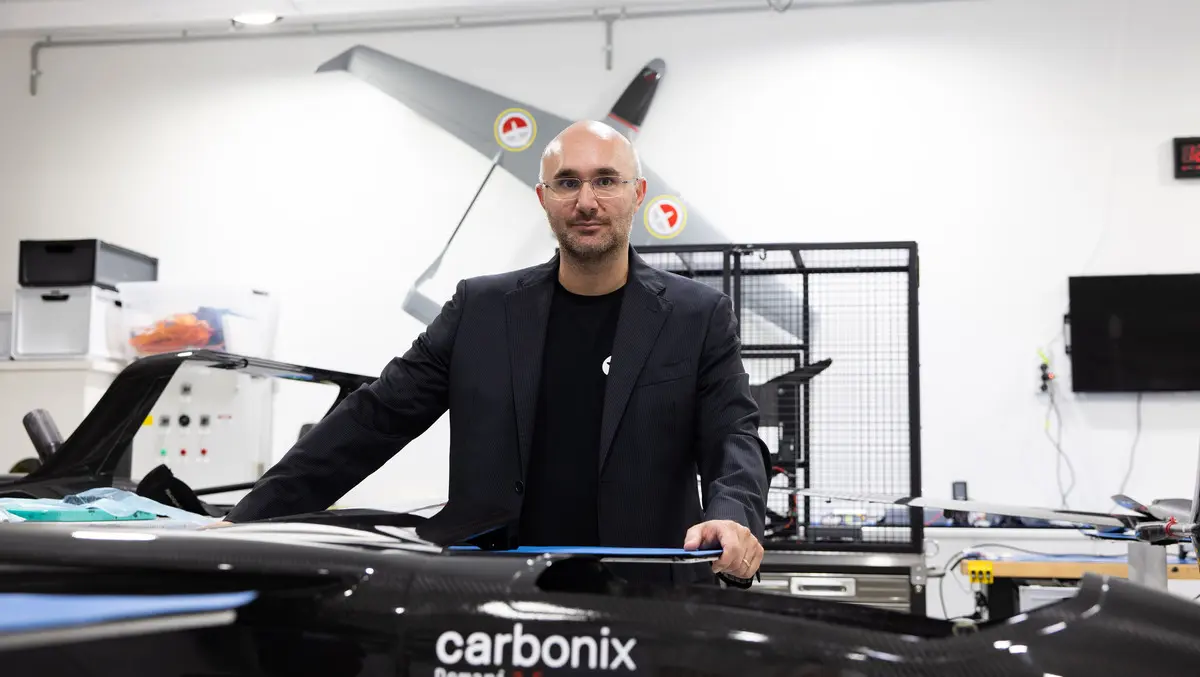
Carbonix was founded in Sydney by Valenza, a former America's Cup engineer. The business uses composite engineering methods first developed in elite yacht racing to build lightweight aircraft for long-endurance operations.
Its aircraft use a fixed-wing vertical take-off and landing design, allowing them to launch and recover like a helicopter while flying with the endurance and efficiency associated with fixed-wing platforms. Carbonix said the drones can travel hundreds of kilometres in a single mission.
The aircraft can carry a range of payloads, including LiDAR, photogrammetry systems, multi-spectral sensors, ISR payloads and high-resolution imaging systems. The platforms also use redundant Starlink-enabled communications for operations beyond conventional radio range in remote parts of Australia.
The approval comes as Australia builds a reputation as a test ground for autonomous aviation, supported by long distances between assets, demand from remote industries and a regulatory system that has worked with operators on new categories of flight.
For infrastructure operators, the Surat Basin approval offers an early example of how that framework could be used at industrial scale. Gas and pipeline networks cover vast tracts of land, and inspection by crewed aircraft or ground teams can be expensive and difficult to schedule.
Valenza said the shift to autonomous aircraft has practical safety and efficiency implications for those customers.
"Replacing crewed aircraft with long-range autonomous drones significantly improves safety, reduces fuel burn and delivers faster, higher-quality data for infrastructure operators," said Valenza.
Carbonix is now working towards Safety Assurance Integrity Level IV certification, which would allow operations in more complex airspace and expand the potential use of autonomous aircraft across critical infrastructure, emergency services and defence.