

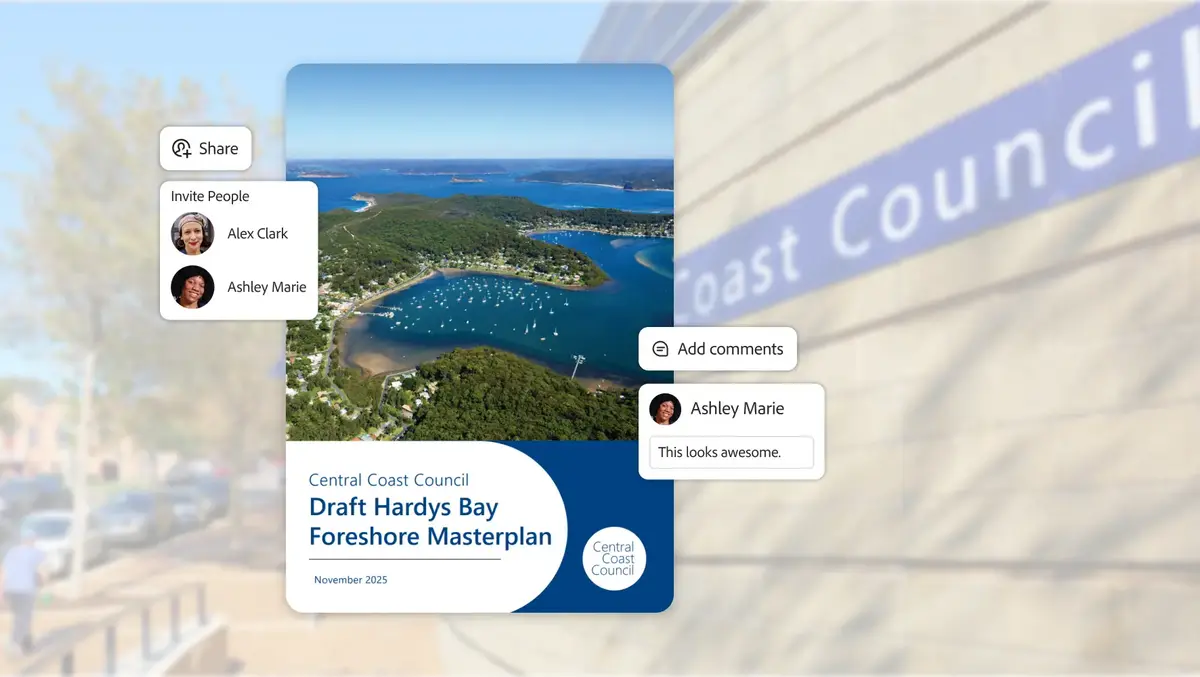
Central Coast Council adopts Adobe tools in digital overhaul
Wed, 26th Aug 2026
Central Coast Council has adopted Adobe's document and e-signature software as part of a broader digital transformation program, as it works to modernise operations after a period under administration.
The New South Wales local authority is rolling out Adobe Acrobat, Acrobat Sign and Acrobat AI Assistant across parts of the organisation to replace paper-based processes, strengthen the handling of sensitive information and reduce the number of software applications staff use.
Central Coast Council's remit is unusually broad. It is responsible for most of the region's roads, as well as water and sewer services, parks, rubbish collection and emergency management, while planning for population growth in one of Australia's largest urban areas.
The technology changes are being shaped by strategic priorities including internal efficiency, privacy compliance and the experience of residents using council services. Population projections cited by the authority show growth of 23% by 2036, with resident numbers expected to exceed 400,000 by 2041.
That backdrop has increased pressure to simplify internal workflows and prepare more services for online delivery. The authority emerged from a financial crisis in 2024 after four years under administration and has since placed greater emphasis on modernisation and operational discipline.
Document processes
One of the first areas targeted was document management. Many tasks relied on manual, paper-heavy processes that were slow and prone to error, particularly when documents moved between teams or required multiple approvals.
Adobe's tools are being connected with systems staff already use, including Microsoft 365, the council's enterprise resource planning software and, in time, TechnologyOne. The aim is to let employees manage files and approvals within existing applications rather than switching between separate tools.
Information handling was also a major factor in the rollout. As a public body, the council regularly manages personally identifiable information, legal agreements and documents that may later be disclosed under Freedom of Information processes.
Acrobat's redaction functions are being used to remove sensitive information from files before they are shared online or released externally. For councils, where privacy obligations sit alongside public access requirements, that work can be labour-intensive if done manually.
E-signatures
The authority has begun with two e-signature use cases. One is employee onboarding, where new hires previously received physical contracts that had to be signed and returned manually.
With Acrobat Sign, contracts can now be sent, signed and returned electronically from any device. The council expects this to shorten turnaround times and simplify the early stages of employment administration.
The second use case involves formal council business requiring multiple councillor signatures, including rescission motions and extraordinary meeting requests. These steps involved circulating physical documents between councillors, a process that could take hours.
Digital routing now allows those documents to be signed in minutes. For a council managing frequent approvals across elected members and staff, the change could remove delays from procedural matters that depend on timely sign-off.
Resident services
The technology program also extends beyond internal administration. Central Coast Council is working to digitise services used by businesses and residents, including permit and development application forms.
Under the plan, residents will be able to complete fillable forms online instead of relying on paper documents or in-person visits. The council is also updating its website, with accessibility and processing speed among the intended improvements.
Automated workflows linked to Adobe's signing tools are expected to reduce the time needed to process applications and approvals. That matters for residents and businesses dealing with planning, licensing and other local government requests that often involve multiple stages of review.
Training rollout
Alongside the software deployment, the council is putting staff training in place. It is rolling out Acrobat AI Assistant licences in phases, identifying user groups for targeted support and developing an internal "change champion" model to help drive adoption.
The AI Assistant is being assessed both as a document support tool and as a way to help employees understand features already available in the Adobe software. The council also cited the tool's closed ecosystem as an important factor in its decision-making.
Training is expected to focus on practical tasks such as formatting, document management and workflow changes rather than broad theory. Strategic staff members will act as mentors to colleagues as the software is introduced more widely across the organisation.
After reviewing its roadmap and organisational objectives, the council concluded Adobe offered stronger overall value than alternative options and was a better fit for its existing systems and operating model.