


DroneShield update boosts counter-drone detection & tracking
Wed, 14th Oct 2026 (Today)
DroneShield has released a quarterly software update for its counter-drone systems, delivering it to more than 4,200 deployed devices through its Mission Ready Services subscription.
The update covers detection, identification, tracking and electronic disruption, with a focus on identifying unfamiliar drone signals and improving the accuracy of existing sensors. It works with compatible equipment already in the field and does not require new hardware.
One of the main changes affects RfRecon, the firm's radio-frequency sensing system. It can now flag signals that behave like drones even if they are not yet in DroneShield's threat library, then send them to the DroneSentry-C2 dashboard for operator review.
This is intended to give users earlier warning of modified or previously unseen drones that might otherwise go unnoticed until they are catalogued. Operators can also filter records by frequency range when reviewing those detections.
DroneShield also reported gains in classification and detection accuracy across several sensing modes. Thermal camera classification accuracy has improved by 44%, while fixed-wing drone identification has improved by 18% in precision and 8% in recall. The company also said target detection in standard video has improved, though it did not provide a percentage figure.
Passive tracking
Another part of the release links radio sensing with optical cameras to allow visual confirmation of a drone without using radar. This enables a passive approach that does not emit signals that could disclose an operator's position.
With compatible Bosch Starlight cameras, the system can direct a camera to search along the bearing of a radio detection, then lock on to the drone and track it. This allows operators to confirm a target through camera footage after it has first been identified through radio-frequency sensing.
Coordinated response
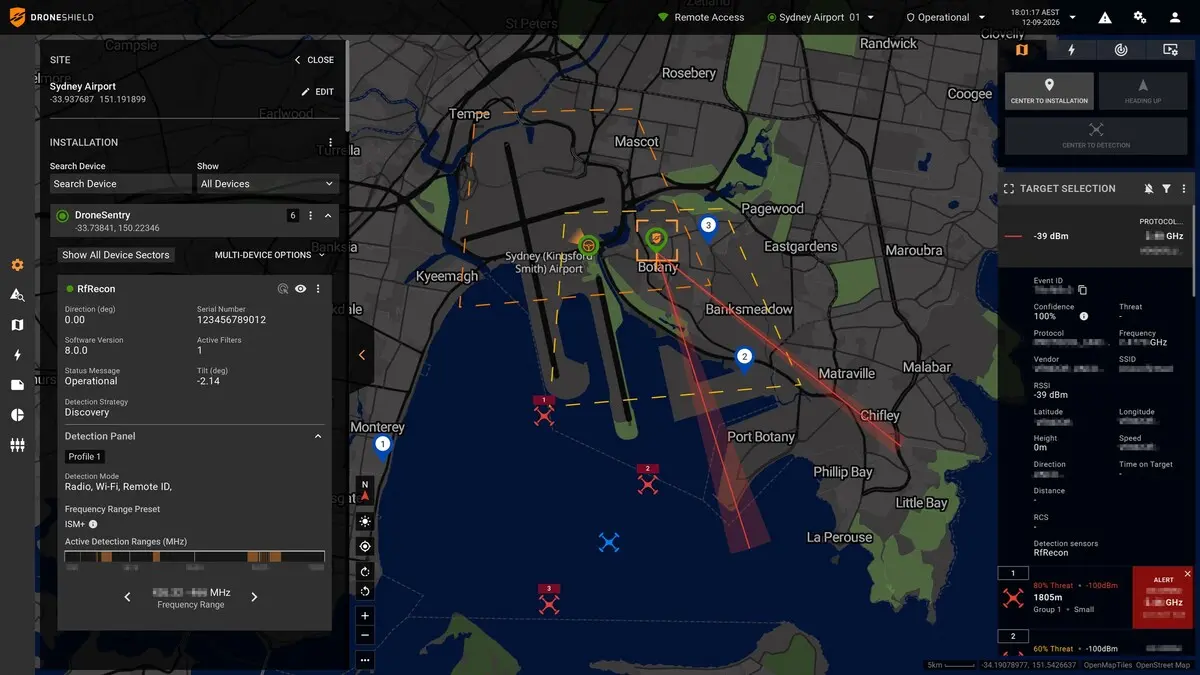
The update also changes how DroneSentry-X Mk2 units work together. When one unit detects a threat, that information can now be shared with connected DroneSentry-X Mk2 units so several systems can respond to the same drone.
The jamming response can also be narrowed to the frequencies a particular drone is able to use. This is designed to focus disruption on the target while reducing interference with nearby systems.
Other elements of the release include a simplified setup process, changes to the user interface and connectivity configuration, and compatibility with Sentrycs firmware 6.7.1 for layered deployments. The software package is available through Mission Ready Services, which provides updates across installed systems.
The release comes as counter-drone suppliers face pressure to keep pace with fast-changing drone designs and signal patterns. That has created a challenge for systems that rely heavily on known threat libraries, because new or modified drones may not match existing signatures.
DroneShield said the latest update is intended to narrow that gap by allowing operators to spot suspicious signals based on behaviour rather than requiring a direct match with a known library entry. That approach sits alongside efforts to reduce false alarms and improve the reliability of sensor outputs across radio, thermal and video feeds.
Angus Bean, Chief Executive Officer, DroneShield, said the update reflects the need for counter-drone systems to remain effective after deployment. "Drone threats change constantly, and counter-drone capability has to keep pace long after it is deployed," Bean said.
He added that the software package is intended to improve response without requiring customers to replace equipment already in use. "Through Mission Ready Services, this release gives operators better information and a more focused response, delivered as an update to systems already in the field," Bean said.