

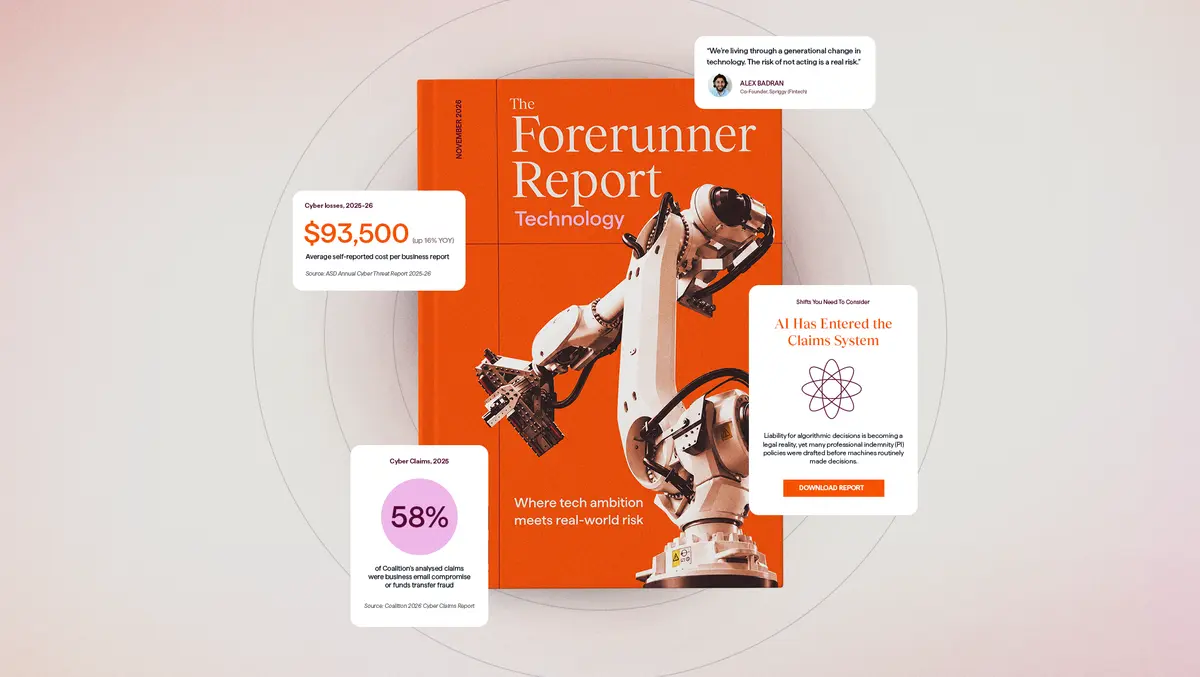

Knightcorp has launched its Forerunner Report - Technology, which examines insurance issues linked to AI, cyber risk, cloud exposure, directors' liability and connected devices.
The research argues that insurance reviews are struggling to keep pace with how technology businesses now operate, particularly when companies rely on AI tools, cloud infrastructure and third-party software platforms. It presents insurance less as an annual procurement exercise and more as part of broader risk governance for finance leaders, boards and technology teams.
One of the report's central findings is that policy wording may not clearly address AI-related claims. Some professional indemnity and cyber policies are silent on AI, Knightcorp said, which could leave room for disputes over whether cover applies when businesses either build AI into their own products or use AI embedded in third-party platforms.
The report also points to movement in the market. Citing Lander & Rogers, it says AI exclusions are appearing in some policy wordings, adding to pressure on companies to check whether their existing insurance arrangements match their use of the technology.
Cloud scrutiny
The report also raises the treatment of cloud and vendor platforms in cyber cover. Undeclared systems, or systems that do not fit a policy's wording, can become a point of dispute during claims, Knightcorp said. It suggests businesses start by mapping third-party systems that handle client data, then test how each one is treated in policy applications and wording.
The report applies the same logic to connected hardware. It says companies that make or supply smart devices should check whether new mandatory security standards apply to them, including rules banning universal default passwords on in-scope consumer devices manufactured after a specified threshold. It adds that undeclared connected devices may affect how insurers assess a claim.
Board exposure
Governance and disclosure risks form another section of the research. Knightcorp highlights recent action by the Australian Securities and Investments Commission over misleading sustainability claims, noting that penalties in greenwashing cases involving Mercer Superannuation and Vanguard Investments fell on the companies involved.
That focus on sustainability disclosure raises wider questions for boards about how they substantiate public governance statements, the report says. It advises organisations to examine how directors' and officers' cover would respond if directors were drawn into proceedings, whether that insurance sits in a standalone policy or within management liability cover.
Regulatory change is another factor. The report notes that organisations covered by the Privacy Act that use automated decision-making in certain ways will need to disclose that use in their privacy policies. It also refers to a Federal Court development in the Medibank matter, where Deloitte reports prepared after the cyber incident were found not to be protected by legal professional privilege, underlining the importance of how post-incident reviews are commissioned.
Trent Brown, Chief Executive Officer of Knightcorp, said the issue for companies is whether insurance arrangements still reflect the pace of change inside technology businesses.
"The question is no longer simply 'Are we insured?' It is 'Do our risk and insurance arrangements still reflect the business we have become?' In technology, a business can change faster than the systems around it," Brown said.
Brown said that uncertainty is most likely to surface in policy interpretation and claims handling, particularly once an incident has already occurred.
"Where a policy is silent on AI, the outcome is uncertain and coverage can be disputed. We encourage technology leaders to ask how their cover treats AI they build versus AI they buy, because the answer can differ," said Justin Geldart, Account Director at Knightcorp.
Claims outcomes often turn on what was disclosed to insurers at the outset and how the policy defines the underlying risk, Knightcorp said. That makes the accuracy of applications and schedules an important issue for businesses with complex and fast-changing software stacks.
"Claims tend to be tested on what was declared and how the policy defines it. For a technology business, the practical question is whether your wording and your application reflect the platforms your business actually relies on," said Jessica Tanner, Key Account Manager, Technology, at Knightcorp.
The report includes several tools intended to help organisations assess that question, including a matrix of exposures, a broker checklist for AI risk, examples of where claims uncertainty can begin, and an 11-question insurance readiness checklist. It also features a client endorsement from Spriggy Co-Founder Alex Badran: "Before working with Knightcorp, it felt like we were trying to piece together off-the-shelf solutions from different providers. Knightcorp spent the time to understand our unique needs and built insurance solutions to fit our business."