

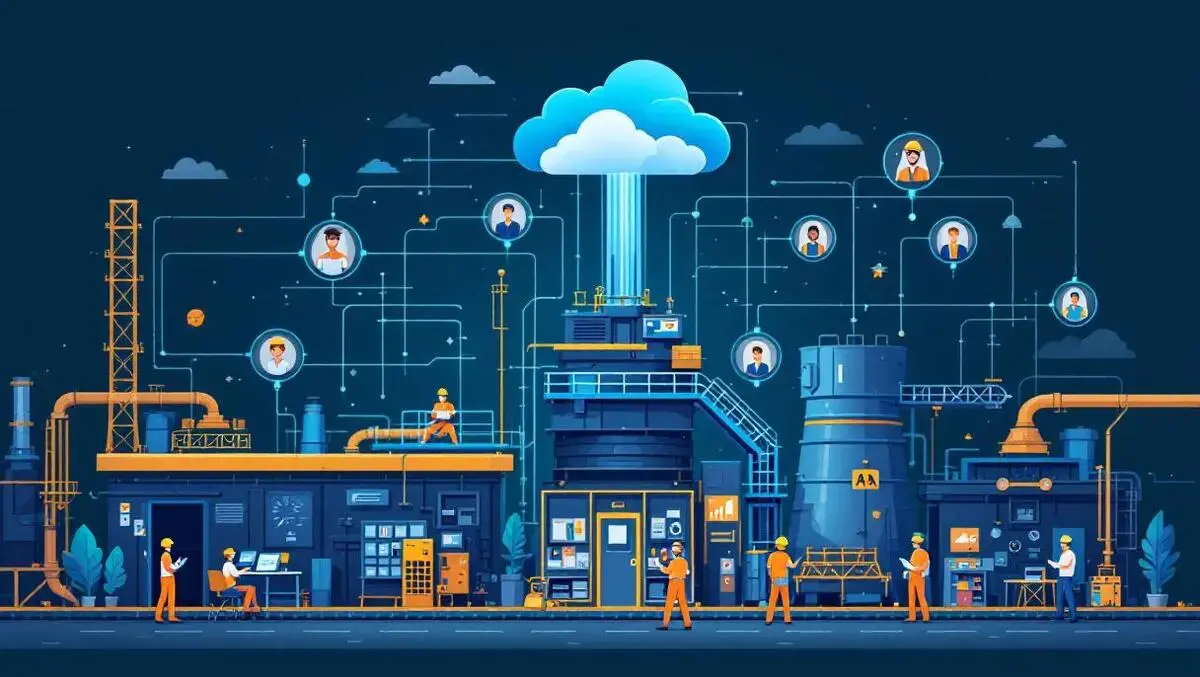
Tata Steel expands Google Cloud AI across global operations
Thu, 23rd Apr 2026
Tata Steel has expanded its strategic partnership with Google Cloud to deploy an enterprise-wide agentic AI system across its global value chain. More than 300 AI agents have been deployed in nine months.
The rollout spans manufacturing, back-office processes, customer service and internal support functions as Tata Steel pushes ahead with a broader digital overhaul. Built on Google Cloud's technology stack, the system is designed to connect operational data, internal business systems and user-held information within a single framework.
At the centre of the programme are two internal platforms. Zen AI is a low-code system that lets software developers and frontline managers build, test and deploy AI agents without needing to be data scientists. The other, the Tata Steel Digital Assistant, or TDA, is an internal portal that brings together data from public sources, enterprise systems and proprietary user files, including call recordings, spreadsheets and PDFs.
The aim is to move away from isolated digital tools and use decades of operational data more directly in day-to-day decision-making. The setup uses BigQuery, Google Cloud Storage and Google Cloud's Agent Development Kit.
Internal operations are one of the first areas of use. TDA now helps Tata Steel's HR helpdesk resolve more than 70% of routine employee tickets autonomously, cutting time spent on administrative requests across teams.
Business process agents are also being used in finance and procurement. These cover invoice processing, goods and services tax creditable and non-creditable classifications, and contract analysis, all typically manual and time-consuming tasks in large industrial organisations.
Shop Floor Use
The deployment also extends to manufacturing sites, where AI agents monitor safety and equipment performance. A system called Safety EyeQ analyses live video feeds in high-risk zones to check compliance with standard operating procedures and identify hazards, such as heavy equipment moving near hot materials.
Another set of agents, known as Asset Sphere, evaluates equipment health and helps plan maintenance before breakdowns occur. This is intended to reduce unplanned downtime across operations.
Customer service is another part of the rollout. AI agents are being used to analyse complaint material, detect complaint intent and defects from images, and route cases to the correct resolver groups. Tata Steel said this has reduced average turnaround time by 50%.
The infrastructure underpinning the system runs on Google Cloud Run, allowing workloads to scale up during peaks in demand and scale back when idle. Tata Steel also has access to more than 200 models on Google Cloud's AI Agent Platform, which it uses to match different models to different tasks while maintaining governance controls.
Data Strategy
The partnership reflects a wider trend among large industrial groups to link AI initiatives to consolidated data platforms rather than deploy standalone tools in individual departments. For manufacturers, this often means combining operational records, maintenance data, supply chain information and internal documents to support automation and analysis across multiple functions.
In Tata Steel's case, the system also pulls in external data such as global news, geopolitical sentiment and commodity price information. This allows AI agents to support predictive market intelligence and help staff respond to shifts in supply chains and market conditions.
Jayanta Banerjee, Chief Information Officer at Tata Steel, described the project as a move from experimentation to wider operational use. “Working with Google Cloud has allowed us to turn AI from a technical experiment into a specialised partner for every employee. This isn't just about new tools; it's about a continuous engine of execution that enables our people to act on insights instantly. From predicting asset maintenance to reducing customer response times, we are using agentic AI to simplify the most complex parts of our business and drive execution at an entirely new scale,” Banerjee said.
Google Cloud presented the Tata Steel rollout as an example of how industrial companies can use unified data systems as the basis for large-scale AI deployment. “While many industrial players are still navigating the complexities of digital transformation, Tata Steel has moved at unprecedented speed to deploy AI at a scale few in the industry have achieved. Their success demonstrates what is possible when an organisation anchors its strategy in a unified AI and data ecosystem. By creating a new blueprint for autonomous business processes at scale, Tata Steel has demonstrated that the synergy between a unified data cloud and generative AI is the key to turning industrial complexity into a distinct, data-driven competitive edge,” said Sreedharan.