

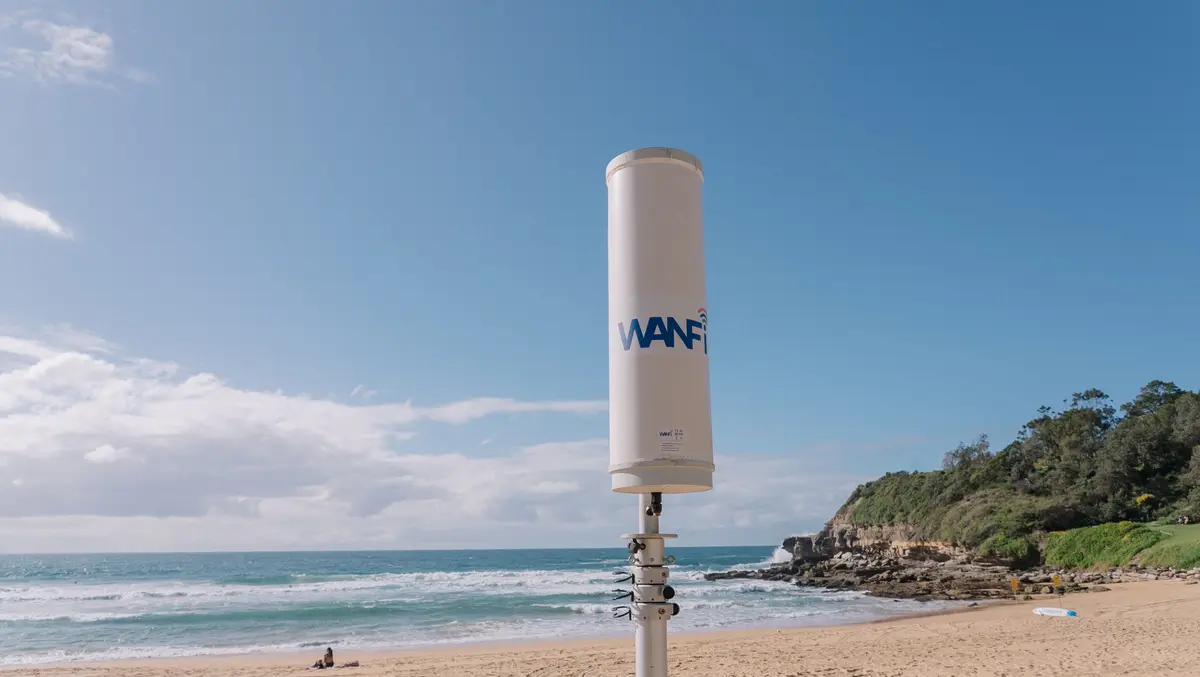
WANFi launches long-range Wi-Fi system for remote Australia
Tue, 24th Nov 2026 (Today)
WANFi has launched its W600Pro long-range Wi-Fi system in Australia. The product grew out of research at the University of Sydney and the University of Technology Sydney.
The system is designed to extend wireless coverage across large outdoor areas, including farms, industrial sites and remote communities. A single W600Pro access point can cover up to 1.8 kilometres, while multiple units can be linked in a mesh network to extend coverage further.
The technology works with standard Wi-Fi devices, including smartphones, laptops, tablets and connected equipment. The access points can be installed quickly and use existing internet services such as satellite, cellular or fibre connections for backhaul.
Research roots
According to WANFi, the product combines a patented Wi-Fi protocol with antenna design developed through university research. It is intended to address the limits of conventional Wi-Fi, which is typically used over shorter distances in homes, offices and buildings.
Each access point provides 180-degree coverage. Two units mounted back-to-back can provide 360-degree coverage, and each node supports more than 200 concurrent terminals.
“Because it requires minimal infrastructure, this plug-and-play technology can be deployed in minutes and is simple to use, even for people with limited technical knowledge. It is compatible with existing Wi-Fi devices, including Wi-Fi 6 devices, and can support hundreds of users simultaneously,” said Peiyuan Qin, Co-Director, WANFi Technology.
Farm deployment
WANFi pointed to a deployment at Narrabri Farm in north-west New South Wales as an example of how the system is being used in agriculture. The mixed cropping and grazing property had limited connectivity because of its size, open paddocks and areas with little or no mobile reception.
At the site, five access points were used to create a mesh network across about 15 square kilometres. A single Starlink connection provides internet backhaul, while the WANFi access points distribute the connection across the property and to a neighbouring site.
The network is being used to connect working areas, sheds, cameras and other devices across parts of the farm that were previously unconnected. The setup supports monitoring of livestock, crops and perimeters, and could also be used for machinery telemetry, soil and weather sensors, asset tracking and autonomous equipment.
“WANFi has delivered a high-quality connectivity solution that has transformed how we operate at Narrabri Farm. Coverage is strong and consistent across the entire property, and the system has proven extremely reliable-even under challenging weather conditions. Since commissioning, we have experienced zero unexpected downtime. This network has enabled us to connect devices and equipment across areas that previously had no service, supporting our transition toward more advanced, data-driven farming practices,” said Kieran Shephard, Farm Manager, Narrabri Farm.
Wider uses
Beyond agriculture, WANFi sees applications in mining, construction, infrastructure, utilities, logistics and emergency response. It says the technology could also help regional and remote communities extend wireless connectivity across buildings and shared facilities from a central internet connection.
That reflects a broader challenge in Australia, where distance and sparse infrastructure can make network deployment costly. In many remote settings, extending coverage has traditionally required multiple access points, cabling and other equipment.
WANFi says its mesh design allows organisations to expand coverage gradually as needs change. The system can also be used where existing communications infrastructure is unavailable or damaged, provided suitable backhaul and power are available.
Commercial step
The launch marks a commercial step for technology that began in academic research. WANFi says the rollout shows how work from Australian universities can move into operational use across sectors including agriculture, industry and regional connectivity.
One of the company's founders described the product as a response to a persistent coverage gap. “Around 67 per cent of Australia's landmass has no Wi-Fi coverage. Our technology offers a new way to address this connectivity gap, which affects critical industries, services and communities across Australia,” said Yonghui Li, Co-Director, WANFi Technology.