

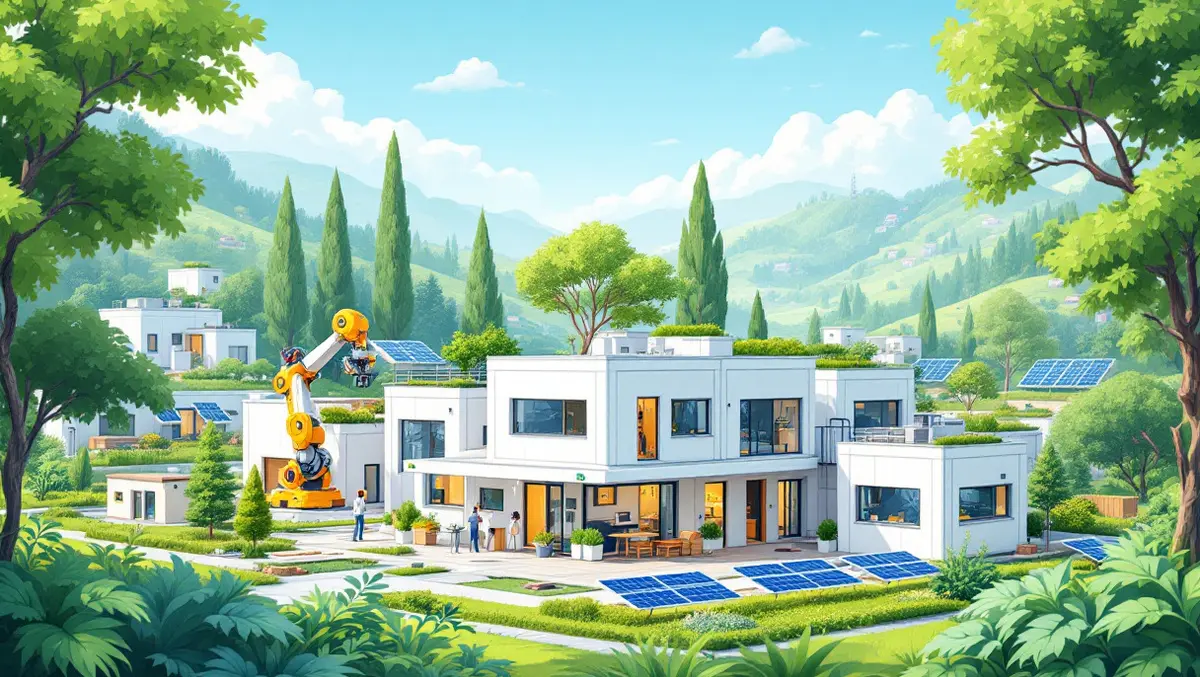
ADMARES uses Siemens Xcelerator to drive smart, green homes
Wed, 24th Sep 2025
ADMARES is incorporating Siemens Xcelerator to transform the production and delivery of sustainable and affordable housing using digital twin, automation and advanced manufacturing technology.
Industrialised housing
Founded in 2016, ADMARES specialises in the application of advanced manufacturing methods for constructing affordable, smart, and connected homes. The company is leveraging Siemens Xcelerator, an open digital business platform, to further digitalise and industrialise its homebuilding processes.
ADMARES aims to address the global affordable housing challenge by utilising a flexible, modular design and an automated greenfield smart factory that can significantly reduce both emissions and waste associated with traditional residential construction. By using this approach, ADMARES projects the elimination of up to 75% of carbon dioxide emissions and a reduction of 80% in material waste in housing production.
Automated manufacturing
Mikael Hedberg, Chief Executive Officer of ADMARES, explained the advantages of this approach:
"Siemens' technology has enabled us to make affordable homes a product, rather than a process reliant on construction labor - of which there is a global shortage. When homes become productized, industrialized and digitalized, we're able to fully automate the manufacturing process and deliver homes the world so desperately needs at the affordable cost, scale and speed it needs."
Using Siemens' technology, the manufacturing process becomes highly automated, reducing dependence on manual labour and allowing for quicker and consistent delivery of completed homes. The smart factory model supports this strategy, with an operational takt time of 22.5 minutes per building unit. This enables the factory to produce a 1,400 square foot home in 45 minutes, including built-in software for real-time monitoring of energy, water, and air quality.
Enabling new business models
Siemens Digital Industries has supported ADMARES in its utilisation of Siemens Xcelerator, specifically the Designcenter, Teamcenter, and Simcenter software, which are used to design, validate, and refine modular housing units. These tools contribute to the creation of a comprehensive digital twin that not only models the end product but also contains process data relevant for production line optimisation at the smart factory.
Eryn Devola, Head of Sustainability at Siemens Digital Industries, commented:
"The work that ADMARES is doing is a compelling example of how Siemens technology enables entirely new business models to emerge. Building on the Siemens Xcelerator portfolio, ADMARES has transformed housing from a traditional construction process into a scalable, digitalized product. Our digital twin, automation and manufacturing technologies have empowered them to industrialize homebuilding – cutting emissions, reducing waste, and accelerating delivery. This is the kind of industry reinvention Siemens Xcelerator was designed to make possible."
Smart, connected homes
All homes produced in the new ADMARES smart factory are delivered as fully connected smart homes. These units are equipped with building software that enables real-time monitoring of key environmental parameters, such as energy consumption, water usage, and indoor air quality.
This approach to home construction is intended to be scalable and responsive to the growing demand for affordable housing in various markets. By shifting the focus from site-built construction to a product-based, modular approach, ADMARES and Siemens aim to offer a solution to address shortages in construction labour whilst improving quality and sustainability outcomes.
The collaboration highlights a shift within the construction industry as manufacturers integrate digital and automated processes to reduce their environmental impact and become less reliant on traditional construction methods. The use of digital twins and manufacturing automation is anticipated to have further applications in the industry as companies seek to address housing demands within environmental limits.