

Australian farms test AI assistant to cut paperwork
Mon, 12th Oct 2026 (Today).webp)
Regen Farmers Mutual is piloting its Farm Assistant artificial intelligence tool on 20 Australian farms. The trial comes as official data shows agriculture, forestry and fishing has one of the country's lowest rates of AI use.
More than 40 farms are waiting to join the programme, the farmer-owned co-operative said. Producers across the country are testing the tool in weekly sessions described as an "AI gym", using it for practical administrative tasks and helping shape its development.
The trial comes against a backdrop of low AI adoption in Australian farming. Figures cited by Regen Farmers Mutual show AI use in agriculture, forestry and fishing at 3%, compared with a 12% national average across industries.
International comparisons suggest a different trend overseas. Research across 10 countries found 17% of farmers surveyed now use generative AI for farm-related tasks, indicating agriculture elsewhere is integrating the technology more quickly.
Andrew Ward, Co-Director at Regen Farmers Mutual, said the issue was not resistance to technology but a mismatch between available software and the day-to-day work of a farm.
"Low AI uptake shouldn't be mistaken for farmers being reluctant to embrace technology. Australian farmers have been using GPS, automated machinery, sensors and remote monitoring for years," Ward said.
He said many current AI products do not address the work farmers most want reduced.
"The problem is that a lot of the conversation around AI has very little to do with the problems farmers need solved. They don't need AI to tell them how to farm. They know their land, livestock, crops and seasons. What they do need is a way to cut down the hours spent at night entering information into different systems and doing paperwork," Ward said.
Farm Assistant is designed to ease that administrative burden. Farmers can record work using voice notes, photographs or text while in the paddock, on machinery or in livestock yards. The system then updates records and prepares associated documentation, removing the need to enter the same information again later.
One example is livestock treatment. A farmer can tell the assistant what has been done, and the system can update treatment records, adjust inventory and prepare related paperwork.
The software is also intended to reflect the language already used on a property. It can learn paddock names, livestock group labels and farm staff shorthand rather than forcing users to adopt a standard naming system.
"If you've called a paddock 'The Back Forty' for 30 years, you shouldn't have to rename it because you've bought some new software," Ward said.
"The technology needs to adapt to the farmer, not the other way around," he said.
Farm Assistant is designed to work alongside existing sources of farm and business information, including farm management software, weather information, machinery systems, sensors and commodity data.
On-farm use
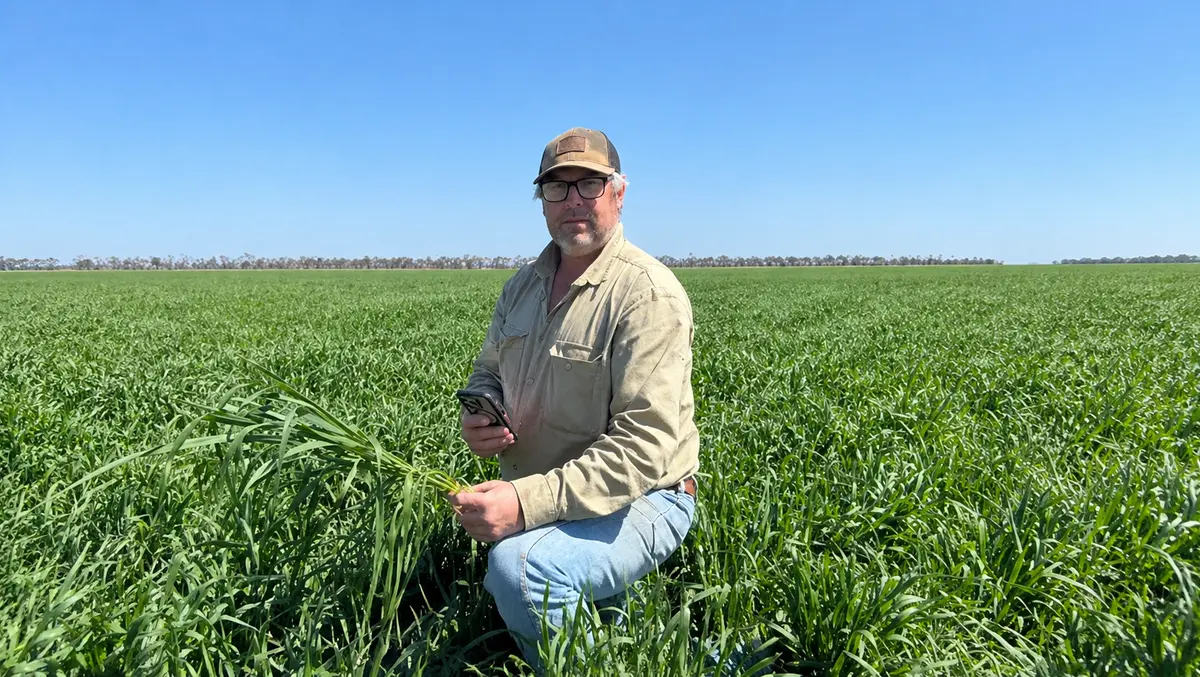
Among the farmers testing the tool is Andrew Gill, a cotton, beef and sheep producer in the Central West of New South Wales. According to Regen Farmers Mutual, Gill has used the system to work with farm data that had previously been harder to bring together, including mapping sheep movements to paddocks and comparing that with satellite imagery to estimate remaining feed in real time.
The co-operative says examples like this are emerging from routine work rather than specialist tasks. Christophe Bur, also a Co-Director and a cattle farmer, said repetitive processes make up much of farm work.
"Farming involves an enormous number of repetitive processes. Spraying, sowing, fertilising, harvesting, moving stock, keeping records, reconciling accounts and meeting compliance requirements happen again and again," Bur said.
"The opportunity isn't to replace the farmer's judgement. It's to stop valuable information disappearing into notebooks, different systems or someone's memory, and to reduce the time farmers spend entering the same information more than once," he said.
Bur said the issue affects household routines as much as farm productivity, with office work often starting only after field work ends.
"For a lot of farming families, paperwork happens after the day's actual farming is finished. If AI means someone gets through the gate at the end of the day and has dinner with their family instead of sitting at the computer for another two hours, that's technology solving a real problem," Bur said.
Regen Farmers Mutual was founded by Ward and Rohan Clarke. The co-operative said Farm Assistant has been built around the systems, terminology and working practices of individual farms rather than a fixed template.