

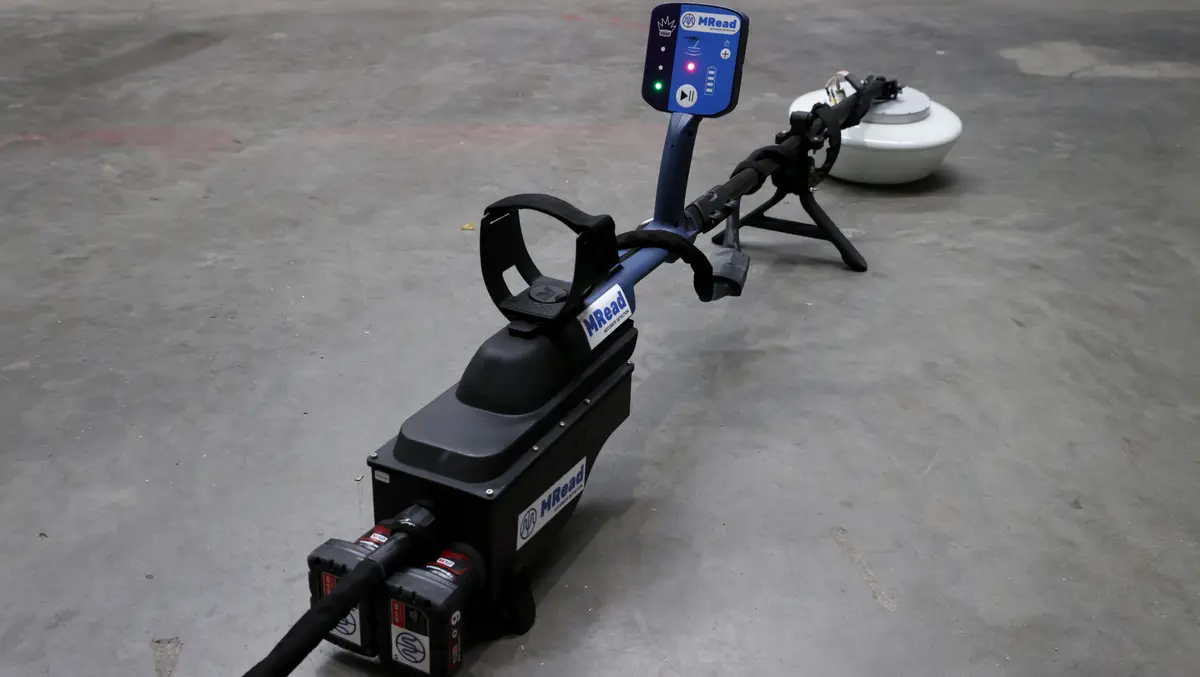

MRead has won the Breakthrough Innovation Award at the 2026 Mine Action Innovation Awards, presented by the Geneva International Centre for Humanitarian Demining with funding from the European Union.
The Australian company was recognised for MineReader, a landmine detection system developed from more than 20 years of CSIRO research. The technology uses magnetic resonance to detect the molecular signature of explosives buried underground, rather than relying on the presence of metal.
That approach addresses a long-standing problem in humanitarian demining. Conventional detectors often pick up shrapnel, wire and other battlefield debris, forcing clearance teams to investigate large numbers of harmless signals before finding a mine.
MRead is testing the detector in live minefields in Cuito Cuanavale, southern Angola, with The HALO Trust. The trials focus on low-metal and non-metallic R2M2 and Number 8 landmines, which are considered difficult targets for conventional systems.
Initial testing in Angola has shown the technology operating successfully in those conditions, according to the company. The work is continuing under the supervision of HALO's research and development team.
MineReader was also tested in Brisbane, where it detected 50 grams of RDX explosive buried up to 13 centimetres underground. That result met a key international mine action testing requirement, MRead said.
The international competition drew 64 submissions, with winners chosen by specialists in mine action, technology and humanitarian demining. MRead Managing Director John Shanahan and Chief Technology Officer Dr Nick Cutmore accepted the award in Brussels.
Shanahan said the recognition marked a major moment for the company and the underlying Australian research effort.
"This is an enormous honour for our team and recognition of more than two decades of Australian research and development. Landmines continue to kill and injure people long after conflicts have ended. They prevent communities from returning home, farming their land and rebuilding their lives. If we can give deminers a tool that helps them distinguish an actual landmine from the countless pieces of metal left behind by war, we have the potential to make their work safer, faster and far more effective. To have that potential recognised by the international mine action community is incredibly rewarding," Shanahan said.
Field testing
The HALO Trust says deminers in some operations carry out about 400 excavations for every landmine found because existing detectors cannot distinguish explosives from metallic clutter. Reducing that ratio is one of the central aims of MRead's system, as each unnecessary excavation adds time, cost and risk to clearance work.
The Angola trials have also been observed by representatives of Angola's national mine action authorities, Norwegian People's Aid, the Mines Advisory Group and GICHD. Their presence underlines wider interest in tools that can improve the accuracy of mine detection in contaminated areas.
Mine clearance remains a major challenge in countries affected by long-running conflicts, where contaminated land can remain inaccessible for years after fighting ends. Humanitarian demining groups have sought methods that reduce false positives while remaining practical in difficult field conditions.
Research base
Cutmore has led the underlying research since its inception. He said the award reflected the length of the scientific effort behind the detector and the difficulty of identifying explosives directly in real-world conditions.
"We've spent more than 20 years developing this technology, taking it from fundamental scientific research through to a detector that can now be tested in real minefields. The challenge has always been to identify the explosive itself, even when it's buried underground and surrounded by soil, water and other materials. Seeing the technology working in these environments is enormously satisfying, and this award recognises the potential of what we've been working towards for so long," Cutmore said.
MRead is part of MagnaTerra Technologies, an Australian group focused on commercialising magnetic resonance sensing systems. Alongside humanitarian demining, the technology also has applications in defence and security, according to the company.
The award for MRead was one of three categories in the 2026 Mine Action Innovation Awards, which recognised breakthrough, frugal and scalable approaches in the sector. The company is also carrying out trials with Norwegian People's Aid in Cambodia as it continues work on the detector.