


Construction leads Australian small business sales growth
Thu, 29th Oct 2026 (Today)
Construction was among Australia's strongest-performing small business sectors in the September quarter, with sales up 7.9% year on year, according to Xero data.
The sector was also one of the leading industries for small business hiring, recording jobs growth of 6.7% year on year, behind mining, utilities and public administration.
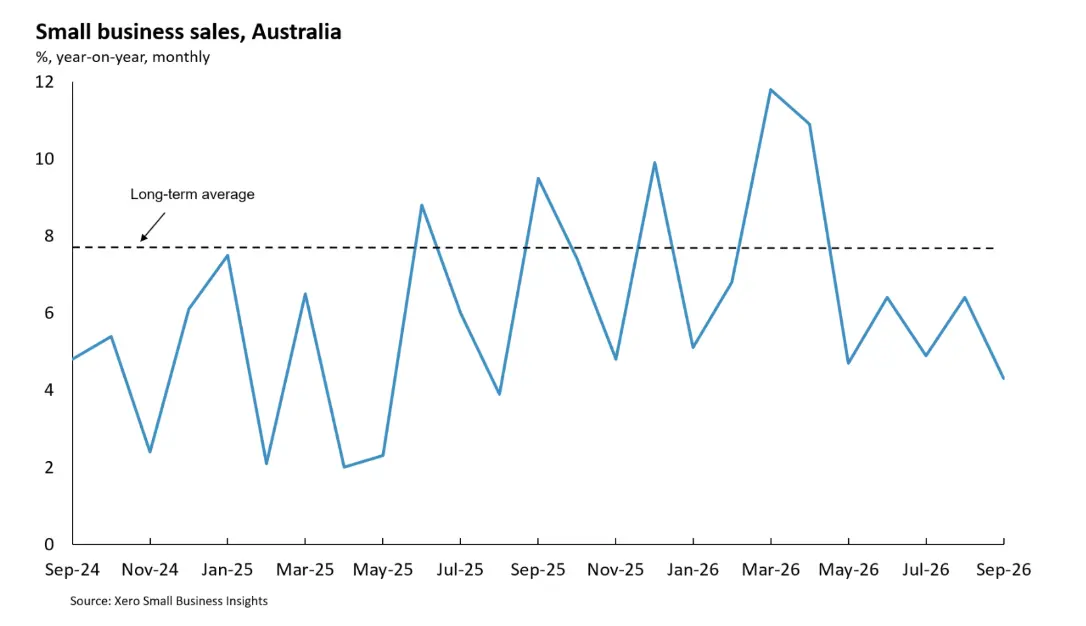
Across the wider economy, Australian small business sales growth slowed to 5.2% year on year in the September quarter, from 7.3% in the June quarter and below the long-term average of 7.8%. The figures were drawn from anonymised, aggregated accounting records from about 520,000 Australian small businesses.
Monthly readings pointed to softer momentum through the quarter. Sales growth was 4.9% year on year in July, rose to 6.4% in August, then fell to 4.3% in September, a five-month low.
Mining led all sectors on sales growth at 12.0% year on year, followed by healthcare at 8.1% and construction at 7.9%. At the other end of the scale, retail and hospitality lagged the national average at 2.4% and 2.7% respectively, pointing to weaker discretionary spending.
Xero linked stronger construction activity to housing demand, major infrastructure work and investment in data centres. It also found those gains were not evenly spread across the economy, with information, media and telecommunications sales growth at 2.4%.
Louise Southall, Economist at Xero, said the latest quarter showed little change in underlying conditions for smaller firms.
"The September quarter tells us small business conditions haven't worsened, but they also haven't improved," Southall said.
"Rate rises typically take time to filter through to household spending, and that delayed effect is continuing to weigh on sales."
Jobs and wages
Hiring trends were firmer than sales. Small business jobs growth rose to 3.9% year on year in the September quarter, from 3.1% in the previous quarter.
Mining posted the strongest jobs growth at 8.9%, followed by utilities at 8.3%, public administration at 8.1% and construction at 6.7%. Hospitality recorded 0.5% jobs growth, while information, media and telecommunications rose 1.6%.
Wage growth moved in the opposite direction, slowing to 1.2% year on year from 2.3% in the June quarter, less than half the long-term average of 2.9%.
Eight industries recorded wage increases below 1%: healthcare rose 0.4%, education 0.5%, public administration 0.8%, real estate services 0.8%, information, media and telecommunications 0.8%, manufacturing 0.9%, wholesale trade 0.9% and transport and logistics 0.9%.
Hospitality was the only industry where wage growth exceeded 2%, at 2.8%.
Southall said labour market conditions were helping to contain pay growth.
"Labour participation is at record highs," she said.
"With workers choosing to stay in jobs for longer, there's less pressure on small businesses to offer higher wages. That's consistent with ABS data showing more Australians are taking on second jobs."
State divide
Performance also varied by region. Western Australia led state sales growth at 7.7% year on year, helped by continued strength in mining.
Queensland followed at 5.7%, with South Australia at 5.3% and New South Wales at 5.2%. Victoria and the Northern Territory recorded the weakest results at 3.8% and 3.7% respectively.
The payment picture remained tight for many businesses. Small firms waited an average of 24.3 days to be paid, while invoices were 6.9 days late on average.
Southall said the contrast between resilient hiring and softer revenue would be important to watch in coming quarters.
"Small businesses are still finding ways to hire, even as costs and softer sales limit what they can pay. The real test over the coming quarters will be whether that hiring momentum holds if sales and costs don't ease."