

Edith Cowan University installs 100 ceiling mics in Perth
Tue, 24th Nov 2026 (Today)
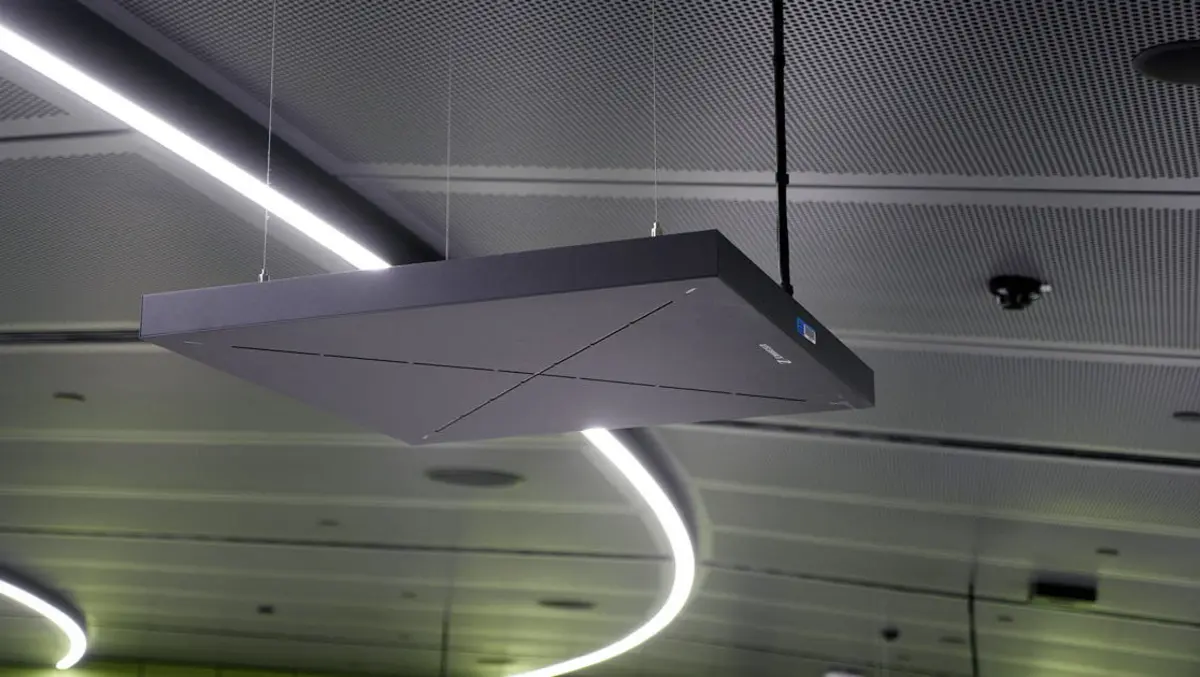
Edith Cowan University has installed more than 100 Sennheiser ceiling microphone arrays across its new Perth city campus. The A$852 million site includes hundreds of learning spaces designed for both in-person and remote teaching.
The deployment spans collaborative theatres, flat-floor rooms, meeting pods and a moot court. It is intended to let lecturers move freely while remaining audible to students in the room and on Microsoft Teams calls and recordings. The installation was shaped by a teaching model in which lecturers act as facilitators rather than speaking from a fixed position at the front of the room.
That created different audio requirements from those of a standard lecture theatre. Voice pickup needed to work across rooms with no clear centre, while student questions had to be heard across the space and captured clearly for remote participants.
Edith Cowan University worked with integrator Vizcom Technologies on the rollout, which took place while construction was still under way in parts of the campus. The system uses Sennheiser TeamConnect Ceiling 2 and TeamConnect Ceiling M arrays as the main speech-capture equipment in teaching spaces.
Before selecting the final setup, the university tested different approaches during an 18-month pilot at its Joondalup campus. The aim was to find a system academic staff could use without having to think about the underlying technology during classes.
Commissioning process
Vizcom said software played a central role in delivering the installation at scale. The integrator used Sennheiser's Control Cockpit tools to map microphone lobes visually, set coverage zones and refine pickup patterns for different rooms.
David Jones, Director, Vizcom Technologies, said the software was a deciding factor in the platform choice. "Sennheiser's Control Cockpit proved to be the difference - we chose TeamConnect as the preferred platform," Jones said.
He said scale was also a major factor during commissioning. "When you have around 120 ceiling mic arrays on site, it was Control Cockpit that saved us so much time in the commissioning phase," Jones said.
The visual mapping tools were also used to set priority zones for specific student pods, allowing the integration team to focus pickup in designated parts of a room where needed. That was particularly important in rooms with flexible furniture layouts and multiple speaking positions.
Hybrid teaching
The audio design reflects a broader shift in higher education towards hybrid teaching environments, where remote students are expected to have a similar experience to those attending in person. In practice, that means lecture-capture and live-collaboration systems must handle lecturers moving around, students speaking from different parts of a room and varied room acoustics.
At the Perth campus, voice-lift settings have been added to help project quieter student questions across larger rooms while keeping levels natural for people sitting nearby. According to the project details, low and high presets are available through room touch panels.
Where greater mobility or gain is needed, the university has also installed Sennheiser EW-DX wireless handheld and belt-pack systems in most teaching spaces. Project details said the inner-city campus environment, which includes glass, plasterboard and nearby public event areas, required a large number of wireless channels to operate with limited interference.
The microphones form part of a wider networked audio-visual setup that includes Crestron control and DM NVX, Q-SYS audio processing and Lightware USB-C connectivity. Within that environment, the speech-capture system is intended to support both in-room teaching and remote access through collaboration platforms.
Low support demand
Chris Cooper, from ECU's Digital Services Collaboration team, worked with Vizcom on the campus project over three years to standardise the experience across different space types. The university said microphone-related support issues have remained low since the system went live.
Cooper said the ceiling microphones were central to the teaching model adopted for the campus. "The ceiling microphones were essential to ensure that staff could wander anywhere in the room and be picked up in the Teams call or a recording," Cooper said.
The city campus installation is now being used as a benchmark for other Edith Cowan University sites, with the design centred on allowing staff and students to contribute from anywhere in the room while remaining clearly heard by remote participants.