

Ericsson unveils 5G router to power connected fleets
Fri, 13th Feb 2026
Ericsson has launched a new in-vehicle 5G router for public safety, mass transit and commercial fleet operators, as demand grows for dependable connectivity in vehicles and mobile field teams.
The product, called the Ericsson Cradlepoint R2400, ships with an extensible RC1250 modem. Ericsson positions the pair as a modular vehicle platform designed for continuous connections, with the option to scale performance without replacing the full unit.
Vehicle connectivity has moved beyond passenger Wi Fi and basic telemetry. Operators increasingly run live video feeds, push software updates, monitor assets in real time, and connect sensors and cameras. Emergency services have also expanded their use of mobile data and video during incident response.
Failover Focus
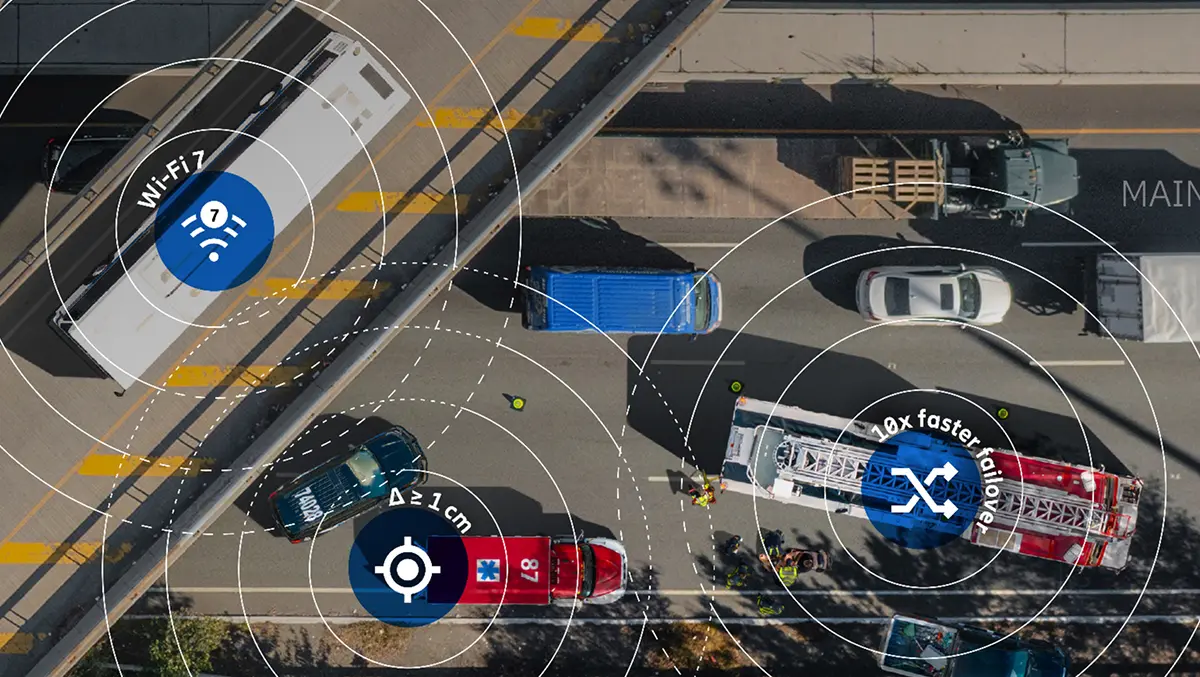
A key feature is Dual SIM/Dual Standby on a single modem. Ericsson says it can switch carriers around 10 times faster than earlier approaches, helping maintain voice, video and data sessions during coverage changes or network issues.
The router also supports multiple concurrent wide area links, with up to five cellular connections at the same time, plus multiple low-Earth-orbit satellite connections. The combination targets fleets and agencies that operate beyond dense urban coverage.
Wi Fi 7 is built into the in-vehicle unit, using a 4x4 software-defined access point. Ericsson says this delivers about two to four times faster Wi Fi speeds than prior generations. The router targets both operational use cases and passenger connectivity on public transport.
Location Accuracy
Another headline feature is centimetre-level positioning. The R2400 supports Real-Time Kinematics positioning combined with dead-reckoning. Ericsson says this can improve location accuracy from one to three metres to around one centimetre in suitable conditions, enabling lane-level vehicle identification and more precise tracking of staff, vehicles, assets and drones.
These positioning features are becoming more relevant as transport operators test automation and emergency services increase their use of drones and live mapping during incidents. The launch also aligns with industry moves towards 5G standalone. Ericsson says the router supports public safety networks and network slicing services and draws on 5G standalone Release 17 features.
Ericsson also cited research suggesting rising expectations around field AI and drones. Verizons Frontline Study 2025 found 46% of first responders in the US expect to use AI daily within five years, and 48% expect daily drone use. A 2024 National Academies survey found 84% of US transit agencies plan to use or evaluate autonomous buses within three to five years.
Edge Compute
The R2400 adds on-device compute for work carried out inside the vehicle. Ericsson says it has 2.5 times more compute than previous generations, supporting local AI inferencing, computer vision and containerised applications.
Security and networking features are also part of the pitch. Ericsson says the router provides twice the security processing throughput of earlier generations, supporting NetCloud SASE zero-trust security and SDWAN services for fleet and site networking.
Management features sit within Ericssons NetCloud platform, which includes an agentic AI virtual expert for enterprise 5G networking and AIOps dashboards that flag anomalies.
Jason Leigh, Senior Research Manager for 5G & Mobile Services at IDC, said: As digital transformation evolves, operations across public safety, mass transit, and commercial fleets, vehicles are increasingly THE critical hub for information, coordination, and incident response. This shift necessitates invehicle connectivity that is more reliable, adaptable, and better suited to realtime, datadriven tasks. Solutions like the Ericsson Cradlepoint R2400 aim to meet that need by giving mobile teams a stronger, more reliable foundation for emerging IoT and AI-enabled solutions in the field that fuel improved response times, enhanced worker safety, and more efficient operations on a daily basis.
Channel Signals
Partners are already outlining use cases. Luke Wadeson, CEO at Exceed ICT, an Ericsson Enterprise Wireless Solutions partner in Australia, said the router fits fleet and field-team deployments across large geographies.
Ericssons Cradlepoint R2400 raises ruggedised edge networking to the next level. Its an impressive leap forward on an already market-leading portfolio, delivering the performance, resilience, and flexibility that our customers - who run modern fleets and field teams - demand. With features like Wi-Fi 7, Dual-SIM failover, precision Real Time Kinematics (RTK) positioning, built-in edge AI, and a modular architecture designed for real-world environments, the R2400 is purpose-built for always-on operations across public safety, utilities, construction, mass transit, and fleet operators, Wadeson said.
He added: For Australian organisations working across vast, harsh environments, the R2400 enables realtime video, connected vehicle services, advanced telemetry, and AI-enabled network management without operational disruption. Were very confident deploying the R2400 in our IVA (Intelligent Vehicle Access) solutions to help customers boost productivity, safety, and compliance at scale.
Ericsson also framed the R2400 as a reliability and precision platform for the field.
Pankaj Malhotra, Head of Product and Engineering, Ericsson Enterprise Wireless Solutions, said: Mobile connectivity is becoming a core operational platform for public safety, transit, and fleet organisations. The R2400 is designed to keep vehicles connected and mission-ready in environments where reliability and precision are non-negotiable. With centimeter-level RTK, lightning-fast Dual SIM failover, and significantly more edge compute, it supports the real-time intelligence these teams increasingly rely on.
Ericsson said the Cradlepoint R2400 router and RC1250 modem accessory will be available in Q2 2026.