

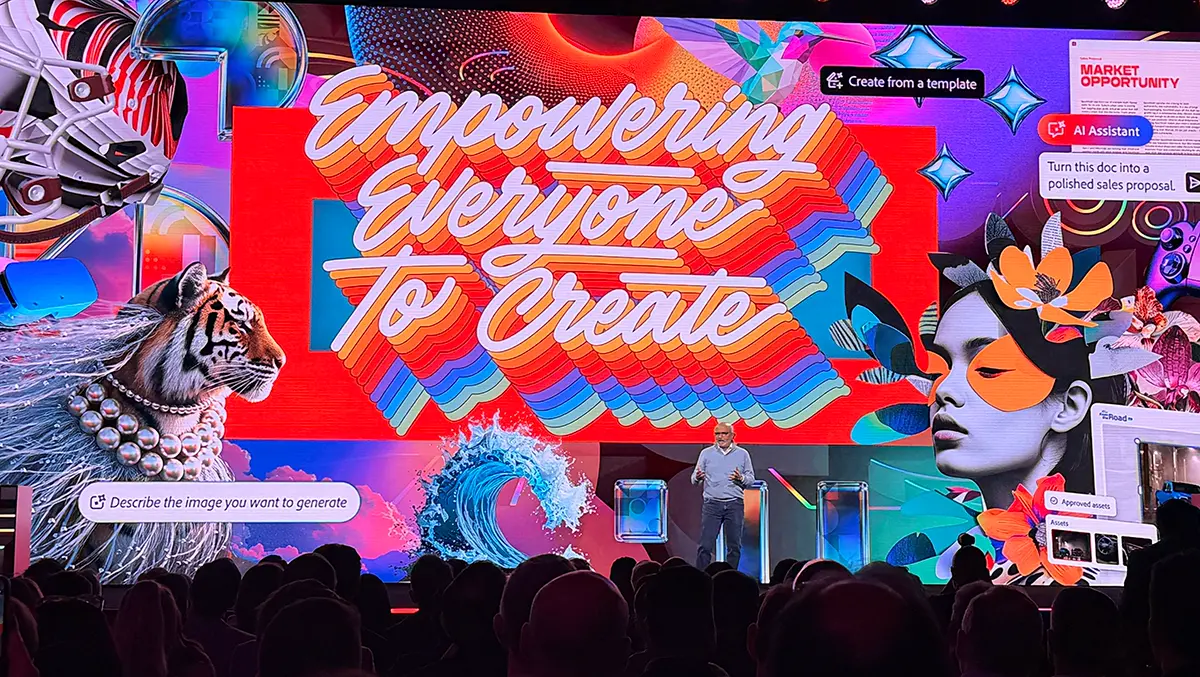

Adobe used its 2026 Summit in Las Vegas to outline a structural shift in design and marketing software. Artificial intelligence agents will soon sit at the centre of how work is planned and executed.
The company introduced a broad set of updates across Experience Cloud and Creative Cloud. The common thread is a move from isolated tools to connected systems. These systems allow software agents to handle multi-step tasks across content creation, campaign management, analytics and commerce.
The announcements point to a repositioning of Adobe's platform as an operating layer for customer experience orchestration. The aim is to link data, content and delivery into a continuous loop, with human oversight at key decision points.
Agent model
Adobe is shifting from tools that assist individual tasks to systems that act across workflows.
These agents are designed to interpret goals, gather data, generate content, execute campaigns and adjust performance. The model changes how marketing teams operate. Teams define objectives and supervise execution, rather than manually coordinating tools.
This marks a step beyond prompt-based AI towards structured, multi-step automation.
Core platform
At the centre is CX Enterprise, a new system designed to coordinate agent-led workflows.
It brings together data, applications and agents, with Adobe Experience Platform as the underlying layer. It also includes tools to build and manage agents, alongside connectors that allow them to operate across external systems.
Adobe introduced CX Enterprise Coworker as the main interface. It translates business goals into workflows spanning segmentation, content creation and delivery.
Supporting updates include new analytics tools, expanded customer data profiles and enhancements to journey orchestration. Many features will roll out over time.
Brand control
Brand visibility in AI-driven environments was a key focus.
Discovery is shifting from traditional web search to conversational interfaces and AI-generated responses. This creates new risks for brand representation.
Adobe introduced tools to monitor and shape how brands appear in AI systems. These track brand references and manage approved content sources.
Experience Manager was expanded with agent-based features. These can update content, enforce brand rules and manage digital assets.
The shift moves content management from static publishing to active brand control across channels, including AI interfaces.
Content supply
Adobe addressed the growing demand for content production.
GenStudio gained Brand Intelligence, which uses past approvals and feedback to guide new content. This embeds brand rules directly into workflows.
Workfront added automation features to structure projects, reduce bottlenecks and improve collaboration.
The goal is a unified content supply chain. Planning, creation, approval and distribution operate within a single system, supported by AI agents.
Creative link
On the creative side, Adobe extended Firefly with an AI assistant.
The assistant works across Creative Cloud applications. It allows users to generate, edit and adapt content using natural language. It also connects creative work with marketing workflows.
Creative production is now tied more closely to campaign execution and analytics. This reduces the gap between design and deployment.
Data layer
Adobe introduced a consolidated analytics layer to support these workflows.
Campaign, content and customer journey data are brought together into a single view of performance.
Customer data capabilities now include unstructured inputs such as text, images and video. This broadens the range of insights available.
Journey Optimizer gained features for simulation and optimisation. These allow campaigns to adjust in near real time.
In business-to-business marketing, integration with Marketo was strengthened, alongside new tools for campaign management and quality checks.
Commerce link
Commerce was integrated more tightly into the system.
New features make product data easier for AI systems to access and use. Tools were added to support automated customer interactions, including transactions and post-purchase processes.
This links marketing activity more directly to commercial outcomes.
Ecosystem ties
Adobe positioned its system as part of a wider technology ecosystem.
Partnerships were expanded with Microsoft, Amazon Web Services and OpenAI. These integrations allow agents to operate within external platforms.
Support for emerging interoperability standards was also highlighted. The approach focuses on embedding Adobe's capabilities within broader workflows rather than operating in isolation.
Experimental work
The "Sneaks" session presented prototypes that signal future directions.
These included tools for real-time content generation, automated testing and dynamic asset creation. Other projects explored adapting content for different markets and formats with minimal manual input.
These are not product releases, but they indicate a push towards further automation and data-driven creative processes.
Industry shift
The announcements point to a broader shift in how marketing and design functions are structured.
Creative production, campaign management and analytics are being brought into a single system. Agents handle repetitive and data-heavy tasks, while people focus on strategy and oversight.
The model depends on strong data foundations, governance and integration. Many features remain in development, so full impact will take time.
The direction is clear. Adobe is positioning its platform as the backbone of a more automated and interconnected approach to marketing and design.