

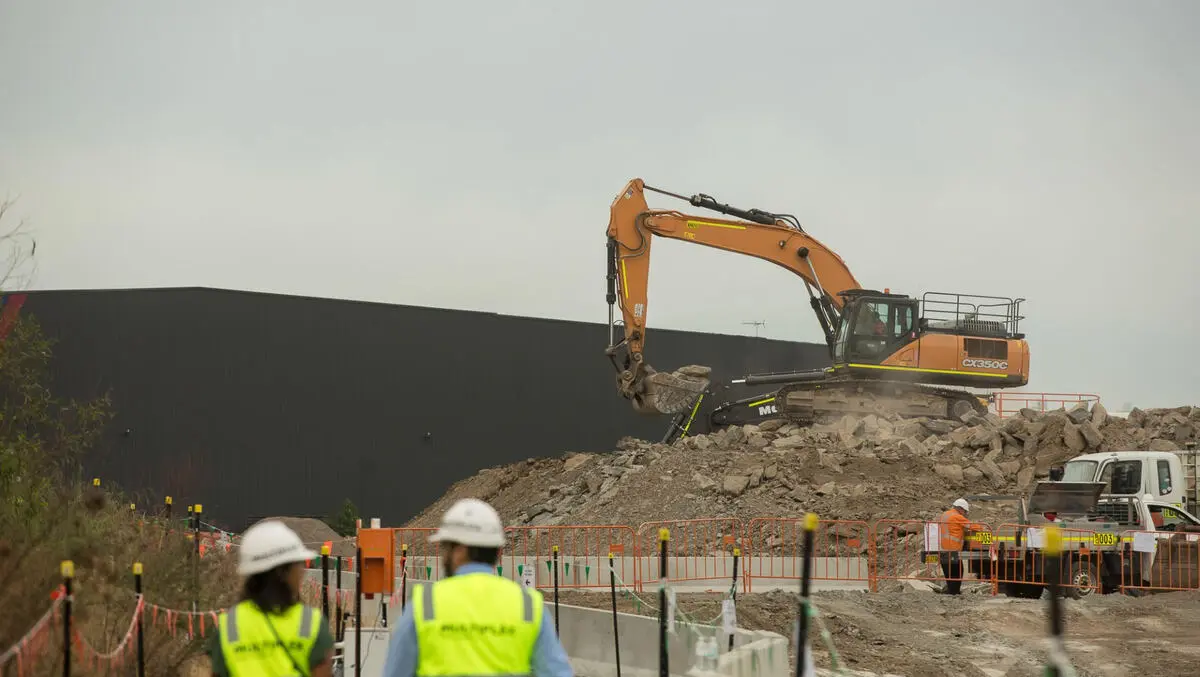

Multiplex has started construction on NEXTDC's S4 Sydney data centre in Western Sydney, one of NEXTDC's largest facilities in Australia.
Located at 16 Johnston Crescent in Horsley Park, the development will span 30,743 square metres across two four-storey buildings. Designed by HDR and Greenbox Architects, it is due for completion in mid-2027.
S4 Sydney has a planned capacity of 350MW and is the first facility approved to directly interconnect with New South Wales' transmission grid.
The project was marked by a sod-turning and Smoking Ceremony led by Uncle Colin Locke. Attendees included NEXTDC Group Chief Development Officer Simon Cooper, Multiplex Regional Managing Director David Ghannoum and Multiplex Regional Director Patrick Murphy.
Declared a State Significant Development, the project is intended to meet demand for AI computing, cloud services, and data storage.
Construction is also expected to generate substantial local employment. Around 1,800 workers are forecast to be on-site at peak, and procurement will include spending with local suppliers.
Project scale
For Multiplex, the project extends a six-year relationship with NEXTDC across data centre developments in Perth, Brisbane and Sydney. It is the fourth NEXTDC facility the builder has delivered in New South Wales.
Previous projects in the state include the S2 Sydney facility in Macquarie Park, stages one and two of S3 Sydney in Artarmon, and the S6 Sydney data centre, also in Artarmon. Multiplex is also completing expansions at NEXTDC facilities in Fortitude Valley in Brisbane and Malaga in Western Australia.
Delivery model
Work on the Horsley Park project has been progressing for several years. Multiplex was first engaged on the initial design in April 2022, before the project moved into an Early Contractor Involvement phase in mid-2024, which covered design refinement, planning approval support, and commercial and technical feasibility.
The scope extends beyond the main data centre buildings. Multiplex is also delivering a high-voltage switchroom building and will facilitate a 330kV electrical substation for the site.
The construction approach relies heavily on prefabrication and modular methods, including prefabricated mechanical plantrooms, electrical switchrooms and main services reticulation pathways, along with precast lift cores, columns, onsite detention tanks and facade elements.
Some installation work will require very large luffing cranes, reflecting the scale of the prefabricated and precast elements used across the development.
Demand growth
NEXTDC linked the investment to rising demand driven by AI adoption and large cloud customers, saying the facility's scale reflects the need for additional digital infrastructure in Australia.
"This milestone marks the beginning of a significant new phase in NEXTDC's investment in Australia's digital infrastructure, reflecting the scale of demand to support growing AI adoption and hyperscale cloud requirements. This new 350MW facility, the first to be approved to directly interconnect to NSW's Transmission Grid, is sized and designed to deliver highly resilient, high-performance infrastructure that will support next-generation AI compute platforms so significantly contributing to Australia's digital economy, sovereign capability, and AI future," said Simon Cooper, Group Chief Development Officer, NEXTDC.
Multiplex said its early involvement from the design stage helped accelerate construction, highlighting the importance of delivery timing for data centre projects.
"We are proud to continue our partnership with NEXTDC to deliver another highly technical, AI‐ready data centre. For data centre developers, speed of delivery is critical, and our early involvement has enabled us to fast track the construction activity while maintaining a high standard of safety and quality, and ensuring the building is future proofed for future needs," said Ghannoum.
Site history
The Horsley Park site has a long industrial history. It was previously a major clay and shale quarry that supplied material to Western Sydney's early construction sector, and later housed convict-era brickworks in the 1830s as well as industrial operations, including PGH Bricks.
Its redevelopment into a data centre adds another chapter to Western Sydney's industrial shift, as logistics, advanced manufacturing and digital infrastructure projects increasingly cluster around major transport and utility corridors.
The project also includes environmental measures such as passive design features, rooftop solar photovoltaic systems, smart LED lighting, low-global-warming-potential refrigerants, low-carbon materials and electric vehicle charging provisions. Water management measures include rainwater harvesting for irrigation, toilets and cooling towers, alongside native planting, raingardens and a managed ecological zone.