

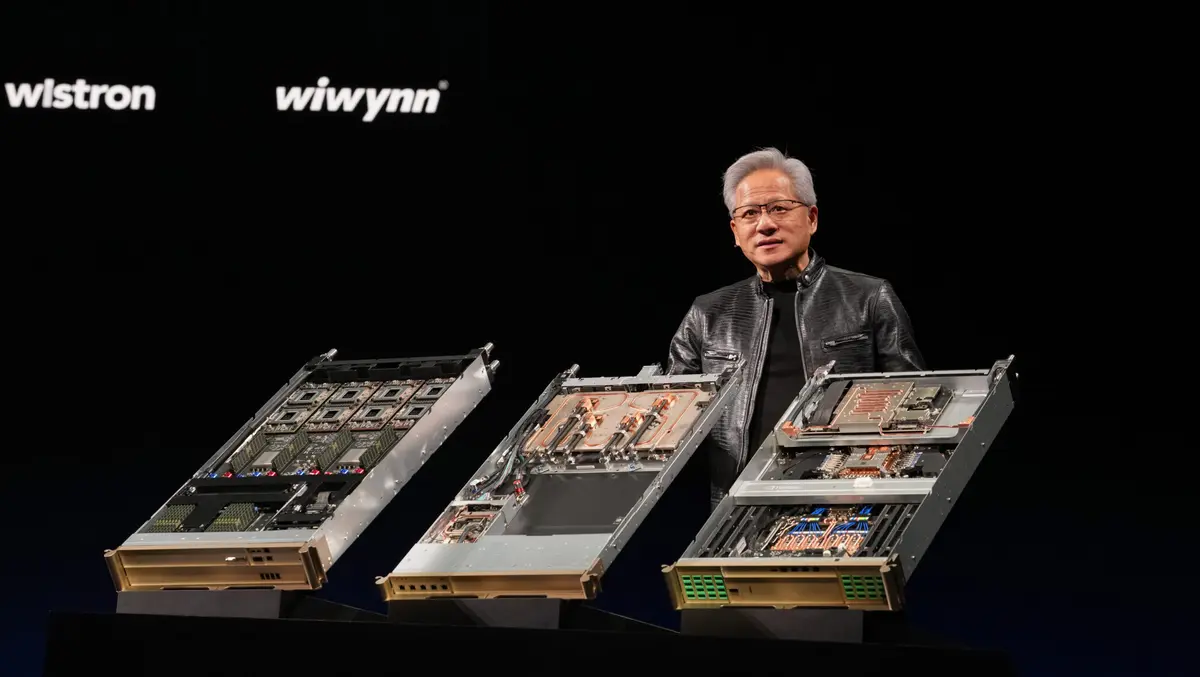

Chief Executive Officer Jensen Huang used Nvidia's GTC Taipei keynote to announce that the company's Vera Rubin platform is moving into full production.
At the event, Nvidia also outlined new software and hardware for autonomous AI agents and personal computers.
Huang framed the keynote around a broader shift in artificial intelligence from experimentation to revenue generation. "AI is now a profit generator. AI is now a GDP generator," he said.
He argued that the industry is moving from a period in which businesses questioned whether AI would be useful to one in which companies are building systems designed to run continuously and at scale. "Useful AI has arrived," he said.
Factory push
A central theme was Nvidia's effort to define AI infrastructure as a new class of industrial asset. Huang said customers are less interested in buying stand-alone computers than in building large systems dedicated to training and running AI models.
"Ultimately, our customers don't want to buy computers, they want to build AI factories," he said.
Nvidia said its DSX framework is aimed at infrastructure builders, with DSX MaxLPS designed to fit more GPUs within the same power budget and DSX OS offered as open-source software. Huang linked that approach to a broader surge in global spending on data centres and related systems.
"The world is racing to build AI factories, the largest infrastructure build out in human history ... because compute is revenues," he said.
He tied that argument to energy efficiency and system design, saying the economics of AI deployment now depend on how much output operators can produce from a fixed power supply. "If you have 1 gigawatt of power, then throughput per watt is revenue ... Choosing the wrong architecture just because the chips are cheaper doesn't make sense - compute is revenue," he said.
He then distilled the pitch further: "The more you buy, the more you make."
Rubin production
Vera Rubin is now ramping into full production through a supply chain that spans hundreds of partners and factories across multiple countries, including a large concentration in Taiwan. Huang said the manufacturing base assembled for the system is significantly larger than the one used for Grace Blackwell.
"The supply chain we created for Vera Rubin is twice as large as Grace Blackwell," he said. "We need it all to support the demand."
Huang described Taiwan as central to that network, from upstream manufacturing to downstream deployment in data centres. "NVIDIA's ecosystem spans all the way upstream to our supply chain here in Taiwan, where it all begins, and downstream all the way to data centers and eventually to end users," he said.
He added: "the richest ecosystem, the world's best supply chain ecosystem."
Nvidia also said its Spectrum-X Ethernet Photonics networking product is now in production. The company named CoreWeave, Lambda and Oracle Cloud Infrastructure among early adopters.
Agents focus
Another major part of the keynote centred on software for AI agents, which Huang described as the next computing pattern for business systems. Nvidia introduced the Agent Toolkit as a runtime and development stack for building, deploying and securing autonomous agents across companies' operations.
Huang argued that this model would also reshape processor demand. "We created CPUs for humans in the past ... There will be billions of agents, and these agents are going to be using the CPUs with very little patience," he said.
In support of that effort, Nvidia announced Nemotron 3 Ultra, a 550-billion-parameter mixture-of-experts model that the company said is designed to offer faster inference at lower running cost than other open models. Huang also said Nvidia would continue to make open models available for adaptation by customers and developers.
"We're dedicated to building open models for the world, so you can take all of it, add to it, make it even better, make it yours," he said.
As an example of where agent software could be used, Huang highlighted work with Cadence on chip design verification. "What once took weeks now takes hours," he said.
He said verification cycles are now "over 40 times faster."
PC redesign
Nvidia also used the keynote to outline a new line of Windows systems built for what Huang called personal agents. The announcement included RTX Spark, a chip for slim laptops and compact desktops, developed with MediaTek and designed to run local AI workloads on Windows machines.
Huang said the effort with Microsoft marks a deeper shift in how PCs are designed and used. "This is the first across-the-lineup PC reinvention in forty years," he said.
He presented a range that includes laptops, a compact desktop system intended to run continuously at home, and DGX Station for Windows, which he described as a deskside AI supercomputer.
One desktop product was presented as an always-on machine for persistent agent workloads rather than conventional PC tasks. "This agent could run 24/7, meter free," Huang said. "You could download your agent. You could raise your lobster in here. This is your claw, it's running all the time, no meter anxiety, and it's yours."
Huang said the concept could change how users think about the computer in the home. "There's actually an AI supercomputer in your house ... these in time become a lot more like R2-D2 to you, more like C-3PO to you, than it feels like a PC to you," he said.
Physical AI
Nvidia also set out plans for robotics, autonomous driving and industrial systems, describing them as part of a move into physical AI. The company introduced Cosmos 3, a world model intended to simulate and understand physical environments, and announced new software and reference designs for autonomous vehicles and humanoid robots.
Huang said this would extend the same computing pattern beyond the data centre and desktop. "This agentic computing pattern will be replicated in computers all over," he said. "How we think about the personal computer will very likely change."
He closed by thanking Nvidia's manufacturing and industry partners gathered in Taipei. "I want to thank all of you for your partnership, your friendship. We couldn't be here without everything that we do together," he said.