


Sennheiser Spectera transforms wireless audio at Notre-Dame
Thu, 5th Feb 2026
Sennheiser has deployed its Spectera wideband wireless audio system at Notre-Dame de Paris as the cathedral resumes regular worship and expands its programme of concerts and broadcasts after the 2019 fire.
The installation was delivered with French integrator Novelty, brought in during the reconstruction to re-equip the cathedral's sound system. The brief called for wider coverage while keeping hardware discreet in a sensitive heritage setting.
Engineers also faced a difficult radio environment. Notre-Dame spans more than 100 metres from the main entrance to the rear chapels and is almost 50 metres wide at the transept. Dense stonework, pillars, and temporary or movable partitions can disrupt signal paths. Services require clergy to move around the building, increasing the risk of dropouts in wireless microphone links.
Public access
Operational demands extend beyond audio coverage. Notre-Dame is open daily and combines worship with continuous visitor access, including during services. Laurent Prades, Technical Manager at Notre-Dame de Paris, said this mix of activity and access is central to the cathedral's identity.
"Notre-Dame is a place of sharing open to all visitors, whether they wish to attend a service or just want to walk under its vaults," Prades said.
The cathedral holds five services a day and remains open to the public for 12 hours a day, seven days a week, throughout the year. That schedule limits how often staff can intervene with equipment and leaves little tolerance for visible cabling or intrusive antenna placements.
Wireless upgrade
Notre-Dame previously used an analogue two-channel receiver from Sennheiser's 3000 series, with directional antennas at the centre of the liturgical area. Novelty project lead David Créteur said the expanded coverage requirement changed the wireless design equation.
"Instead of working only along the axis, we now had to cover almost the entire cathedral, which is just over a hundred metres long from the entrance to the back and almost 50 metres wide at the transept," Créteur said.
He said a conventional digital approach would have required at least eight antennas distributed through the building, along with long cable runs and additional equipment for signal distribution and zone management. That would have increased complexity and made day-to-day operation harder in a site that cannot rely on constant technical supervision.
"With the digital wireless technologies we were familiar with, we could have done it, but we would have had to multiply the number of antennas to a total of at least eight to be placed throughout the building, and then connect them with long lengths of cable," Créteur said.
Four antennas
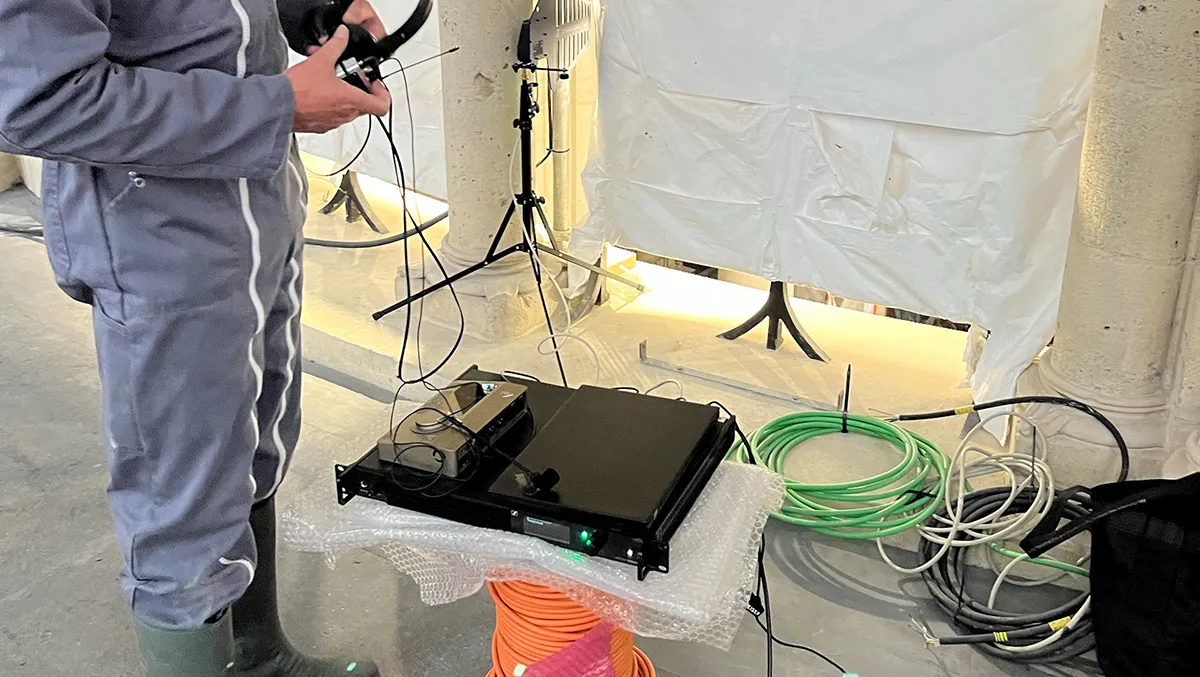
Novelty selected Spectera, Sennheiser's wireless multi-channel audio system, for its wideband approach and reduced antenna requirements. Coverage across almost the entire interior was achieved using four antennas, according to the companies. Fewer antennas reduced cabling and simplified placement decisions in a protected architectural environment.
Network infrastructure also shaped the design. Antenna connections run over Ethernet, and the team wired the cathedral with fibre as part of the wider rebuild. The configuration uses fibre extensions with media converters validated by Sennheiser, meeting constraints on cable routing and long-distance signal transport.
Alain Richon, Project Manager for the Diocese's sound system in the cathedral, said the team worked closely with architects on cable paths and chose fibre to preserve future flexibility.
"Every cable path was carefully considered with the architects, and to anticipate future developments, it seemed logical to opt for fibre. In this context, a system like Spectera, which is based on technologies from the world of telecoms and networks, fits perfectly with this vision," Richon said.
Testing and timeline
Novelty and Sennheiser carried out a full-scale onsite trial in early 2024 while the cathedral remained under construction. The test assessed radio stability and system integration, and also checked visual impact and audio quality.
The project then moved through a phased deployment. In autumn 2024, Sennheiser supplied a temporary pre-production Spectera configuration with a base station and three bidirectional bodypacks. A separate Digital 6000 system covered handheld microphones while Spectera handheld transmitters were not yet available.
Broadcast integration
Notre-Dame now uses a mix of handheld and bodypack wireless microphones, including MKE 40 clip-on microphones for discreet spoken-word reinforcement, according to the cathedral's technical team. Boundary microphones at the altar are also used for television capture. KTO, a Catholic television channel, produces daily broadcasts from the cathedral's audiovisual control room.
The audio system integrates with a DiGiCo console via Dante networking and a 4ERA4 matrix for channel transport and distribution. The Spectera base station occupies one rack unit and supports up to 32 microphone channels and 16 stereo in-ear monitor links. The compact footprint reduces space demands in the cathedral's technical areas.
Antenna placement changed during commissioning. The original plan put antennas on a gallery about 10 metres high, but the final installation brought them lower. The revised positions delivered stable coverage across the cathedral, according to the project team.
Future events
The system design leaves room for expansion, including events that extend outside the main building. Créteur said the team tested moving one antenna outdoors during operation without restarting the system.
"There may be occasions when priests need to speak in front of the church. In this case, a fifth antenna would be needed, and we might add that. We already tested such a scenario live, and simply took antenna 4 outside during operation. It worked without having to restart the system," Créteur said.