

.webp)
The best of both worlds: Managing AKS, EKS & GKE with Rancher
Sun, 23rd Nov 2025
In a previous discussion, we explored how Rancher RKE2 outperforms vanilla Kubernetes for many organisations in terms of speed, security, and simplicity. The conclusion was straightforward: if your goal is rapid, reliable production readiness, Rancher's integrated tooling provides an enormous advantage.
But that naturally leads to the next question:
If managed Kubernetes services like Amazon EKS, Google GKE, and Azure AKS already exist, why not just use those?
After all, the major cloud providers promise to remove operational burden and simplify cluster management. So how does a self-managed platform like Rancher compare?
This article compares Rancher Manager + RKE2 against the "big three" managed Kubernetes services - and examines why the most powerful strategy may actually be to use both together. These insights come directly from our hands-on work deploying hybrid and multi-cloud platforms at Darumatic, where we support organisations navigating cloud-native complexity at scale.
The Core Trade-Off: Control vs Convenience
More than a comparison of features, this is ultimately a question of philosophy.
Managed Kubernetes (AKS, EKS, GKE) = Convenience
The control plane - etcd, API server, schedulers, controllers - is fully maintained by the cloud provider. You don't worry about high availability, patching, or backups. Your responsibility is limited to worker nodes and workloads.
It's an excellent model if you operate entirely within one cloud provider and prefer minimal operational overhead.
Rancher Manager + RKE2 = Control and Consistency
With Rancher, you own the control plane and the underlying infrastructure, whether that's on-premises, in the cloud, or at the edge. Rancher provides the automation, UI, and governance layer to unify everything. This brings unmatched flexibility, architectural freedom, and consistency across environments.
If you need Kubernetes anywhere outside a single cloud, Rancher becomes the strategic choice.
Rancher vs Managed Services: A Practical Comparison
We evaluated the approaches across the factors that matter most to engineering, SRE, and platform teams.
Control Plane and Flexibility
Managed services are convenient but opinionated. You receive only the Kubernetes versions, CNI plugins, and CSI storage drivers supported by the cloud provider. If you need something outside their approved ecosystem - perhaps for performance, compliance, or security - you may be blocked.
Rancher offers full flexibility. Deploy on bare metal, vSphere, or any IaaS provider. Choose your own CNI, CSI, OS, and networking model. RKE2 gives you a secure, fully conformant Kubernetes distribution that runs anywhere.
Winner: Rancher, especially for hybrid environments or teams requiring control over every layer.
Cost Model
Managed Kubernetes services charge a continuous fee for control plane uptime - typically around $0.10 per hour per cluster - plus the usual compute, network, and storage costs. Predictable, but often expensive at scale.
Rancher itself is open-source and free. You only pay for the infrastructure you choose to run it on, and for your engineering effort. If you already have hardware or can obtain low-cost VMs, Rancher can be significantly cheaper. Enterprises may opt for SUSE Rancher Prime support, which can still cost less than cloud control plane fees at large scale.
Winner: Tie.
Managed services are simple to budget. Rancher can be far cheaper if you have existing capacity and the right skills.
Multi-Cluster and Multi-Cloud Management
This is where Rancher stands out. Rancher is designed to be a unified control plane for any Kubernetes cluster, anywhere. It can provision clusters on-premises and in the cloud - and it can also import existing EKS, AKS, and GKE clusters.
From one dashboard, you can manage:
- Centralised authentication and RBAC
- Unified monitoring
- Shared application catalogs
- GitOps pipelines through Fleet
- Consistent security policies
Replicating this with cloud-native tools requires jumping between different consoles, CLI tools, and IAM models.
Winner: Rancher, by a wide margin.
The Best of Both Worlds: Managing AKS, EKS & GKE Through Rancher
Here's the part that surprises many teams:
You don't need to choose between Rancher and managed services - you can use both.
Rancher Manager can directly provision and configure managed clusters in AWS, Azure, and Google Cloud. Provide cloud credentials once, and you can create, upgrade, and scale these clusters - including node pools - from within Rancher's interface.
This unlocks a powerful hybrid-cloud operating model:
Unified Provisioning
Provision an on-prem RKE2 cluster and a cloud-managed EKS cluster using the same workflow. No need for teams to learn different cloud-specific CLIs or APIs.
Centralised Authentication
Rancher allows you to use your organisation's central identity provider - LDAP, SAML, or OIDC - to manage access across all clusters. No more battling with complex AWS IAM roles for Kubernetes access.
Consistent Day-2 Operations
Once a managed cluster is imported or provisioned, it behaves just like any other cluster in Rancher:
- Same monitoring
- Same security tools
- Same GitOps pipelines
- Same operational workflows
This creates a unified Kubernetes platform across all environments, something cloud providers do not deliver on their own.
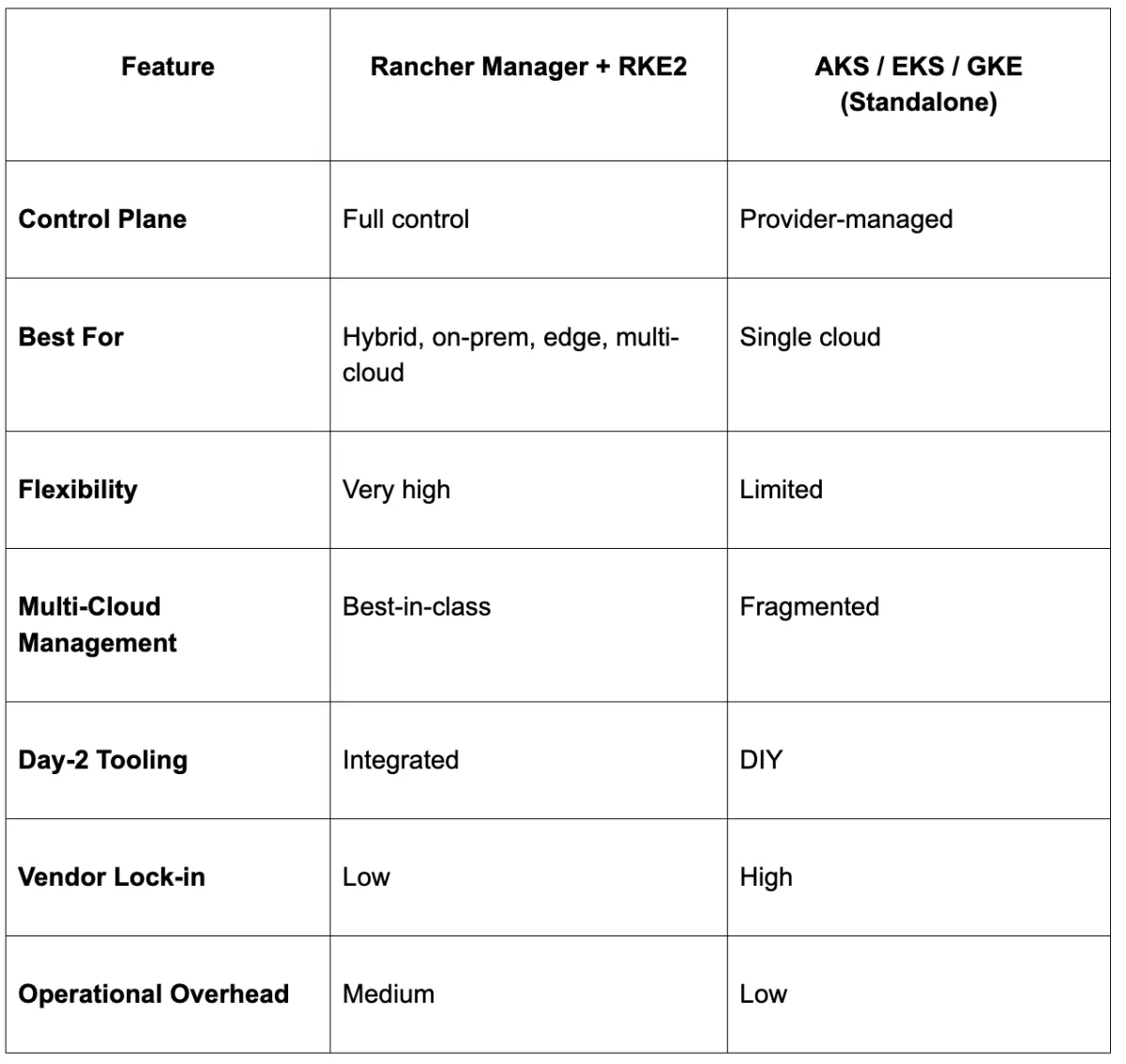
Key Takeaways: When to Use What
1. Choose Standalone Managed Services if:
- You are fully committed to one cloud
- You want minimal infrastructure operations
- You operate only a small number of clusters
2.Choose Rancher as your Central Platform if:
- You run hybrid or multi-cloud environments
- You operate at the edge or in air-gapped settings
- You want a single control plane for all clusters - including EKS, AKS, and GKE
- You want consistent security, governance, and tooling everywhere
- You want to simplify Kubernetes consumption for developers
Final Thoughts: Beyond the "Easy Button"
Managed Kubernetes services are an excellent starting point. But for organisations operating at scale, the biggest challenge is achieving consistent, secure management across all environments.
Rancher solves this by providing a single, unified platform that manages everything from on-prem RKE2 clusters to cloud-managed EKS and AKS clusters. It offers the convenience of managed services while adding a powerful layer of control and visibility.
For many enterprises Darumatic works with, this hybrid approach delivers the best of both worlds - reducing operational burden while enabling a strategic, multi-cloud Kubernetes platform.