

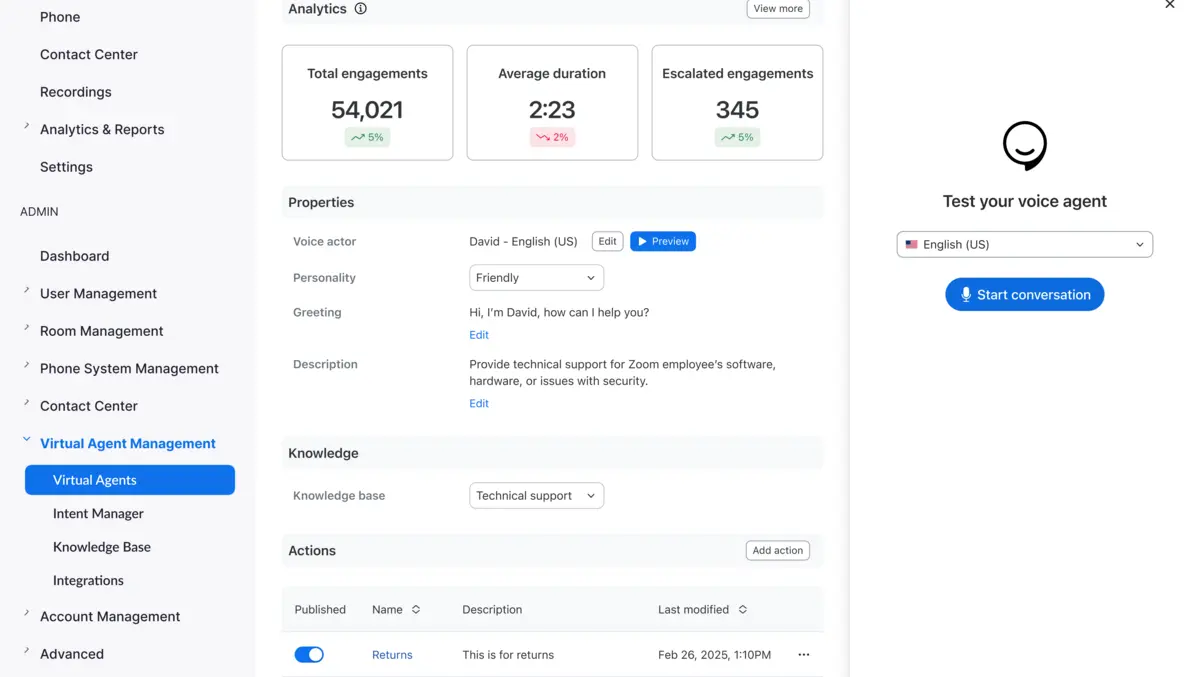

Zoom has launched Zoom Virtual Agent 3.0, an updated automated customer service product designed to complete multi-step resolutions across business systems and, when needed, hand off to a human agent with full context.
The release comes as companies push more support work into chat and voice automation, aiming to reduce repeat contacts and prevent customers from having to restate information. Zoom cited research showing dissatisfaction with current chatbot experiences, with 43% of consumers saying chatbots fail to resolve their issues.
Zoom Virtual Agent 3.0 is part of Zoom's CX portfolio and is intended for voice and chat. It is designed to complete actions as well as hold a conversation, with workflows that run across customer relationship management, billing, and order management systems.
Execution focus
Zoom described a new execution architecture that can orchestrate multi-step workflows across compatible systems and complete tasks that typically require multiple handoffs.
According to Zoom, the latest version is built on the Zoom AI Companion 3.0 architecture. It connects the virtual agent layer to back-end actions and to governance features for administrators and customer experience teams.
Zoom framed the update as part of what it calls a "resolution economy," where service performance is measured by first-contact resolution and completion of end-to-end workflows, rather than by how many interactions a bot can contain without escalation.
Governance tools
Zoom also added features aimed at transparency and control. Account administrators can view the data sources used, the decision logic, and the workflow path behind automated actions.
Customer experience teams can audit performance, troubleshoot breakdowns, and refine automation policies based on workflow history.
Visibility into automated decisions has become a key theme in customer service automation as organisations balance increased automation with compliance and risk controls. Virtual agents often interact with personal data and may trigger account changes, refunds, or order adjustments.
Next features
Zoom outlined additional functions it expects to make generally available in Spring 2026. These include multimodal large language models that can interpret documents and images submitted by customers, such as photos of serial numbers and forms.
Zoom also described a continuous learning capability when the product integrates with Zoom Contact Centre. In that model, the virtual agent would extract insights from cases resolved by human agents and apply those recommendations to similar future requests, with oversight and controls.
Another planned addition is proactive outbound engagement. Zoom said the virtual agent could initiate contact based on known events, confirm updates, and complete tasks, reducing inbound volume by resolving issues earlier.
Warranty scenario
Zoom provided an example based on warranty fulfilment. In that scenario, the virtual agent authenticates the user, extracts a serial number from an uploaded image, validates eligibility across back-end systems, schedules a device pickup, initiates a replacement order, and confirms shipment within a single interaction.
If escalation is required, the product passes the workflow history and verified inputs to a live agent so the customer does not need to repeat information or restart the claim, according to Zoom.
Internal results
Zoom said it has been using the latest updates internally and shared performance figures. It reported improved query-understanding accuracy after reducing its "no-match" rate, defined as the share of conversation turns where the virtual agent failed to understand the user's input.
Zoom said its no-match rate dropped from 35% to 0%, which it described as moving from 65% query-understanding accuracy to 100%.
On billing support, Zoom reported that deflection rates rose from 0% to 30% in three months, saving more than 1,000 agent hours per month.
Zoom also sought to differentiate its approach from chatbots focused on scripted responses or basic conversation handling, positioning the product as a system that can authenticate users, interpret customer inputs, orchestrate back-end actions, and complete business tasks in a single workflow.
"Agentic AI was just the beginning," said Chris Morrissey, General Manager of Zoom CX. "Zoom Virtual Agent 3.0 orchestrates multi-step workflows across systems, continuously learns from human resolutions, and provides full transparency into every agentic action. This allows organisations to confidently automate complex interactions. It's more than a product update; it's another step toward more connected customer relationships, where AI and humans work together to resolve issues faster and build trust."