

A defining moment is approaching for Australian manufacturing
Tue, 19th Aug 2025
Australia's manufacturing sector faces a defining moment.
Professor Cori Stewart, Founder and CEO of the Advanced Robotics for Manufacturing (ARM) Hub, believes the nation must act swiftly to give small and medium-sized enterprises (SMEs) the confidence and tools to embrace automation.
"I think Australia can be exceptional at using automation and robotics in our current industries, if we just had SMEs that had the confidence to invest in themselves," she said. "If we don't do it now, it's hard to imagine."
From the ground up
Stewart founded the ARM Hub five years ago, spinning it out of a university with support from government, industry and academic partners. What began with four and a half full-time staff has grown into a team of 30.
"We started off really small. I had to build all our systems like any other business, but also support many other businesses," she explained. "The whole idea was spinning out something like this so you don't have big bureaucratic structures. You can operate at the kind of pace industry needs."
While the organisation runs a proprietary company for certain contracts, ARM Hub remains a not-for-profit at its core. "When industry works with us, they know whatever we do goes back into the business," Stewart said. "It's a level of trust and it was a condition of government and industry getting behind us."
Three pillars of transformation
The Hub's work spans three main areas: scaling up manufacturing, delivering data and AI as a service, and running targeted accelerators.
"We work with companies to assess their tech environment and help them figure out how to scale," Stewart said. "Most of my staff are engineers, and we also have designers who think about the human aspect."
Through its data services, ARM Hub manages company datasets on a cloud-based system. "Most manufacturing SMEs don't have data science staff. So we run that capability and service a number of companies rather than just one. We do it transparently and with trust," she explained.
On accelerators, Stewart pointed to a defence programme modelled on the US DARPA approach. "We had companies wasting money prototyping tech no one knew about. The accelerator gave them sponsorship and visibility," she said.
Bananas to biotech
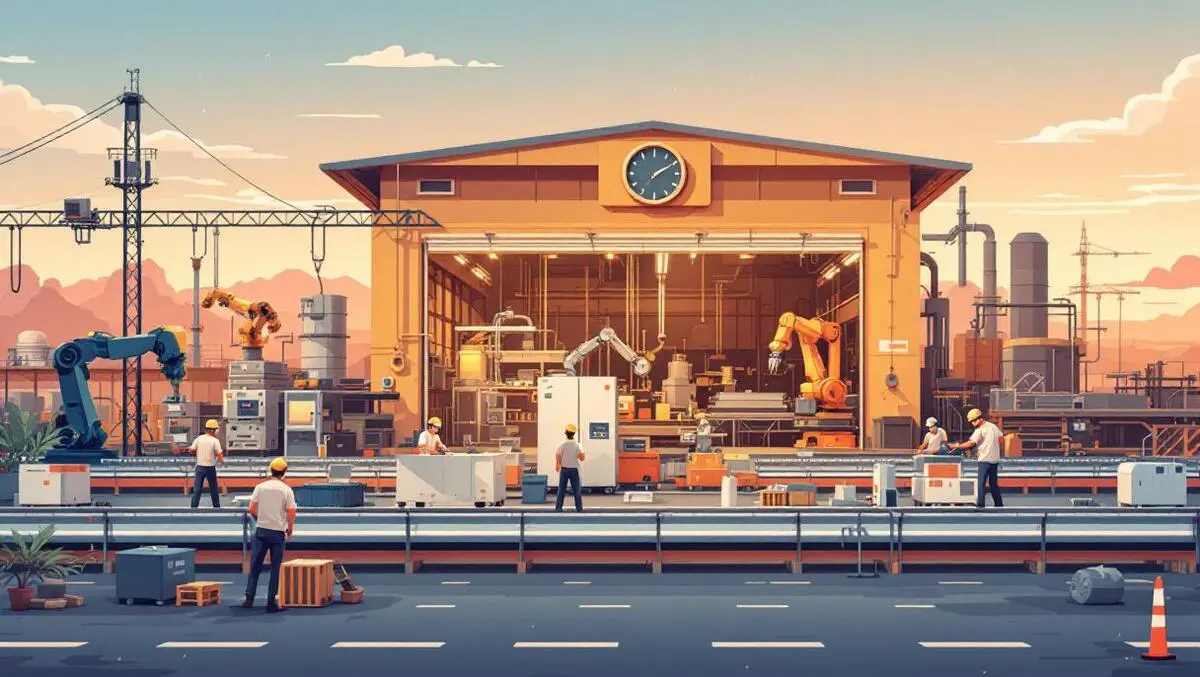
The ARM Hub's headquarters is an industrial hangar in Brisbane where six companies at a time co-locate to develop prototypes and scale their ideas. "It's a destination for people to come and look at advanced manufacturing. A tech showroom in action," Stewart said.
Projects range from the futuristic to the everyday. "We have a VTOL aircraft, a balloon for the stratosphere, and right now we're working on de-handing bananas in Queensland," she said with a laugh.
The organisation also has its eye on new frontiers. "We are looking at establishing a next-gen facility in South Australia focused on AI and automation for biotech, medtech and electronics," Stewart revealed. "It will mean our companies get automation right up front so they can compete better when they go to market."
The 3D printing challenge
Stewart acknowledged the limitations of 3D printing but pointed to examples of commercial breakthroughs. "There is a Melbourne company that developed 3D printing inside a shipping container. They send it out to remote areas to build advanced widgets for defence and infrastructure," she said. "They had to get the business model right, but it's one of the first commercial solutions."
While enthusiasm for industrial 3D printing has cooled, Stewart insisted it still plays a vital role. "Space and medical sectors have been reasonably successful, but in heavy industry it's not seen as strong enough yet," she said.
Lessons from the past
Australia's retreat from car assembly left scars, but Stewart argues it also demonstrated manufacturing's adaptability. "There were highly capable supply chains feeding into it. Those skills transferred into other jobs," she said. "The amazing thing about manufacturing is it's transferable. One day we're making heart stands, the next day steel fabrication."
Education, however, remains a concern. "In China, the big prize is to be a tech entrepreneur. Here it's still like, are you doing the right thing by people? I believe in ethics, but not at the expense of actually doing it," she said.
Universities, she warned, face a crisis. "They've lost their social licence. International students have funded research, but industry doesn't pay for Australian research. It's a really tough time for universities," she said.
A shrinking middle
Stewart worries about the hollowing out of mid-sized enterprises. "Large companies are becoming medium, medium are becoming small. SMEs are 93 per cent of all businesses, but the middle is shrinking," she explained.
Without a strong base of mid-sized firms, Australia risks losing competitiveness. "Other countries have proper local procurement and support for SMEs. We're way behind," she said. "We often have this view that Australia can't do it on its own. Well, we never will if we never invest in it."
Despite the challenges, Stewart sees cause for optimism. "At this time we have industries starting to understand their troubles, and we have AI that can actually support SMEs as much as global corporations," she said. "If we're smart, we can do it. But if we don't, there's no Plan B."