

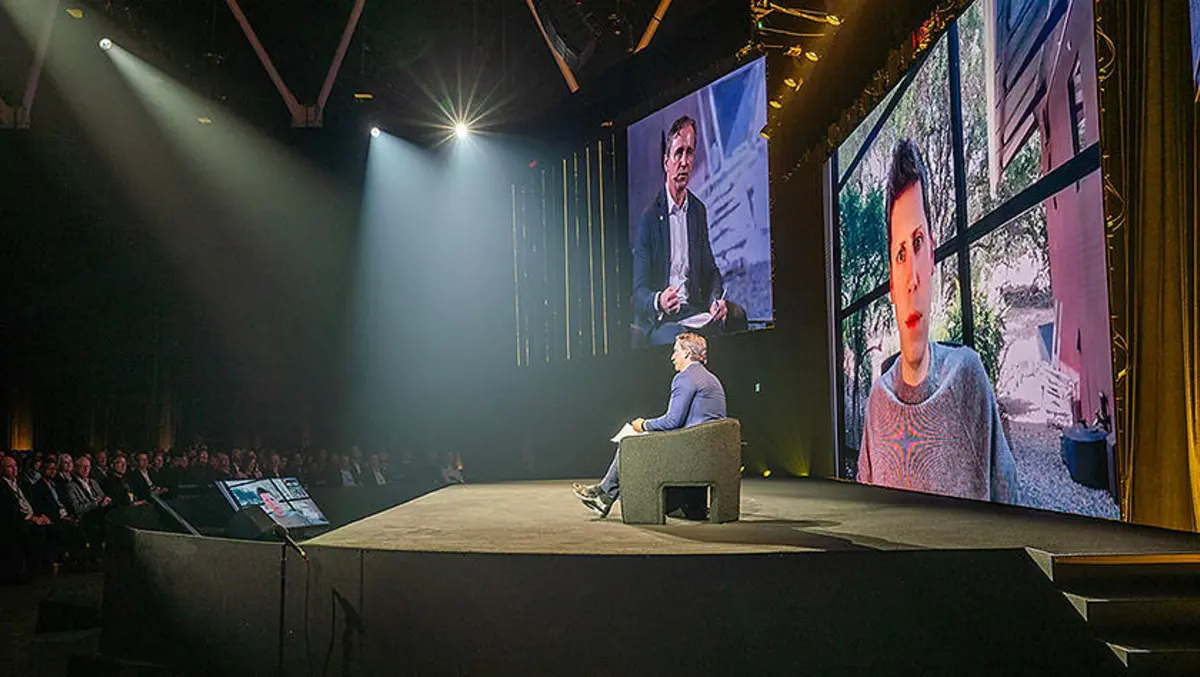
Altman says businesses lag AI adoption amid rapid change
Wed, 27th May 2026
OpenAI Chief Executive Officer Sam Altman said businesses are lagging behind the pace of artificial intelligence development, with enterprise adoption still at an early stage.
In a video conversation with Commonwealth Bank Chief Executive Officer Matt Comyn, Altman said AI models had advanced to a point where their use across companies and the wider economy had not kept pace. That gap, he said, was putting pressure on leaders to make decisions in uncertain conditions and adapt faster than traditional business cycles allow.
"Overall, I think the technology has gotten to a notable place," Altman said.
Deployment, he said, was far less mature than the underlying systems. "We have these incredibly smart models [but] I think one has to look at the state of the economic adoption and say we're still very early," he said.
The mismatch means there is still substantial work to do before businesses can embed AI in ways that produce clear financial returns. It also means companies cannot treat the consequences as a distant issue.
Trust and uncertainty
One response to that uncertainty, Altman said, is to be more open about what companies know and do not know. Organisations should address concerns directly rather than rely only on polished messaging.
Describing OpenAI's approach, he said the company had tried to share its thinking publicly even when those views were provisional or later turned out to be mistaken. "We try to think out loud," he said.
"I believe that so much of society here is going to be impacted by this, that we are all stakeholders, and it is better for us to be going in the direction of too much transparency and occasionally being wrong," he said.
Altman said OpenAI had been more accurate in forecasting technical progress than in anticipating the broader social and economic effects. "My scorecard, at the highest level would be we've been roughly right on technological predictions and pretty wrong on the social and economic implications," he said.
He cited entry-level white-collar employment as one area where his expectations had not been borne out. "I'm delighted to be wrong about that," he said.
Human boundaries
Altman also outlined where limits may emerge in the use of AI. A revealing test, he said, came when he tried using AI for personal communications such as email and Slack messages.
That experience reinforced the distinction between tasks people may delegate to software and interactions they may want to keep personal. "We really do care about our interactions with people," he said.
He added that his own communications, which take up a large part of his time, were not something he could imagine handing over to AI in the near term. He linked that view to a broader principle for the design of AI systems. "The world has got to be built for people and be better for people," he said.
Workplace change
On the use of AI agents in companies, Altman said businesses were still working out how people and automated systems should operate together. Workplace norms have evolved around human communication, he said, and those expectations do not transfer neatly to machines.
"We have expectations about what we do with a person. And right now...we have not yet figured out how we're going to have a world where people and AI co-collaborate together," he said.
He suggested current methods, in which AI agents are inserted into communication channels built for people, were unlikely to last. "What I expect will happen is we will figure out new ways for agents to use our same services and interact with our same systems and data, but via a different channel," he said.
He also pointed to a likely shift from tools that respond to prompts to systems that remain active in the background. "What I think will be possible soon is you will have an AI that is always running. It is understanding you and your goals and your company's goals. And it's just trying to be as helpful as it can given the amount of computing resources it has available," he said.
Faster cycle
For executives, the issue is increasingly one of speed, Altman said. Many leaders, he said, are asking how to manage organisations on annual or quarterly planning cycles when technology and competitive conditions are shifting every few months.
"How can I run a company on an annual or quarterly cycle when the whole world is changing every month, or every two months, or less," he said.
He argued that companies would have to move more quickly to remain competitive. "I think that business is going to get reinvented when the world has to move at a much faster clock cycle to be competitive," he said.
As an example, Altman pointed to the take-up of AI coding tools in large organisations. He said that shift showed how rapidly companies can change course when executives see a direct competitive risk in delay.
"It was one of these moments where people realised, hey, if we don't get serious about this, we won't be competitive," he said.
He described that uptake as one of the fastest he had seen at a serious enterprise level, while adding that companies still lacked established methods for broad deployment that preserved productivity and security. The strongest organisations, he said, were letting teams experiment in controlled ways, learning from use and adjusting quickly. "This is the thing that I've observed the best companies do," he said.
Altman said OpenAI itself was making more bets, learning quickly and shifting resources when one line of work began to show results. The challenge was not trying new ideas, he said, but stopping other work quickly enough to focus. "It's easy and fun to try a lot of bets. And then no matter how well one is working, it's always painful, in my experience, to stop doing other things, to concentrate on one area," he said.
On whether AI is producing measurable gains in productivity and revenue, Altman said the answer remained uncertain because adoption is still at an early stage. "My best answer to that is it's all still very new, and it's just going to take a little bit longer, to figure out how a company actually does run more efficiently and to make these great new products," he said.
"But if a year from now we're still talking about the same question, I'd be more concerned," he said.