

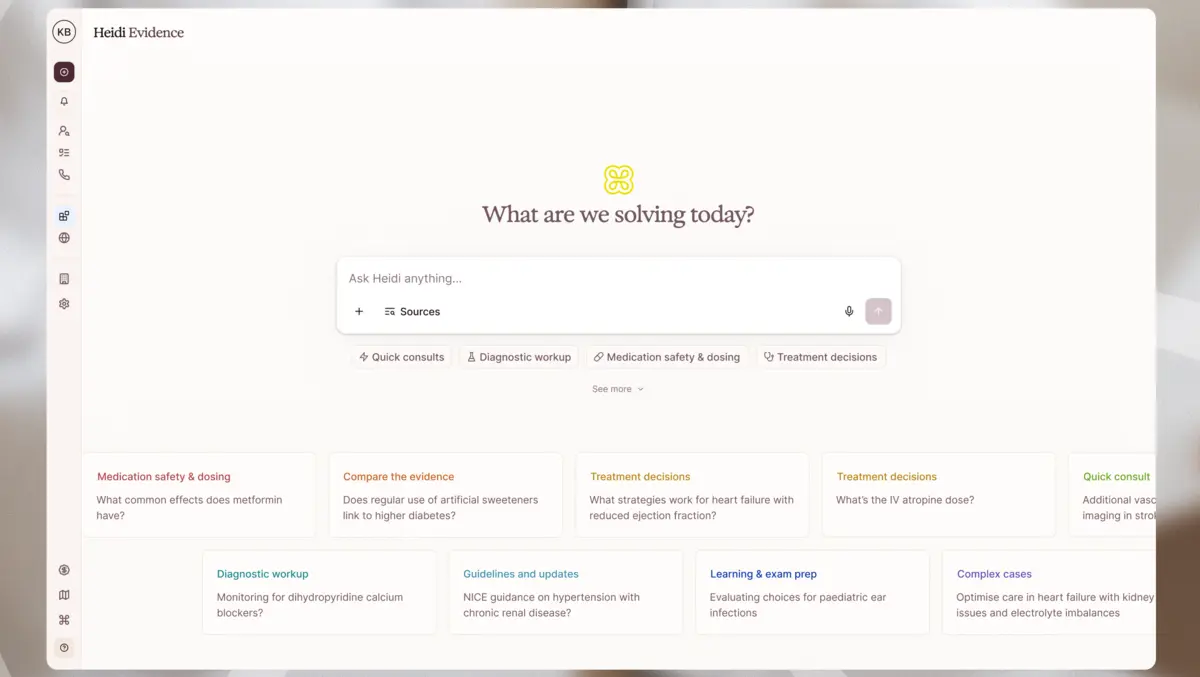

Australian health AI company Heidi has launched two new products-Heidi Evidence and Heidi Comms-and acquired UK clinical AI firm Automedica in its first deal. The expansion broadens Heidi's product line beyond AI-generated clinical notes into research, decision support, and patient communications.
Heidi Evidence is a research and decision-support layer embedded in the consultation workflow. Heidi Comms is a patient communications suite covering calls, bookings, reminders, and follow-ups. Together, the additions form part of a wider platform Heidi describes as an AI Care Partner for clinical teams.
Evidence layer
Heidi Evidence aims to provide clinicians with sourced medical information during care delivery. It presents summaries with citations and verbatim excerpts, positioned as suitable for audit and verification in clinical settings.
The product includes content and guidance partnerships. Heidi named EMGuidance and NICE Guidelines among its sources, and said guidance is intended to reflect local standards and formularies, which can differ between health systems.
Heidi said Evidence will be ad-free and free for individual clinicians. It framed enterprise revenue as the way to subsidise access in markets where budgets and infrastructure vary.
Heidi linked the launch to the pace of change in healthcare information, citing a claim that medical knowledge now doubles every 73 days. The pace has increased pressure on clinicians to keep up with new research and methods while managing rising workloads.
"We believe that for AI to be a true care partner, the integrity of its evidence must be non-negotiable," said Dr. Thomas Kelly, co-founder and CEO of Heidi.
Heidi also contrasted clinical software with consumer AI services. Kelly pointed to concerns about advertising and commercial influence in some general-purpose AI models as the sector experiments with different revenue models.
"As we see more general-purpose AI platforms like OpenAI move toward ad-supported models, consumers are rightly concerned about hidden influence. In a healthcare setting, that concern becomes paramount. Bringing transparent, clinical-grade insights into the room makes it easier to deliver quality care, but that information must be free from the ambiguity of commercial influence. By committing to Evidence being ad-free and independent, we ensure clinicians can stay present with their patients, knowing their decision-making is built on pure clinical rigor, not a business model," said Kelly.
Comms suite
Heidi Comms extends the company's software into patient coordination, covering appointment bookings, reminders, follow-up messages, and calls. Heidi positioned the tool as designed for healthcare teams rather than individual users.
Patient communication has become a focal point for many providers as they face appointment backlogs and growing demand. Digital reminders and structured follow-ups can reduce missed appointments and improve continuity. Vendors have also targeted call handling and booking workflows, where operational inefficiencies can create delays for patients and extra administrative work for staff.
UK acquisition
Heidi's acquisition of Automedica adds a UK-based clinical AI operation and experience with regulatory engagement. Heidi said Automedica has an evidence-led AI framework and relationships with UK national regulators.
Heidi also linked the deal to access to the MHRA AI Airlock, a UK regulatory sandbox for healthcare AI. Regulatory alignment has become a key competitive issue for vendors developing tools used in diagnosis, decision support, documentation, and patient management, given the sensitivity of clinical data and the potential safety risks of errors.
Financial terms were not disclosed. Heidi described the purchase as strengthening its regulatory capability and its footprint in the UK market.
Model strategy
Heidi said Heidi Evidence is built in part on Claude, Anthropic's AI models. It described Claude as well suited to interpreting unstructured clinical conversations and synthesising medical literature, and said it aims for grounded outputs in high-stakes environments.
Healthcare providers and software firms have increasingly explored large language models in front-line workflows, from note generation and coding support to clinical queries and patient messaging. At the same time, health systems and regulators have raised concerns about accuracy, bias, auditability, and data governance.
Heidi said its AI scribe has supported more than 100 million clinical interactions globally, and is used in emergency departments, general practice, and specialist clinics. It also said it supports more than 2.4 million consultations each week across 110 languages in 190 countries.
Heidi said it adheres to international standards including NHS requirements, HIPAA, GDPR, and Australian Privacy Principles, and cited SOC 2 and ISO 27001 security certifications.
Heidi has raised USD $96.6 million from investors including Point72 Private Investments, Blackbird, Headline, Phoenix Court's growth fund Latitude, Possible Ventures, and Archangel.
Michael Tolo, a general partner at Blackbird, said the company's positioning depends on trust and on how it handles evidence and incentives.
"Heidi is tackling one of the hardest problems in healthcare AI: how to scale capability without compromising trust," said Michael Tolo, General Partner, Blackbird. "By treating evidence as core infrastructure, not content monetised through ads or influence, Heidi is building the kind of defensible, globally relevant platform healthcare systems are demanding."
Heidi said the Evidence and Comms launches, alongside the Automedica acquisition, broaden its work across documentation, clinical reasoning, and patient coordination within a single product stack.