

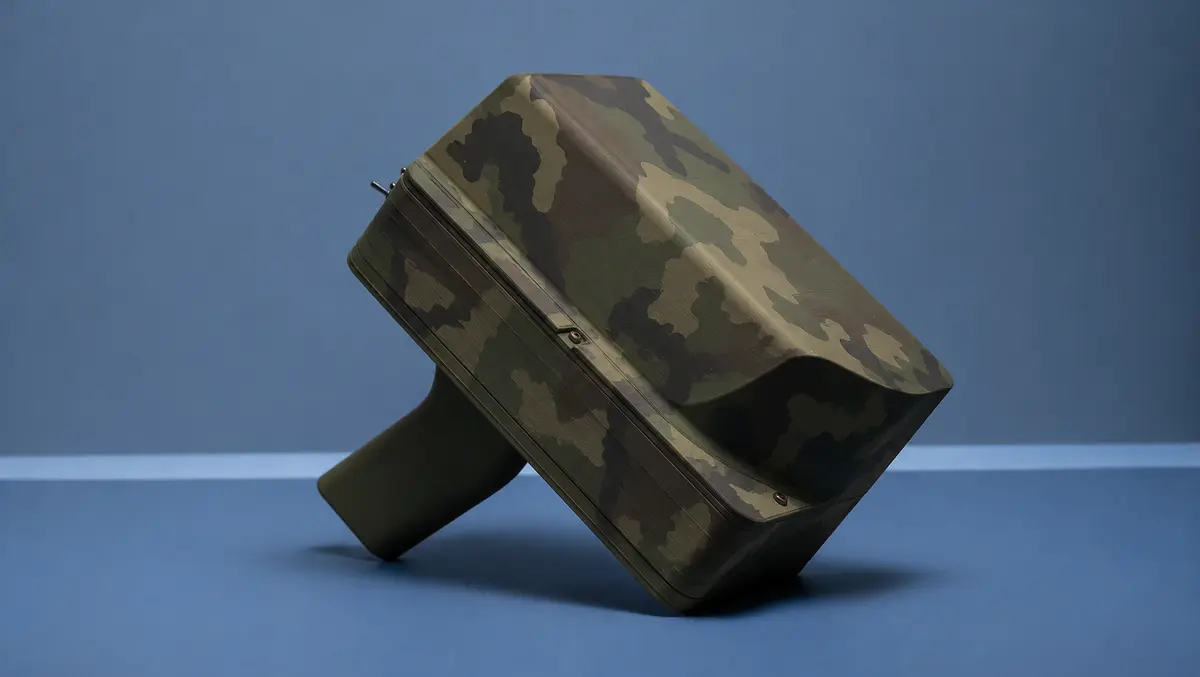
Millibeam unveils Rakurai handheld counter-drone system
Tue, 4th Aug 2026
MILLIBEAM has unveiled RAKURAI, a handheld counter-drone system designed in Australia to help close a gap in sovereign counter-UAS equipment.
The Sydney-based startup says the system is built on its own radio frequency chip and antenna design, rather than the standard third-party parts commonly used in existing handheld jammers. That approach is intended to address limits in weight, battery life and frequency coverage that have constrained wider deployment of portable counter-drone equipment.
The launch follows AUD $4.6 million in federal support for the underlying radio frequency and millimetre wave technology behind the device, including AUD $2.6 million from the Industry Growth Program and AUD $2 million from the Supply Chain Resilience Initiative.
RAKURAI is being positioned for military, emergency response and infrastructure protection use. The system is intended not only for individual soldiers and first responders, but also for fixed installation on buildings, including airports, telecommunications assets and energy infrastructure.
Chip-level design
Counter-drone systems typically work by disrupting the radio links used to control drones or transmit data. MILLIBEAM argues that many current products are assembled from catalogue components, limiting the balance of range, power, size and the number of frequency bands they can cover.
MILLIBEAM says it designed four elements as a single system: antennas, the radio frequency front-end, power electronics and signal generation. According to the company, that integrated approach allows RAKURAI to transmit across widely separated frequency bands at the same time.
That matters because small drones increasingly operate across varied frequencies and can be harder to disrupt with single-band systems. Australia's defence planning has identified smaller, less easily targeted drones as a growing challenge for the Australian Defence Force and critical domestic infrastructure.
MILLIBEAM says RAKURAI has reached Technology Readiness Level 5, which generally indicates validation in a relevant environment ahead of broader field testing.
Main Sequence, an investor in the company, said the technical effort was necessary because conventional design methods had reached their limits.
"Every counter-drone system on the market today is built by bolting together off-the-shelf parts - and that ceiling is exactly what's letting drone threats outpace our defences," said Mike Nicholls, Partner, Main Sequence.
"To deliver the performance needed to put this capability in the hands of individual warfighters and security teams, the MILLIBEAM team had to design and match the entire RF architecture from the ground up, including the chips and the antennas."
Defence focus
The launch comes amid rising attention on sovereign defence manufacturing in Australia, particularly in areas where imported subsystems have dominated procurement. Counter-drone technology has become a higher priority as drone use has expanded from battlefields to domestic security risks, including potential threats to public venues and essential services.
MILLIBEAM linked RAKURAI to policy priorities set out in Project Land 156 and the National Defence Strategy, which both highlight the need for local counter-drone tools. The company argues that rebuilding radio frequency systems from the chip level in Australia would reduce reliance on overseas suppliers for a sensitive part of the defence electronics stack.
Founder and Chief Executive Officer Venkata Gutta said the significance went beyond a single handheld product.
"For a century, the world has built more on top of legacy RF communications networks without ever rebuilding the foundation itself. Every autonomous and defence system currently depends on architecture designed for a different era. Australia has a narrow window to own that foundation rather than import it," said Venkata Gutta, Founder and Chief Executive Officer, MILLIBEAM.
"Designing from the chip up, here in Australia, is how we field sovereign capability at the speed and scale the National Defence Strategy demands."
The government grants were awarded for the core technology platform, not solely for the counter-drone device. MILLIBEAM says the same underlying semiconductor and beamforming work also has applications in 5G and other radio systems.
MILLIBEAM describes itself as a vertically integrated radio frequency systems business with products spanning chips, antennas, radio architectures and field systems. Alongside RAKURAI, it lists other platforms for radio frequency applications across drones, satellite communications, sensing and communications networks.
For investors, the announcement points to a defence market in which governments are seeking smaller, more portable and locally controlled systems. For Australia's industrial policy, it also reflects a broader push to build domestic design and manufacturing expertise in strategic electronics rather than rely solely on imported assemblies.
"That's the kind of sovereign capability we back: hard technology, deep IP, and a founder who's proven - across 15 tape-outs - that he can ship high-performance silicon and systems. Rakurai gives Australia a foundation that can keep pace as drone threats evolve," said Nicholls.