

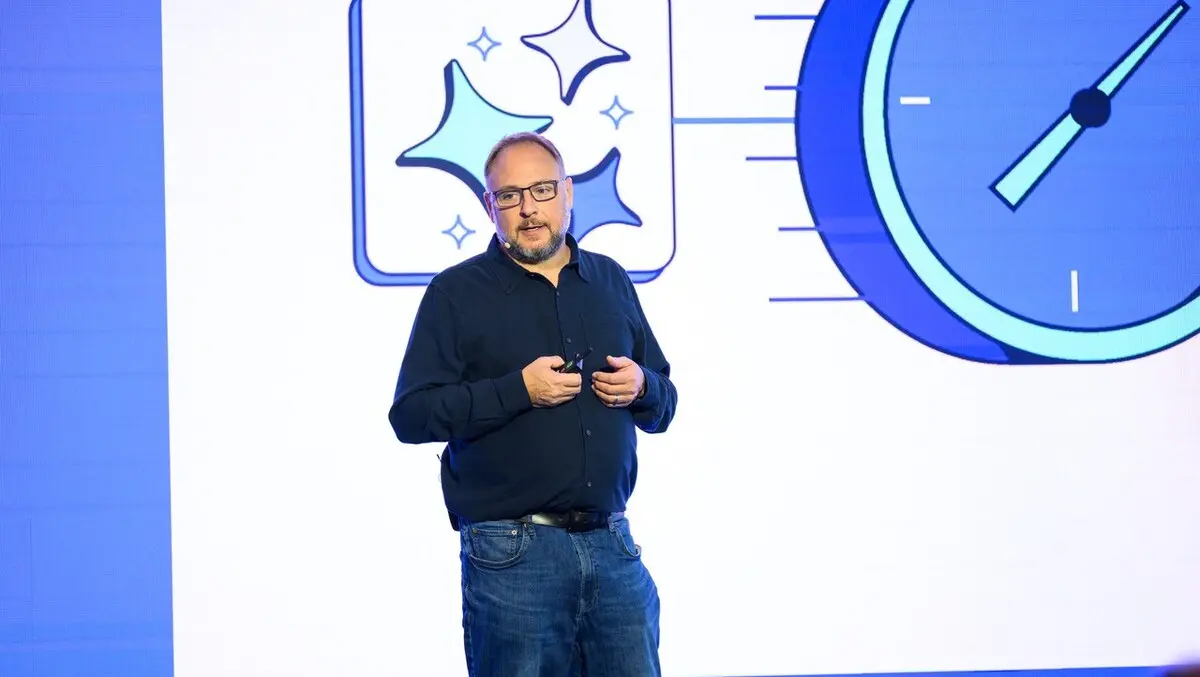
'Software is not dead', says Elastic CPO Ken Exner
Fri, 6th Mar 2026
Declaring that "software is not dead" at the hands of AI, search AI company Elastic has used its global roadshow to showcase emerging trends in AI-led search interfaces.
Addressing media at its global Elastic{ON} tour at Sydney's W Hotel on 5 March, Elastic's Chief Product Officer Ken Exner sought to allay fears that AI will usurp software businesses.
"Software is not dead, let me disabuse you of that notion," he said emphatically.
"The narrative… that the Saas-pocalypse is going to end software I think is a little far-fetched, because these technologies layer on top of the things that already exist. It doesn't make sense to reimplement postgres or reimplement a search engine.
"If you look at how these coding tools work, they leverage software. If you are building with one of these AI coding tools, and you want to build an application that requires a database, it is going to use a database – it is not going to build a database; it is not going to build an operating system before it does anything else."
Context engineering
According to Exner, one of the most considerable shifts in AI capabilities to emerge over the past six months has largely been overlooked: that software can now include reasoning.
"Modern software, for the last 20 or 30 years, has always been UI on top of business logic on top of data. That business logic that sits in between the UI and the data has always been deterministic rules-based software," he said.
"That can now include reasoning and judgement as well… If software can now have business logic that includes reasoning steps, that's a pretty profound change in how software works."
Exner said that one of the fundamental challenges businesses are now grappling with is how to leverage AI across their own private data in which LLMs have not been trained, and in turn how to weight the importance of multiple data sources.
"You do that essentially through a practice called context engineering – it's kind of an evolution of prompt engineering, but it's a way of giving context to an LLM or an agent so that it understands how to scope the response or how to scope its actions," he said.
One of the products launched at the event was the Elastic Agent Builder program. Initially developed as an internal resource, it was productised and brought to market as a means of allowing businesses to build their own custom agents and interfaces, bringing together private datasets and using their preferred LLM.
"LLMs start from where they are – they try to encourage you to figure out how to use them or send data to them, but they don't have data indexed throughout the enterprise. We are in the enterprise, where we help people manage their data and service that data into different applications," Exner said.
"I love messy data… If you try to normalise it and do it all up-front, it's expensive, it takes a long time, people don't do it. But if you provide those tools so that they can do it on the fly, suddenly all data is available to AI-based applications."
Customer intent
Speaking as part of a panel discussion on customer journeys, Woolworths Experience Product Lead Meredith Murphy said the retailer is using AI to push search functionality beyond merely product and pricing.
"When we're thinking about scale of support and using AI, it's how we can… take a customer search term, unravel that and identify what the intent is of that search and deliver on it. So, we're proactively solving a customer want before it becomes a problem," she said.
"The search bar should be where you go to solve all your problems and find what you're looking for, and it's up to the customer what level of complexity they want to engage with that".
Murphy said that product search is evolving into many different areas, such as information about store locations and opening hours, recipes and ingredient lists, through to detailed conversations about specific topics like food allergies. Personalisation is then built on top, using custom purchasing data and search history, including the use of auto-apply filters.
Woolworths recently made global headlines after its AI chatbot reportedly engaged in bizarre discussions with customers abouts its "angry mother". Nevertheless, Murphy said the grocery giant is pushing ahead with plans to enhance its semantic search capabilities.
Revenue implications
Coinciding with the event, Elastic unveiled research demonstrating just how slim the margin of error is for eCommerce businesses in the delivery of search functionality.
Its February 2026 poll of 1,020 Australian consumers found 72 per cent had abandoned a brand because of poor website search capabilities. Alarmingly, 11 per cent admitted to permanently abandoning a brand after a single failed search.
Almost two-thirds (62 per cent) said they turn to external search engines where a brand's own site delivered poor outcomes, with around four in five of those results directing them to competitor brands.
Most strikingly, 69 per cent of respondents confessed to literally shouting at a website's search bar in frustration.
"Search is no longer a utility feature. It is a revenue driver," said ANZ Country Manager, Jeremy Pell.
"Retailers that cannot understand customer intent across [both] structured and the messy, unstructured data trapped in PDFs, emails, images and text messages that traditional systems can't easily read, are actively directing shoppers to competitors."