

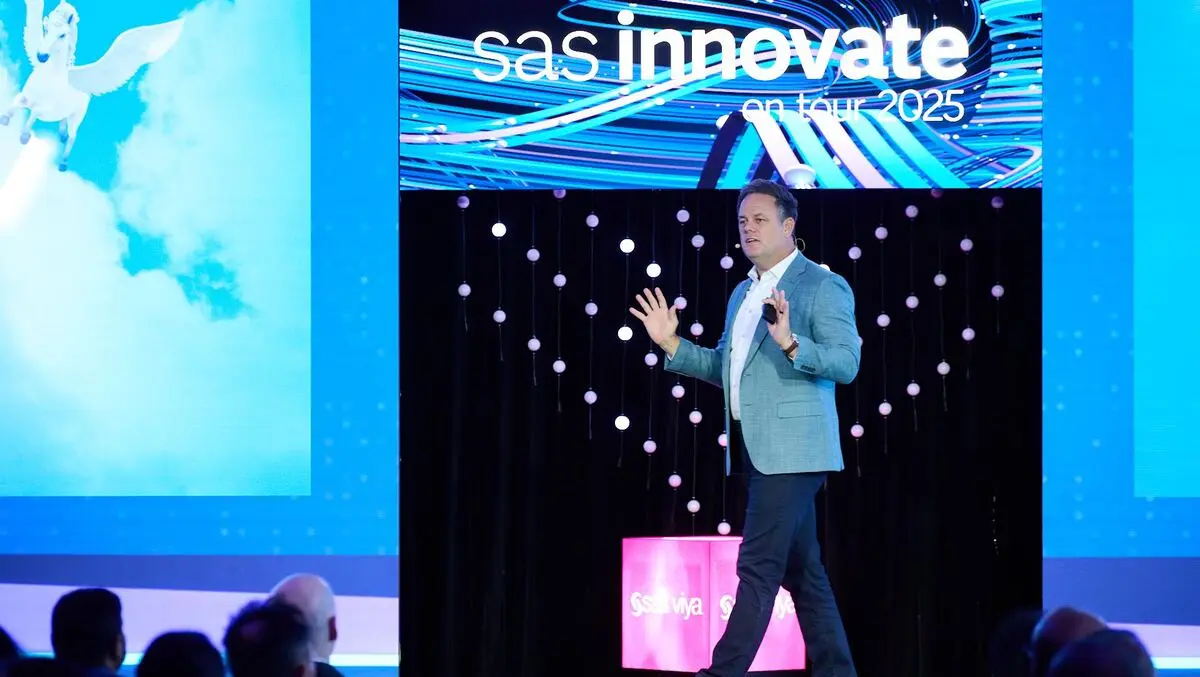
Exclusive: SAS CTO Bryan Harris warns AI cost-cutting risks failure
Thu, 28th Aug 2025
Artificial intelligence will punish companies that use it to slash costs instead of empowering workers, SAS Chief Technology Officer Bryan Harris has warned.
Speaking to TechDay at SAS Innovate On Tour in Sydney last week, Harris said business leaders face a stark choice in how they apply AI.
"There are two types of leaders out there. One says, I'm going to use AI to automate and reduce costs. The other says, I'm going to empower my workforce with AI and enable them to do better, more enjoyable work," he explained.
"The cost-cutting approach is actually a competitive disadvantage."
Harris argued that firms which invest in their people will capture market share, while those focused only on efficiency gains risk falling behind. "If we avoid toil - the menial work - it frees people up to think about the customer experience differently. That's where you create competitive advantage," he said.
Quantum not as far away as you might think
Harris commented on what he thinks the timeline for quantum computing looks like.
"Many have said it's 10 to 25 years away. We said two years ago, it's now. And we still think it's now," he said.
He explained that SAS is developing hybrid architectures combining traditional computing with quantum processing units to solve complex optimisation problems.
"For highly dimensional problems like portfolio risk, we see what's possible sooner than others," Harris said. "When everyone else is talking about it, it's too late. You want to be really working on the bleeding edge."
Beyond just the hype
Harris said the purpose of SAS Innovate On Tour - stopping in 15 cities globally - was to help customers move past hype.
"Sydney is a very important stop for us," he said. "For us, it's about taking all the developments we're doing with data and AI and giving insight into the roadmap, also providing thoughtful leadership on how to practically implement this stuff in ways that drive an outcome for the business."
While the AI conversation is dominated by buzz, Harris stressed SAS's long track record of delivering trusted results.
"We've seen lots of emerging technologies before," he said. "AI has huge potential, but it needs to be done in a very calculated and thoughtful way."
Precision and trust
In financial services, Harris pointed to precision as the critical differentiator.
"There are many use cases that require calculations, stress testing, expected credit loss, risk analysis," he explained. "The trick is, how do you take this natural language experience with search and then offload those calculations to tools like our software, SAS Viya, to do precision-based mathematics?"
That balance, Harris said, enables banks to combine generative AI's convenience with SAS's trusted analytics. "When we tell customers that the things you've trusted us for before won't change in the new experience, that's one of the most reassuring things we can say," he added.
Data quality and the road to production
According to Harris, many organisations fail when moving AI from pilots to production because they neglect data foundations.
"Data quality is number one. You can't get great AI without great data," he said. "If a customer hasn't made that investment, we have to help them focus on cleaning their data. The good news is our software can automate a lot of those data quality issues."
Another challenge is deciding when to use large language models and when to fall back on traditional machine learning.
"A lot of people expect enterprise AI to work like ChatGPT at home. Coaching customers through that split is a big conversation for us," Harris explained.
Responsible AI and regulation
Harris also underscored the importance of fairness and explainability.
"You have to measure outcomes from agentic AI according to the demographic of which you're asking it to do work," he said.
"If your behaviours are the same, your results should be the same, regardless of any other demographic."
Generative models, he warned, cannot be trusted for critical decisions.
"We've seen mortgage applications evaluated with large language models and the results were horrifically biased," he said. "You can still use them for interaction, but when it comes to decision-making, let's put that into traditional AI models that are deterministic, governed and explainable."
He stressed that ethics must be driven from the top.
"Technology cannot govern leadership. Leaders have to ask, can we or should we? If we undermine trust, earning it back is ten times harder."
SAS has embedded this philosophy in its culture. "Our head of data ethics says, we want to make responsible irresistible. I think that's a great way of saying it," Harris added.
AI in the real world
Harris pointed to work SAS is doing in manufacturing with digital twins, computer vision and safety modelling. By simulating rare events inside a game engine, the company can train models to spot risks before accidents happen.
"We can create endless scenarios that prevent injury, save lives and lower costs," he said. "It's unprecedented what we're doing."
What is his advice for executives?
For leaders navigating AI adoption, Harris's advice was direct: "Start with business problems that will be material to performance. At the same time, ask if you have the data to support that outcome. Once you get past improving the data, then move to integrating technologies, governance and orchestration. You've got to have the end in mind."
Ultimately, he said, executives must be willing to envision a radically better future state for their business.
"Imagine what you wish you could do. Sometimes people get mired in legacy infrastructure. But if someone shows that it could look like this - how efficient it could be - that inspires the organisation to act."