

Seeing Machines unveils unified 3D in-cabin sensing
Wed, 14th Jan 2026
Seeing Machines has unveiled a next-generation in-cabin sensing platform that generates a live 3D map of a vehicle interior and tracks multiple occupants using a single perception layer.
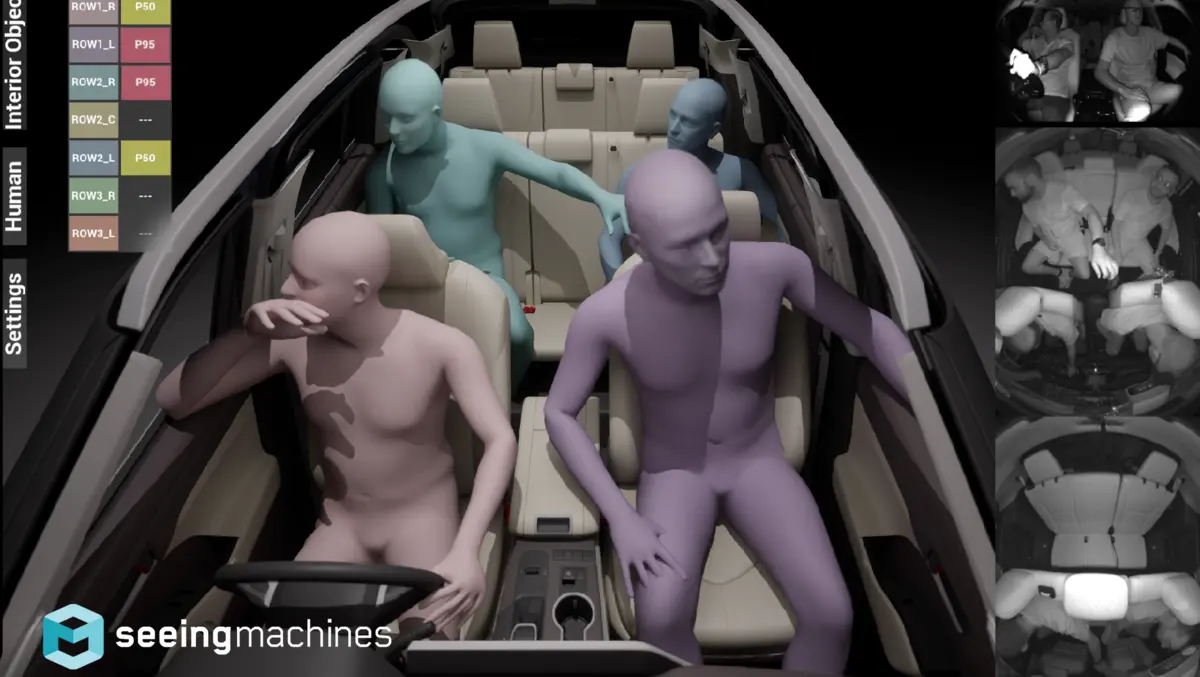
The Canberra-based company showed its 3D Cabin Perception Mapping platform at CES 2026. The demonstration focused on real-time reconstruction of the cabin. The system used multiple cameras and covered up to three rows of seating.
Seeing Machines said the platform differs from approaches that build separate processing pipelines for individual functions. The company described a model that maps the entire cabin simultaneously. It said the method aims to keep accuracy when sensors deliver intermittent or noisy data.
Single perception
The company said the platform runs as a "clean-sheet" architecture. It said the design supports multiple cameras and multiple occupants. It also said the design supports a range of functions from a single, high-trust perception layer.
Seeing Machines said the architecture decouples feature development from the specific camera layout and raw sensor implementation. It said this approach allows developers to build a feature once and then deploy it across multiple product configurations.
In a market where vehicle cabins increasingly include a mix of seating layouts, camera placements and occupant-sensing requirements, the company positioned the platform as a way to simplify engineering work across variants. It also said the platform reduces development effort, cost and time to market.
CES demonstration
The CES demonstration used three cameras across three rows of seating. Seeing Machines said the configuration supported up to seven occupants.
Seeing Machines listed several functions shown during the live showcase. It said the platform produced body size and shape outputs. It also said the platform delivered a full 3D pose solution for all occupants. The company said the system included height and weight classification.
The company said it demonstrated out-of-position detection for all occupants. It cited examples such as an occupant reclining and feet on the dashboard. It also cited near-airbag detection for the driver.
Seeing Machines said the platform identified aspects of seat configuration. It cited headrest presence, seat position and recline angle. It also said the platform performed child seat detection across the entire cabin.
The company said the demonstration included random object detection across the cabin. It gave examples including phones, bags and boxes.
Wider use
Seeing Machines said the platform could extend beyond automotive use. It pointed to robotics and other human-machine interaction environments as potential applications. It said these settings require accurate perception of people and space.
The company also said the architecture supports a "mix-and-match approach to 3D technologies". It said this provides deployment flexibility as sensing hardware and use cases evolve.
Seeing Machines operates in driver and occupant monitoring systems. The company develops vision-based monitoring technology. It supplies technology solutions and services across automotive, commercial fleet, off-road and aviation markets. Seeing Machines has offices in Australia, the US, Europe and Asia.
Seeing Machines gave a brief assessment of the market response at the Las Vegas event.
"This is a fundamental shift in how interior sensing systems are designed and deployed and the feedback from our CES engagements has been overwhelmingly positive," said John Noble, Chief Technology Officer, Seeing Machines.
"By moving from feature-specific pipelines to a unified 3D perception of the cabin, we enable higher accuracy, consistency and scalability. Importantly, this platform will allow our customers to evolve their individual feature strategies, while dramatically lowering the cost and complexity of developing new safety and user experience capabilities," said Noble.
Seeing Machines said the platform design supports multiple camera configurations. It said it expects sensing hardware options to change as the market evolves.